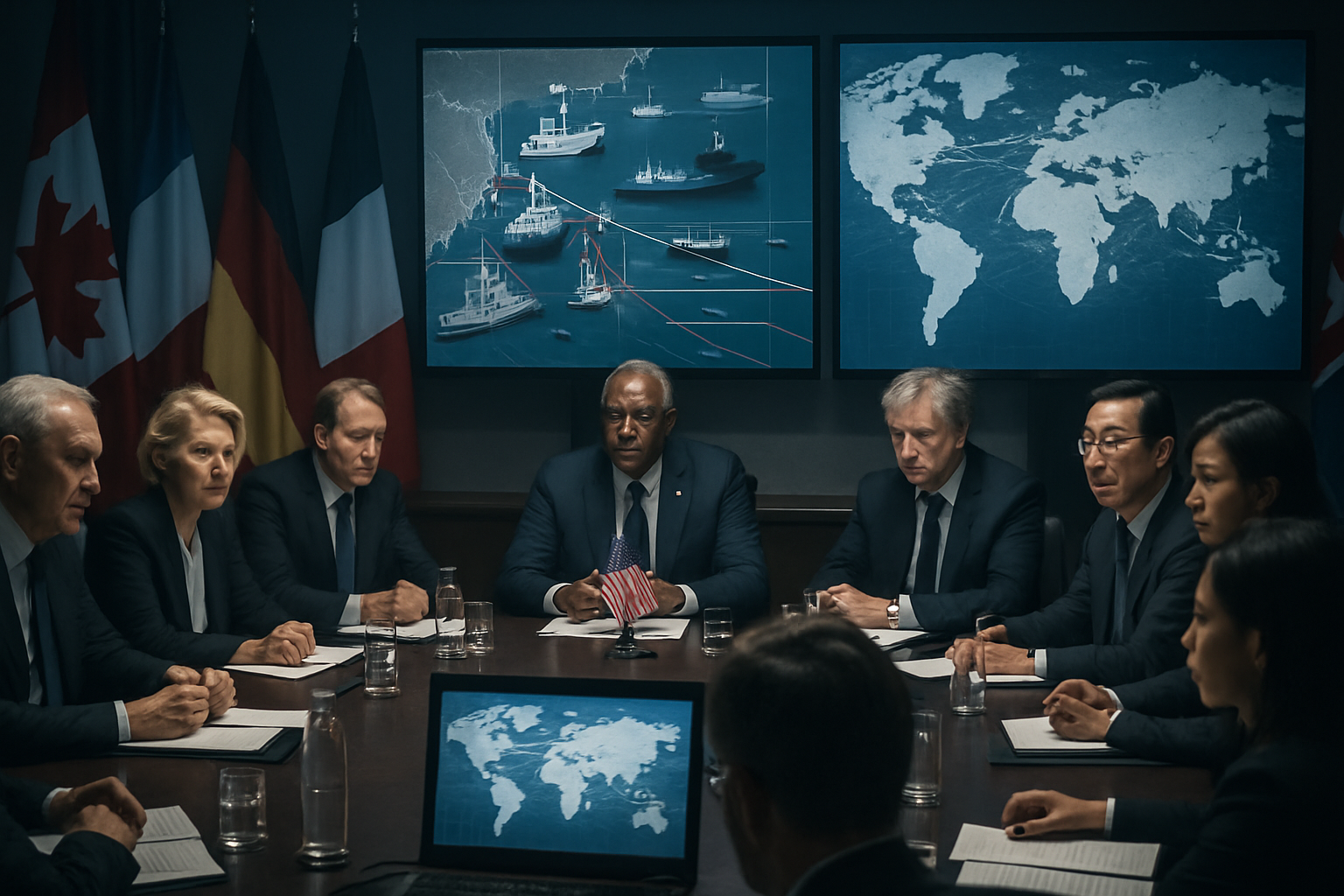
More than 40 countries participated in an emergency virtual summit organized by the United Kingdom to address the Strait of Hormuz crisis, as Iran's Revolutionary Guard maintains its blockade of the critical waterway that handles 40% of global seaborne oil transit.
The historic international coordination meeting, convened amid the most severe global energy crisis since the 1970s oil shocks, brought together officials from all continents to discuss urgent measures for reopening the strategic 21-mile chokepoint. Oil prices have surged to record levels, with Brent crude peaking at $119.50 per barrel and WTI reaching $108.15.
Unprecedented International Mobilization
British Foreign Secretary Yvette Cooper presided over the virtual meeting, which included representatives from NATO allies, Middle Eastern partners, and major energy-consuming nations. The session follows Iran's declaration that the strait is "unsafe for shipping," effectively blocking a route vital to global energy security.
According to Greek media reports, participants discussed "possible actions for the increase" in international pressure on Iran to reopen the waterway. The coalition represents an unprecedented level of global cooperation in response to a single-nation blockade affecting worldwide commerce.
"The countries are determined to use every possible measure to reopen the Strait of Hormuz"
— Coalition Statement from Virtual Meeting
Crisis Escalation and Maritime Security
The emergency stems from Iran's "Operation True Promise 4" retaliation campaign, launched following the largest U.S.-Israeli military operation since 2003. Iran has deployed an estimated 2,000-6,000 naval mines throughout the strait, forcing the suspension of operations by major shipping companies including Maersk and MSC.
Over 150 oil and LNG tankers remain stranded in the Persian Gulf, representing billions of dollars in cargo. The blockade has triggered the International Energy Agency's largest strategic petroleum reserve release in its 50-year history—400 million barrels from 32 countries, more than double the 2022 Ukraine crisis response.
Regional Coalition Under Strain
The crisis has severely tested the unprecedented Saudi-UAE-Qatar-Egypt diplomatic consensus supporting negotiated solutions. Iranian attacks have directly targeted coalition member territories, with casualties reported in the UAE (1 civilian killed in Abu Dhabi), Kuwait (32 injured in airport strikes), and Qatar (8 wounded while intercepting 65 missiles and 12 drones).
Economic and Energy Implications
Natural gas prices have exploded 24% in Europe and 78% in the United States, reaching €47.32/MWh—the highest level since February 2025. Qatar has halted LNG production at its Ras Laffan and Mesaid facilities, affecting approximately 20% of global LNG exports and threatening force majeure declarations.
The aviation industry faces parallel disruption with over 18,000 flights cancelled worldwide—the most extensive since COVID-19. Eight countries have simultaneously closed their airspace, and Dubai International Airport, the world's busiest with 86 million passengers annually, remains shut due to missile damage.
Consumer Impact Worldwide
Government emergency responses have been implemented across multiple countries:
- Bangladesh: Fuel rationing for 170 million people
- Pakistan: Wartime austerity measures with four-day work weeks
- Hungary: Immediate price caps on gasoline and diesel
- France: 500 fuel station inspectors deployed to prevent price manipulation
- Sweden: Electricity increases of 10-20 öre, gasoline up 1-2 kronor per liter
UN Resolution and Diplomatic Framework
The United Nations is expected to vote today on a resolution from Bahrain aimed at protecting commercial navigation in the Strait of Hormuz. Meanwhile, Iran and Oman are reportedly drafting a protocol to "monitor transit" through the waterway, suggesting Tehran may be seeking a face-saving compromise that maintains some control over shipping.
The crisis represents the complete breakdown of nuclear diplomacy despite a Geneva framework that achieved "broad agreement on guiding principles"—the most progress since the 2018 JCPOA collapse. Iran excluded ballistic missiles and proxy groups as "red lines" while the U.S. demanded comprehensive reforms including missiles, armed groups, and human rights.
Nuclear Governance Crisis Context
The energy crisis occurs against the backdrop of an unprecedented nuclear governance breakdown. The New START treaty expired on February 5, marking the first time in over 50 years without U.S.-Russia nuclear constraints. Iran continues uranium enrichment at 60% purity with over 400kg of weapons-grade material—sufficient for multiple nuclear weapons.
UN Secretary-General António Guterres has described the nuclear risks as "the highest in decades" and called this "the greatest test of multilateral cooperation in the modern era."
Supply Chain Vulnerabilities
The Persian Gulf serves as a critical trade hub beyond energy, affecting consumer goods and industrial materials worldwide. The 21-mile Strait of Hormuz represents a dangerous single-point failure in modern logistics, with no realistic alternatives capable of handling the diverted volume.
Manufacturing sectors dependent on Gulf logistics networks—including automotive, electronics, and textiles—face severe disruptions. China has suspended refined fuel exports, while Singapore reports 30% increases in logistics costs.
Historical Significance and Global Response
Energy analysts describe the current situation as unprecedented in scope and severity. Samuel Ciszuk, an energy security expert, characterized it as "the most severe energy security crisis in decades, exposing single-chokepoint vulnerabilities." Financial strategist Damien Boey noted the "situation is going longer than initially thought, with financial markets serving as the ultimate constraint on prolonged conflict."
The crisis has triggered the largest coordinated international evacuation since the Arab Spring of 2011, with Australia reporting 115,000 nationals trapped and Germany struggling to repatriate 30,000 tourists. The EU activated its ESTIA evacuation plan for Cyprus for the first time after Iranian drones struck RAF Akrotiri—the first attack on European territory since World War II.
Financial Market Impact
Global financial markets have experienced severe disruption, with Pakistan's KSE-100 index suffering its largest single-day decline in history at -8.97%. South Korea's KOSPI fell 12%, triggering circuit breakers and pushing the Korean won to a 17-year low. PayPal postponed its $1.1 billion IPO indefinitely due to market volatility.
Template-Setting Crisis Management
The Strait of Hormuz crisis represents the most dangerous international situation since the end of the Cold War, simultaneously affecting regional war prevention, global energy security, nuclear governance credibility, and international law enforcement. The rapid transition from diplomatic breakthrough to military confrontation demonstrates the fragility of crisis management mechanisms in the multipolar era.
Recovery timeline remains uncertain, dependent on military operations and diplomatic normalization rather than predictable economic factors. Traditional monetary policy tools have proven limited in effectiveness against such structural geopolitical disruptions.
Energy Minister Saad Al Kaabi of Qatar has warned that Gulf states may be forced to declare force majeure "within weeks," potentially driving oil prices to $150 per barrel and threatening to "bring down the economies of the world."
Energy Architecture Transformation
The crisis highlights the urgent need for fundamental restructuring to reduce dependence on volatile geopolitical regions and strategic chokepoints. While strategic petroleum reserves provide temporary buffers, sustained disruptions require supply diversification and renewable energy transitions that will take years or decades to implement.
Success in containing the escalation could provide a framework for future nuclear crisis resolution and strengthen diplomatic precedents. Failure may accelerate military solutions, reshape Middle Eastern geopolitics for decades, encourage nuclear proliferation globally, and undermine diplomatic credibility worldwide.
Looking Forward
The 40-nation coalition meeting represents the greatest test of multilateral cooperation in crisis management in the modern era. The decisions made in the coming days and weeks will reverberate through international relations, affecting 21st-century conflict resolution precedents, energy market evolution, supply chain resilience, and nuclear proliferation prevention mechanisms worldwide.
As the international community grapples with this unprecedented challenge, the Strait of Hormuz crisis of April 2026 is establishing a new paradigm for energy security planning that will require fundamental transformation to reduce dependence on strategic chokepoints and affect international stability mechanisms for decades beyond the current events.