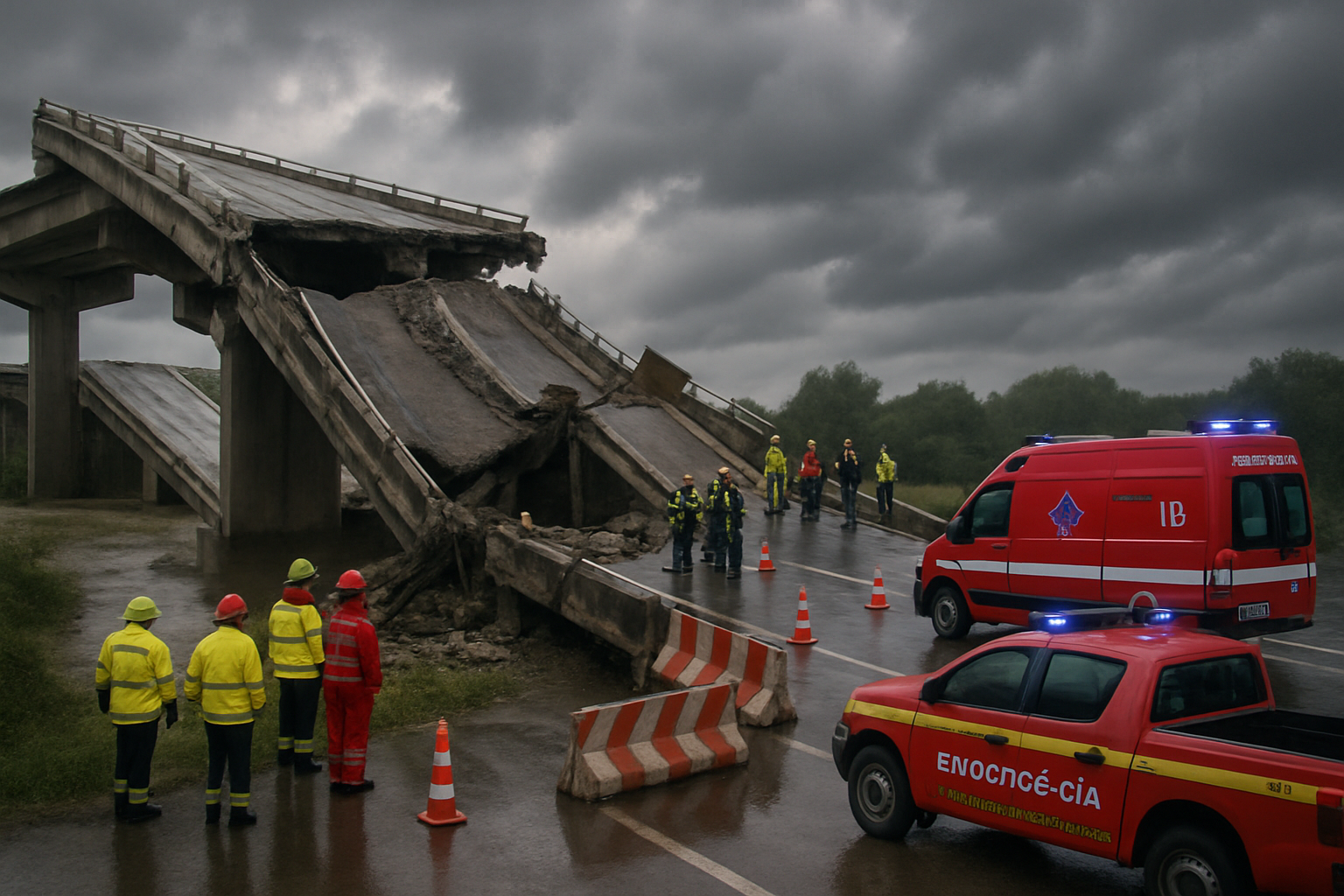
A major section of Portugal's A1 highway collapsed Thursday morning near Coimbra after a catastrophic breach of the Mondego River dike system, marking the latest infrastructure disaster in the country's ongoing weather emergency that has now entered its second week.
The viaduct collapse occurred at approximately 6:30 AM local time, completely severing the critical north-south transportation artery that connects Lisbon to Porto. Portuguese authorities confirmed that repair work will require "several weeks" according to Infrastructure Minister Miguel Pinto Luz, who surveyed the damage site Thursday afternoon.
The collapse was triggered by the rupture of a dike along the Mondego River in the Casais area, which unleashed torrential floodwaters that undermined the highway's foundation structures. The force of the water was sufficient to cause the complete failure of the viaduct section, leaving a gaping chasm where the roadway once stood.
Immediate Response and Traffic Impact
Emergency repair teams began preliminary assessment work Thursday morning, but the scope of the damage has necessitated the complete closure of the A1 in both directions near Coimbra. Portuguese Civil Protection deployed engineering teams to evaluate the structural integrity of adjacent sections and establish emergency access routes for rescue vehicles.
The highway closure affects one of Europe's busiest transportation corridors, forcing thousands of daily commuters and commercial vehicles onto alternative routes. Traffic authorities have implemented extensive diversions through secondary roads, though these routes are experiencing severe congestion as they struggle to handle the displaced traffic volume.
Portugal's national railway company CP has reported increased ridership as travelers seek alternative transportation methods, though several rail lines remain suspended due to flooding from the same weather system that caused the dike failure.
Part of Broader Infrastructure Crisis
The A1 viaduct collapse represents the most dramatic infrastructure failure in Portugal's ongoing weather emergency, which began with Storm Kristin in late January and has continued through successive Atlantic storms Leonardo and Marta. The crisis has tested the country's infrastructure resilience to unprecedented levels.
Portuguese Civil Protection has registered over 1,800 weather-related incidents since February 1, requiring the deployment of 26,500 emergency personnel in what officials describe as the largest peacetime rescue operation in the nation's history. The operation includes 1,975 military personnel and 30 naval vessels working across multiple disaster zones.
Infrastructure damage extends far beyond the A1 collapse. The Castanheira-Alvarca railway line remains suspended, affecting Lisbon commuters, while 167,000 residents across the country are without electrical power. The Douro River has reached critical 1997 flood levels, threatening additional infrastructure in Porto and Vila Nova de Gaia.
Engineering Challenges and Reconstruction Timeline
Preliminary engineering assessments indicate that the viaduct collapse was caused by systematic erosion of the foundation structures due to the unprecedented volume of water released when the Mondego River dike failed. The breach created a temporary lake that gradually undermined the highway's support pillars until structural failure became inevitable.
Reconstruction will require specialized heavy equipment to remove debris, rebuild foundations in potentially unstable soil conditions, and construct new bridge spans. The project's complexity is compounded by the continued threat of flooding, which may necessitate enhanced flood protection measures as part of the rebuilding process.
Minister Pinto Luz emphasized that the reconstruction will incorporate "build back better" principles, integrating enhanced climate resilience features designed to withstand future extreme weather events. This approach aligns with European Union guidelines for infrastructure adaptation in the face of increasing climate volatility.
Economic and Social Consequences
The A1 closure creates significant economic disruption across multiple sectors. Commercial transport companies are facing increased costs due to longer alternative routes, while the tourism industry – already battered by successive storms – confronts additional challenges in moving visitors between Portugal's major cities.
Local businesses in the Coimbra region report immediate impacts from reduced accessibility, with some establishments considering temporary closures until normal transportation links are restored. The agricultural sector, already dealing with extensive flood damage, faces additional logistical challenges in moving products to market.
The psychological impact on communities should not be underestimated. For many residents, the A1 highway represents a vital lifeline connecting isolated areas to urban centers. Its collapse has created a sense of isolation that compounds the stress from weeks of continuous weather emergencies.
Historical Context and Climate Connection
The infrastructure crisis occurs against the backdrop of January 2026 being confirmed as the hottest month in recorded global history – the 18th consecutive month to exceed 1.5°C above pre-industrial levels. This seemingly paradoxical situation, where global warming enables both heat records and regional extreme weather events, demonstrates the complex volatility that climate change brings to weather systems.
Portugal's current crisis echoes the devastating 1997 floods that set previous records for river levels. However, the current emergency's duration and intensity, combined with the succession of three major Atlantic storms in two weeks, represents unprecedented challenges for infrastructure designed to historical climate patterns rather than projected future conditions.
European climate scientists have long warned that infrastructure built for 20th-century weather patterns would face increasing vulnerability as climate change intensifies extreme events. The A1 collapse provides a stark illustration of these predictions becoming reality.
International Response and Support
The European Union has activated its Civil Protection Mechanism in response to Portugal's infrastructure emergency, with Sweden and Denmark providing a €246 million assistance package. The aid includes specialized equipment for infrastructure repair, emergency bridge systems, and technical expertise for rapid reconstruction projects.
International engineering firms with expertise in climate-resilient infrastructure are being consulted for the A1 reconstruction project. The goal is to create a template for highway reconstruction that can serve as a model for other European nations facing similar climate-related infrastructure challenges.
The crisis has also prompted discussions within EU institutions about accelerating infrastructure adaptation funding and streamlining emergency response protocols for climate-related disasters that cross national boundaries.
Looking Forward: Lessons and Adaptations
The A1 viaduct collapse serves as a watershed moment for Portuguese infrastructure policy, forcing a fundamental reassessment of how transportation networks are designed, maintained, and protected against extreme weather events. The incident highlights the urgent need for proactive rather than reactive approaches to climate adaptation.
Portuguese authorities are already announcing plans for comprehensive infrastructure assessments across all major transportation corridors, with particular focus on bridges, tunnels, and elevated sections that may be vulnerable to similar climate-related failures. These assessments will inform a national infrastructure resilience strategy expected to be unveiled later this year.
The reconstruction of the A1 viaduct will likely become one of Europe's first major highway projects designed explicitly for climate change conditions, incorporating enhanced flood protection, improved drainage systems, and structural elements capable of withstanding extreme weather events that are becoming increasingly frequent.
As Portugal continues to battle the ongoing weather emergency, the A1 collapse stands as a sobering reminder that the infrastructure upon which modern society depends must be fundamentally reimagined for a climate-changed world. The weeks-long reconstruction timeline provides both challenge and opportunity – challenge in managing disrupted transportation networks, and opportunity to build back better for long-term resilience.