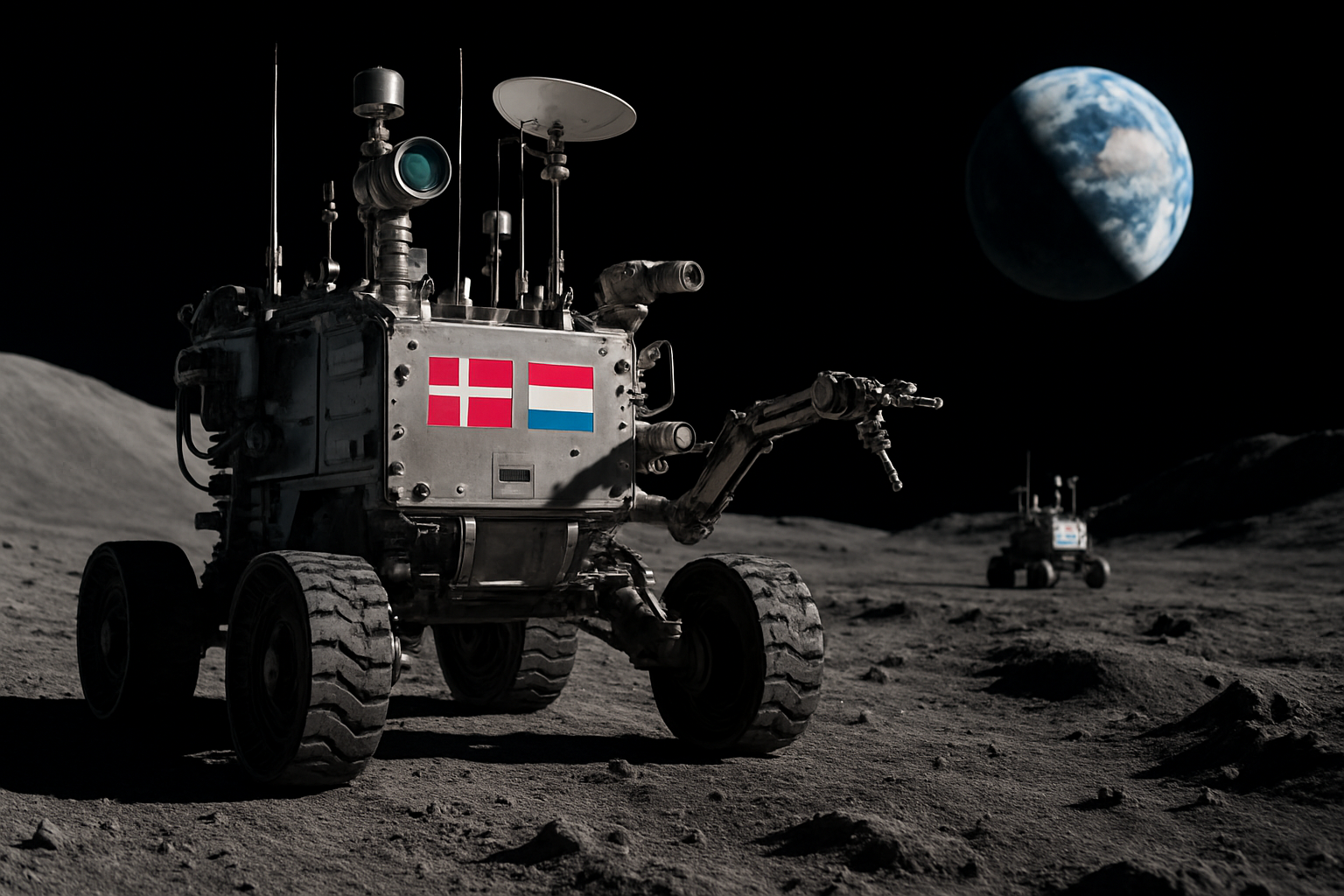
Aalborg University has emerged as a pioneering force in next-generation space exploration technology, developing sophisticated self-driving robots designed for lunar missions that promise to revolutionize how humanity explores the Moon's surface and beyond.
The Danish institution's ambitious lunar robotics project comes at a critical juncture in space exploration history, as the world transitions from what experts call the "AI revolution" to the "space economy golden age" – a period characterized by unprecedented international cooperation and commercial space enterprise expansion.
Danish Innovation Meets European Space Ambitions
According to reports from Danish state broadcaster DR, Aalborg University's lunar rover project represents a significant technological leap in autonomous space exploration systems. The self-driving robots are being engineered to operate independently on the lunar surface, navigating the challenging terrain and conducting scientific research without direct human control.
This development aligns with broader European space initiatives, including Luxembourg's active participation in the prestigious Artemis program. As one of the eight founding members of this international lunar exploration initiative, Luxembourg has positioned itself as a key player in the emerging space economy, with plans to deploy a rover assembled within its borders to the lunar surface by 2027.
Strategic Context in the Modern Space Race
The timing of Aalborg University's lunar rover development coincides with an extraordinary period of global space exploration activity. NASA's Artemis II mission, currently targeting April 2026, will mark the first crewed mission beyond Earth orbit since Apollo 17 in December 1972 – ending a remarkable 54-year gap in human deep space exploration.
Marc Serres, director of Luxembourg's Space Agency (LSA), has emphasized his country's strategic investment in space technology development, highlighting the economic and scientific potential of the emerging trillion-dollar space economy projected to exceed $1 trillion by 2030.
"The investment of Luxembourg in space capabilities represents a fundamental shift toward space technology democratization, where smaller nations can make significant contributions to humanity's cosmic expansion."
— Space Industry Analysis
Technical Challenges and Innovations
Developing autonomous lunar rovers presents extraordinary engineering challenges. Unlike Mars rovers, which can benefit from atmospheric conditions for certain operations, lunar robots must operate in an environment characterized by extreme temperature fluctuations, intense radiation, and the complete absence of atmosphere.
The robots must be equipped with sophisticated navigation systems capable of operating in environments where GPS and traditional communication infrastructure are unavailable. Advanced AI systems, building on recent breakthroughs in autonomous navigation demonstrated by NASA's fully AI-planned Mars rover missions in December 2025, will enable real-time decision-making and adaptive exploration strategies.
Key Technical Requirements
- Radiation-hardened electronic systems capable of withstanding cosmic radiation
- Autonomous navigation algorithms for unpredictable lunar terrain
- Extended-duration power systems utilizing advanced battery technology and solar panels
- Sophisticated scientific instrumentation for geological and atmospheric analysis
- Communication systems for data transmission back to Earth
International Cooperation and Competition
The Aalborg University project emerges within a complex landscape of international space cooperation and competition. China has achieved significant milestones through its space program, including the successful fourth launch of its Shenlong reusable spacecraft and breakthrough AI analysis of Moon's far side chemical composition through Chang'e-6 sample data.
Meanwhile, NASA has announced an unprecedented $20 billion commitment to establishing a permanent lunar surface base by 2030, representing the largest space infrastructure investment in the agency's history. This strategic pivot from orbital operations to surface-based lunar presence directly benefits from advanced autonomous rover technology like that being developed in Denmark.
Commercial space entities are also advancing rapidly. SpaceX, preparing for a potentially trillion-dollar IPO in June 2026, has strategically pivoted from Mars colonization to lunar settlement development, recognizing the Moon's advantages including three-day travel times, frequent launch windows, and real-time communication capabilities.
Scientific and Economic Impact
The development of autonomous lunar rovers extends far beyond individual national space programs. These technologies serve as crucial stepping stones for permanent lunar settlements and eventual Mars exploration. Advanced robotic systems can establish infrastructure, conduct scientific research, and prepare landing sites for human crews.
Current research aboard the International Space Station, including French astronaut Sophie Adenot's record eight-month mission focusing on lung tissue cultivation and Space-Associated Neuro-Ocular Syndrome (SANS) studies, provides essential medical data for long-duration spaceflight. Autonomous rovers will complement this research by establishing the technological foundations necessary for sustained human presence beyond Earth.
Looking Toward the Future
As space exploration transitions from experimental endeavors to essential infrastructure, autonomous rover technology represents a critical component of humanity's expansion into the solar system. The convergence of Danish engineering expertise, Luxembourg's strategic space investment, and international cooperative frameworks creates unprecedented opportunities for technological advancement.
The success of projects like Aalborg University's lunar rovers will directly influence humanity's capacity to establish permanent extraterrestrial settlements and advance toward becoming a truly spacefaring civilization. These developments occur during what many experts consider a watershed moment in human space exploration, where technological capabilities, international cooperation, and commercial investment align to enable sustained cosmic expansion.
With space-based data centers emerging as solutions to Earth's semiconductor crisis, nuclear-powered spacecraft enabling interplanetary missions, and AI systems revolutionizing autonomous operations, the next decade promises unprecedented advances in space exploration technology. Denmark's contribution through Aalborg University's innovative rover development positions the nation as a significant player in this transformative period of human expansion beyond Earth.