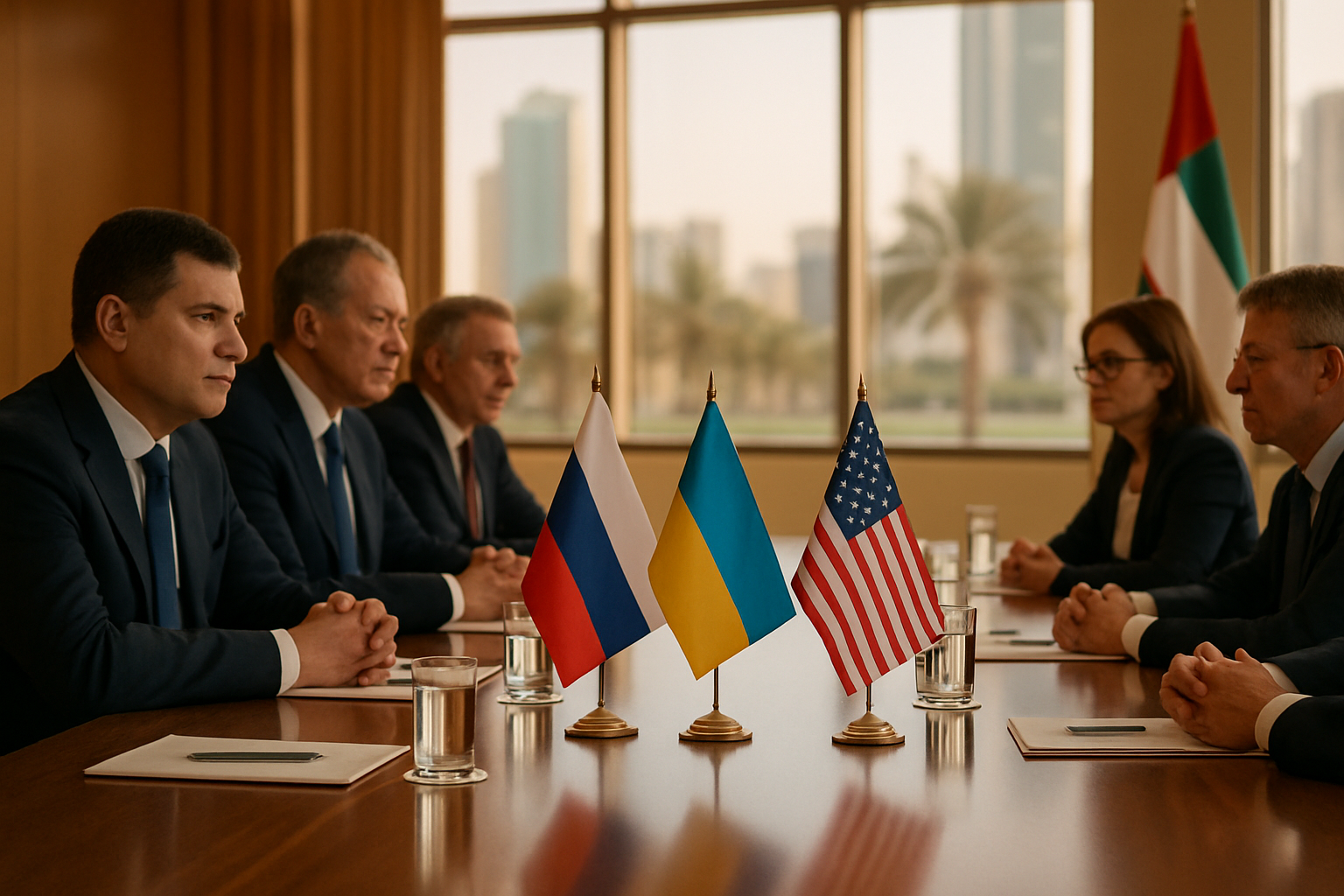
The second round of trilateral peace negotiations between Russia, Ukraine, and the United States concluded Thursday evening in Abu Dhabi with a significant humanitarian breakthrough—an agreement to exchange 314 prisoners of war, the first such swap in five months.
US Special Envoy Steve Witkoff announced the prisoner exchange agreement following two days of "productive" talks that brought together Ukrainian Defense Minister Rustem Umerov, Russian military intelligence director Igor Kostyukov, and American negotiators in the UAE capital. The exchange, implemented immediately, saw both sides transfer 157 military personnel each, with an additional three Russian civilians from the Kursk region returned from Ukrainian custody.
Limited Progress on Core Issues
Despite the humanitarian success, the talks made limited headway on the fundamental territorial and political issues that have defined the nearly four-year conflict. According to US Secretary of State Marco Rubio, the number of disputed questions in the Ukrainian settlement has "significantly decreased," but the most complex challenges remain unresolved.
Ukrainian delegation spokesperson Diana Davitian confirmed that the negotiations had concluded, stating that Kyiv would provide detailed briefings on the discussions at a later date. The main sticking point continues to be the long-term fate of eastern Ukrainian territories currently under Russian control, with Russia maintaining its demand that any Putin-Zelensky direct talks must occur in Moscow.
"The negotiations have been substantial and productive, but significant work remains ahead of us."
— Rustem Umerov, Ukrainian Defense Minister
Talks Proceed Despite Energy Attack
The negotiations took place against the backdrop of a massive Russian energy infrastructure assault that DTEK, Ukraine's largest private energy company, described as the "most powerful blow" of 2026. The February 3-4 attack left more than 1,170 buildings in Kyiv without heating during temperatures reaching minus-30°C, effectively breaking an informal Trump-Putin agreement to avoid energy targets before the peace talks.
Eight Ukrainian oblasts were affected by the strikes, with Kyiv's Darnytska CHP-4 power plant temporarily shut down and Kharkiv experiencing a three-hour bombardment that forced 820 buildings to drain their heating systems to prevent pipe freezing. The attack resulted in civilian casualties, including one death in Zaporizhzhia region.
NATO Secretary-General Mark Rutte made a surprise visit to Kyiv on the eve of negotiations, addressing the Ukrainian Parliament and condemning the energy strikes as a "bad signal" before diplomatic talks. Polish authorities deployed fighter jets preemptively, while Sweden and Denmark announced a €246 million air defense package in response to the escalation.
First Exchange Since September
The prisoner swap marks the 71st such exchange since Russia's full-scale invasion began in February 2022, with most of those freed having been held captive since 2022. According to Ukrainian sources, the majority of the returned personnel had been captured during various phases of the conflict, representing families reunited after years of separation.
The exchange serves as a crucial confidence-building measure in the broader diplomatic framework, demonstrating that sustained engagement can produce concrete humanitarian results even amid ongoing military operations. US officials emphasized that while the territorial issues remain challenging, the prisoner exchange provides a foundation for continued dialogue.
Diplomatic Framework Evolution
The Abu Dhabi talks represent an evolution from the first round of negotiations held in January, moving from technical discussions to more substantive political negotiations with full US participation. The UAE continues to serve as a neutral host, maintaining its diplomatic neutrality while facilitating dialogue between the warring parties.
European divisions on diplomatic engagement persist, with Germany maintaining opposition to direct Putin talks due to what officials describe as "maximalist demands," while France and Italy continue to push for diplomatic channels. The UK and France have pledged potential troop deployments for any future peace agreement enforcement, a proposal that has drawn Russian threats.
The structured approach, featuring separate working groups by topic followed by joint position synchronization, has provided a framework for addressing the complex, multi-dimensional nature of the conflict. However, fundamental positions remain far apart, with Russia having captured 481 square kilometers of Ukrainian territory in January 2026 alone, compared to 260 square kilometers in December 2025.
Military Context and Ongoing Crisis
The peace talks occurred as Russia intensified its "logistics terror" strategy, targeting Ukrainian transportation infrastructure and launching over 10,000 drones and bombs in January 2026. The shift in Russian tactics has killed more than 20 civilians in five days, with Ukrainian railway authorities warning that eastern routes are becoming "high risk."
Ukrainian President Volodymyr Zelensky recently disclosed that 55,000 Ukrainian soldiers have been officially confirmed killed since the February 2022 invasion—the first official casualty count in nearly a year. He emphasized that this figure represents only confirmed battlefield deaths, with a "large number" of personnel still classified as missing in action.
The humanitarian crisis has intensified with more than 17.8 million Ukrainians accessing winter support programs. Emergency warming centers have been activated across affected regions, while the European Union has approved a historic €90 billion loan package for Ukrainian defense and reconstruction—the largest EU aid package in history.
International Support and Future Prospects
The talks have received backing from multiple international partners, with the World Bank allocating $40 million for Ukrainian energy restoration and SpaceX successfully implementing measures to prevent Russian use of Starlink terminals for attack drone operations, according to cooperation between Elon Musk and Defense Minister Umerov.
Both negotiating teams have indicated that discussions will continue, with parties expected to "agree on dates for new meetings" within the UAE framework. The prisoner exchange breakthrough demonstrates that the diplomatic process can yield tangible humanitarian results while broader territorial and political issues remain under negotiation.
"We maintain cautious optimism for achieving lasting and dignified peace, but we will not compromise on territorial integrity."
— Volodymyr Zelensky, Ukrainian President
The success of these talks in producing a concrete humanitarian outcome provides crucial momentum for continued diplomatic engagement. While the fundamental questions of territorial control and security guarantees remain unresolved, the structured dialogue process and neutral venue have created a framework for addressing Europe's deadliest conflict since World War II.
As winter conditions continue to affect millions of Ukrainian civilians and military operations persist on multiple fronts, the Abu Dhabi diplomatic channel represents the most significant opportunity for sustainable peace negotiations. The prisoner exchange breakthrough, while modest in the context of the broader conflict, signals that diplomatic engagement can produce results that directly benefit those most affected by the war.