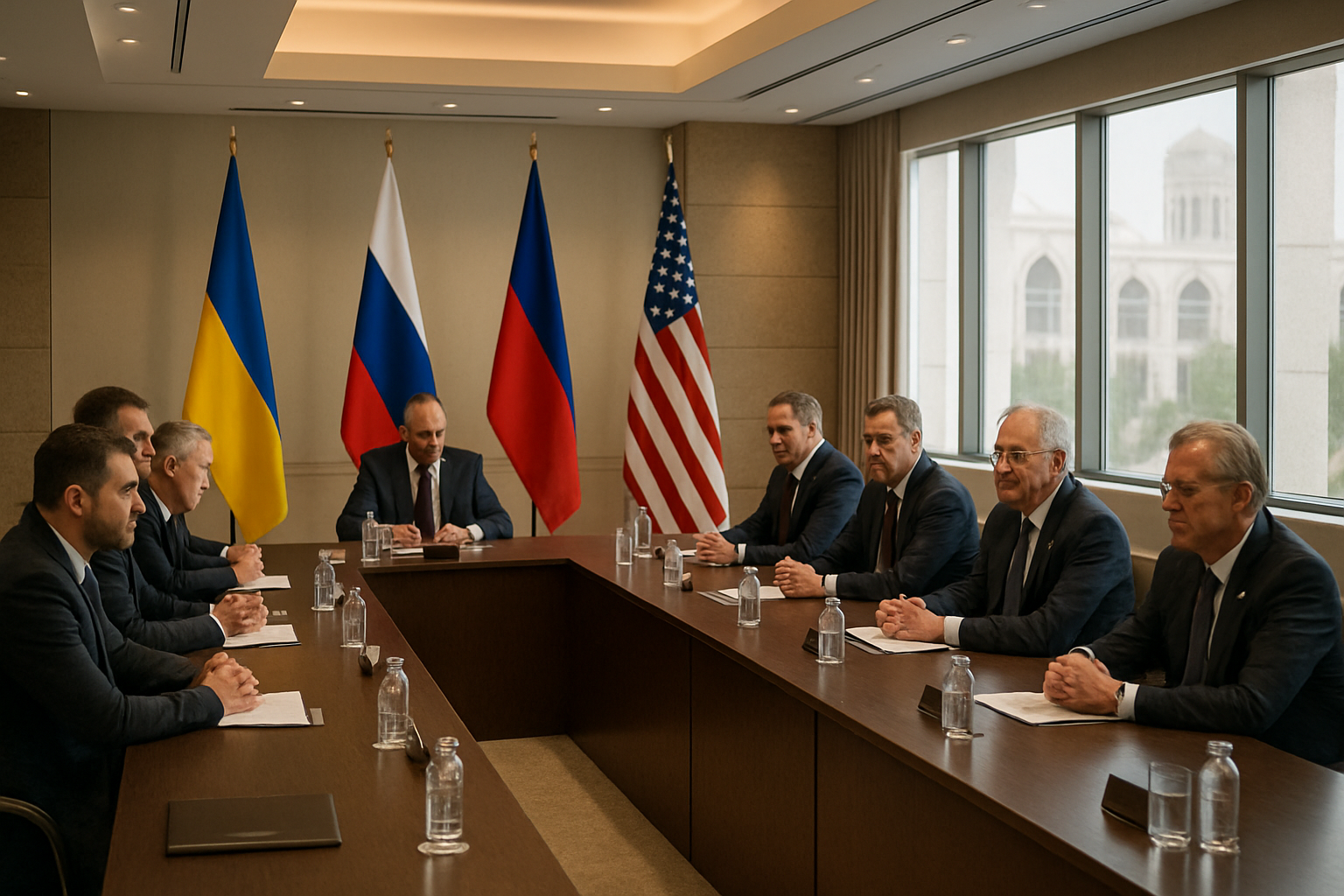
The second round of trilateral peace talks between Ukraine, Russia, and the United States concluded their first day of discussions in Abu Dhabi on Wednesday evening, with negotiations set to resume Thursday as diplomats seek pathways to end the nearly four-year conflict that has devastated Eastern Europe.
Ukrainian Defense Minister Rustem Umerov, leading Ukraine's delegation, described the talks with Russian and American representatives as "substantial and productive" via social media following the conclusion of Wednesday's sessions. The negotiations, facilitated by the United Arab Emirates, bring together the three key parties in a formal diplomatic setting that has become increasingly rare since Russia's invasion began in February 2022.
Escalating Military Tensions Shadow Diplomatic Efforts
The peace talks commenced against a backdrop of intensifying violence, with Russian forces launching what Ukrainian energy company DTEK described as the "most powerful blow" of 2026 against Ukraine's energy infrastructure. The massive coordinated attack left over 1,170 buildings in Kyiv without heating amid brutal winter temperatures reaching minus-30°C in some regions.
The timing of the energy strikes, occurring just hours before the Abu Dhabi negotiations began, broke an informal agreement between former President Trump and Russian President Vladimir Putin to avoid targeting energy facilities ahead of the peace talks. Eight oblasts across Ukraine were affected by the attacks, including critical infrastructure in Kyiv, Kharkiv, and Zaporizhzhia regions.
"This represents terror and escalation by Moscow," Ukrainian President Volodymyr Zelensky declared following the attacks.
— Volodymyr Zelensky, President of Ukraine
The Russian assault forced the Darnytska CHP-4 power plant in Kyiv to temporarily shut down, while in Kharkiv, over 820 buildings were forced to drain their heating systems to prevent freezing. The humanitarian impact was immediate and severe, with emergency warming centers activated across the affected regions as hundreds of thousands of families faced the prospect of winter without adequate heating.
High-Level Diplomatic Representation
The UAE's foreign ministry released photographs showing the three delegations seated around a distinctive U-shaped negotiating table, with US officials positioned at the center of the formation. The American delegation includes Special Envoy Steve Witkoff and President Donald Trump's son-in-law Jared Kushner, underscoring the high-level nature of the diplomatic engagement.
Russian representation is led by Igor Kostyukov, head of the Main Intelligence Directorate of the General Staff of the Russian Armed Forces, while Ukraine's team is spearheaded by Umerov in his capacity as both Defense Minister and head of Ukraine's National Security Council.
NATO Secretary-General Mark Rutte made an unscheduled visit to Kyiv on Tuesday, addressing the Ukrainian Parliament and condemning the Russian attacks as sending a "bad signal" ahead of the crucial negotiations. His surprise appearance highlighted the international community's investment in the diplomatic process.
Territorial Control Remains Central Challenge
According to multiple diplomatic sources, the primary sticking point in negotiations continues to be the long-term status of eastern Ukrainian territories currently under Russian military control. The Institute for Study of War reported that Russian forces captured 481 square kilometers in January 2026, compared to 260 square kilometers in December 2025, indicating an acceleration in territorial gains.
The talks represent the second round of trilateral negotiations, building upon earlier discussions that established the framework for US-mediated dialogue between the warring parties. The first round made limited progress on the territorial question, which remains the most contentious issue between the negotiating parties.
European diplomatic divisions have complicated the broader international response, with Germany maintaining its opposition to direct engagement with Putin while France and Italy have advocated for diplomatic channels. This split within the European Union has created additional complexity for Western coordination on the Ukraine question.
Humanitarian Crisis Deepens
The military escalation has exacerbated Ukraine's humanitarian crisis, with over 17.8 million Ukrainians accessing winter support programs according to government statistics. The targeting of energy infrastructure during extreme winter conditions has been characterized by Ukrainian officials as a deliberate strategy to use civilian suffering as diplomatic leverage.
Emergency medical teams deployed across Kyiv following the attacks, while regional governors reported casualties from the strikes. In Zaporizhzhia, at least one civilian was killed and several others wounded when Russian drones struck residential areas. Educational facilities in the Sumy region also sustained damage from the bombardment.
Poland responded to the escalation by deploying fighter jets preemptively, while Sweden and Denmark announced a €246 million air defense package for Ukraine, including advanced Tridon Mk2 systems. The international military response reflects growing concern about the conflict's trajectory.
Diplomatic Context and International Support
The Abu Dhabi talks occur within a complex international diplomatic landscape, with the UAE maintaining its role as a neutral venue for high-stakes negotiations. The Gulf state has positioned itself as a key mediator in regional conflicts, leveraging its relationships with both Western powers and Russia to facilitate dialogue.
Ukraine has implemented technological countermeasures with assistance from SpaceX, successfully blocking Russian attempts to use Starlink satellite internet terminals for controlling attack drones. Tesla CEO Elon Musk announced the successful implementation of these security protocols, working directly with Ukrainian Defense Minister Umerov.
The World Bank has allocated $40 million for Ukrainian energy system restoration, recognizing the critical nature of infrastructure repairs for both humanitarian needs and economic stability. This financial support comes as Ukraine faces mounting costs from repeated attacks on civilian infrastructure.
Russian Strategic Calculations
The timing and scale of Russia's energy infrastructure assault appears calculated to strengthen Moscow's negotiating position through the application of humanitarian pressure during Ukraine's most vulnerable winter period. Over 10,000 Russian drones and bombs were launched against Ukrainian targets in January 2026 alone, representing a significant escalation in the frequency and intensity of attacks.
Russian forces have shifted their strategic focus to what Ukrainian officials term "logistics terror," systematically targeting transportation infrastructure and supply lines in addition to energy facilities. This approach has resulted in over 20 civilian casualties in a five-day period leading up to the Abu Dhabi talks.
The Kremlin has maintained that any future direct talks between Putin and Zelensky must take place in Moscow, a condition that Ukrainian officials have rejected as incompatible with sovereign equality in negotiations.
Future Diplomatic Framework
As negotiations continue Thursday in Abu Dhabi, diplomatic sources suggest the talks could establish a framework for future higher-level engagements, though significant obstacles remain. The contrast between diplomatic progress and military escalation illustrates the complex dynamics at play in the conflict.
President Zelensky has expressed "cautious optimism" about achieving what he terms "dignified and lasting peace," while simultaneously announcing adjustments to Ukraine's negotiating strategy in response to Russia's continued military pressure. The Ukrainian position emphasizes that any sustainable agreement must address both immediate ceasefire arrangements and long-term security guarantees.
The international community continues to monitor the talks closely, with multiple stakeholders invested in preventing further escalation while supporting Ukraine's territorial integrity. The success or failure of the Abu Dhabi negotiations could significantly influence the trajectory of the conflict and broader European security architecture.
Looking Ahead
Thursday's continuation of talks will test whether diplomatic momentum can overcome the poisoned atmosphere created by Wednesday's massive attacks on civilian infrastructure. The negotiations face the fundamental challenge of bridging seemingly irreconcilable positions on territorial control while addressing urgent humanitarian needs.
The stakes extend beyond the immediate conflict, with implications for international law, European security arrangements, and the effectiveness of diplomatic solutions to major power conflicts. As winter conditions intensify across Ukraine and military pressures mount, the Abu Dhabi talks represent perhaps the most significant opportunity for diplomatic progress in the nearly four-year conflict.