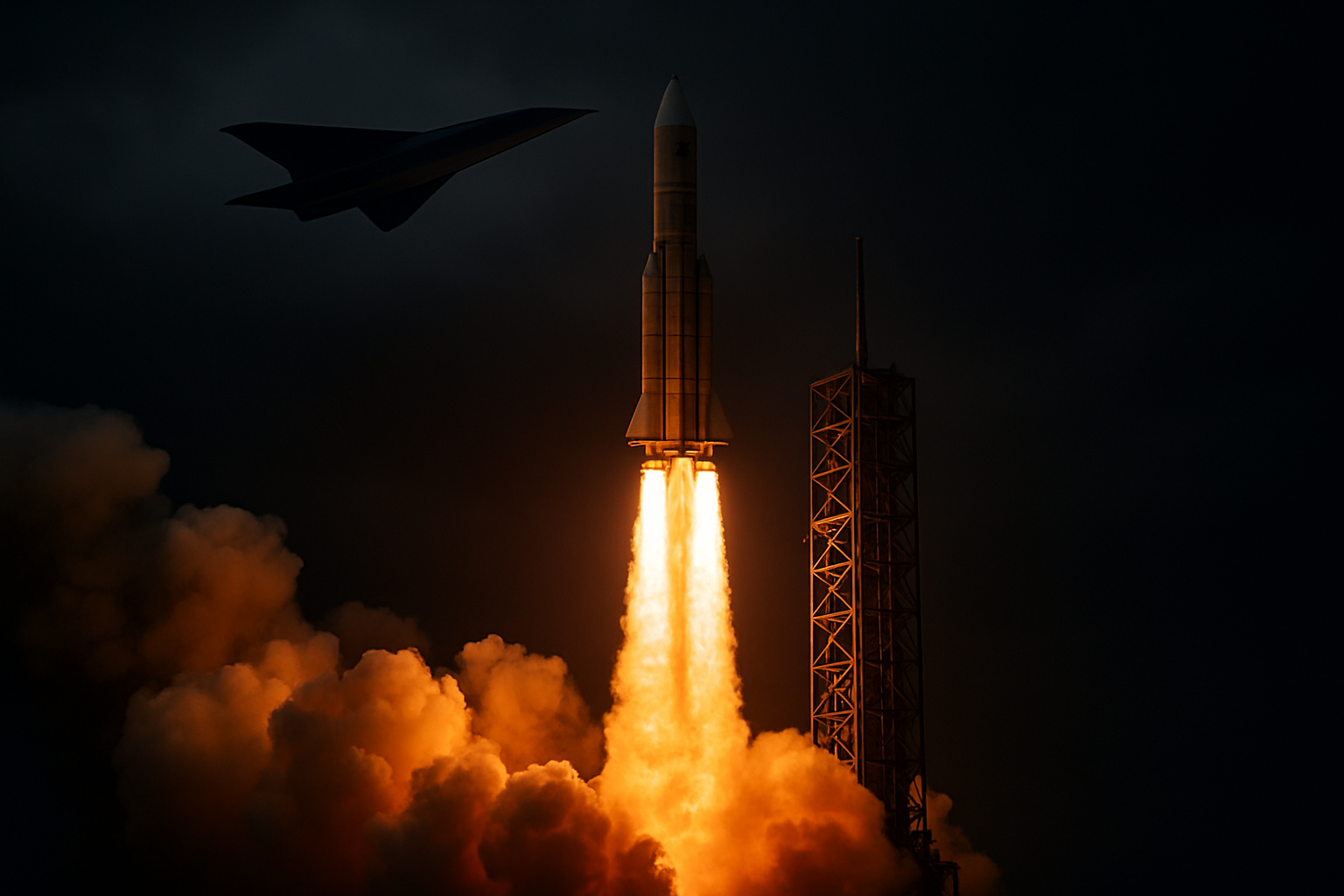
The aerospace industry reached a pivotal milestone in February 2026 as Rocket Lab successfully launched its HASTE rocket from Virginia, deploying a scramjet-powered aircraft in a groundbreaking US Department of Defense hypersonic test mission, while commercial aviation simultaneously advanced toward the threshold of supersonic flight with new-generation passenger aircraft.
This convergence of military hypersonic capabilities and civilian near-supersonic aviation represents a transformation in aerospace technology that could reshape both defense systems and commercial air travel within the decade.
Rocket Lab's Hypersonic Breakthrough
Rocket Lab's successful HASTE (Hypersonic Accelerated Scramjet Test Environment) mission from Virginia marks a significant advancement in the United States' hypersonic weapons and propulsion research program. The mission involved deploying a scramjet-powered aircraft designed to achieve speeds exceeding Mach 5, representing a critical milestone for US Department of Defense hypersonic development initiatives.
Scramjet technology, which stands for "supersonic combustion ramjet," represents one of the most challenging propulsion systems in aerospace engineering. Unlike traditional jet engines that compress air using rotating machinery, scramjets rely on the vehicle's forward motion to compress incoming air for combustion, enabling sustained flight at hypersonic speeds - typically defined as five times the speed of sound or faster.
"This successful test represents years of collaborative engineering between our teams and defense contractors to advance America's hypersonic capabilities,"
— Rocket Lab spokesperson
The HASTE mission's success places the United States among the elite group of nations developing operational hypersonic capabilities, alongside China and Russia, which have made significant investments in this technology sector over the past decade. The ability to deploy and test scramjet technology effectively could have profound implications for both military applications and future civilian aerospace development.
Commercial Aviation's Supersonic Evolution
Parallel to military hypersonic developments, commercial aviation is experiencing its own revolution as manufacturers approach the sound barrier with new-generation passenger aircraft. The Bombardier Global 8000, highlighted in recent Swiss aerospace reporting, exemplifies how commercial aviation is pushing performance boundaries without necessarily requiring full supersonic capability.
The Global 8000 represents a strategic approach to high-speed aviation that prioritizes efficiency and practicality. By operating just below the sound barrier, these aircraft can achieve dramatic reductions in flight times while avoiding the complex regulatory, environmental, and economic challenges associated with supersonic passenger flight.
This near-supersonic approach addresses several practical considerations that have historically limited commercial supersonic aviation. Sound barriers over populated areas, fuel efficiency concerns, and airport noise restrictions have traditionally made supersonic passenger flight economically challenging since the retirement of the Concorde in 2003.
The Technology Convergence
The simultaneous advancement of hypersonic military technology and near-supersonic commercial aviation reflects broader trends in aerospace engineering where military research increasingly influences civilian applications. Technologies developed for defense purposes often find secondary applications in commercial markets, creating a cycle of innovation that benefits both sectors.
Advanced materials science, computational fluid dynamics, and propulsion system design developed for military hypersonic programs contribute to improved efficiency and performance in commercial aircraft. Similarly, commercial aviation's focus on fuel efficiency and operational economics provides valuable lessons for military aircraft designers seeking to balance performance with operational sustainability.

Global Aerospace Competition Intensifies
These developments occur within a broader context of intensifying international competition in aerospace technology. The success of Rocket Lab's hypersonic test comes as nations worldwide invest heavily in advanced propulsion systems, viewing hypersonic capability as essential for future military and commercial competitiveness.
Australia recently achieved its own hypersonic milestone, successfully testing aircraft that reached Mach 5, positioning the nation among the growing group of countries with demonstrated hypersonic capabilities. This achievement, combined with Australia's AUKUS partnership commitments and nuclear submarine program, illustrates how aerospace technology has become integral to national security strategy.
Meanwhile, commercial aviation competition is driving rapid advancement in passenger aircraft performance. Manufacturers are investing billions in developing aircraft that can reduce international flight times while meeting increasingly stringent environmental regulations and operational efficiency requirements.
Economic and Strategic Implications
The economic implications of these aerospace advances extend far beyond the immediate defense and aviation sectors. Hypersonic technology development represents billions in research and development investment, with potential applications spanning space launch systems, commercial transportation, and industrial processes requiring high-speed material processing.
For commercial aviation, near-supersonic capabilities could transform international business travel by dramatically reducing flight times on long-haul routes. A aircraft capable of sustained near-supersonic flight could reduce transpacific flight times by several hours, potentially making day trips between distant business centers economically viable.
The aerospace workforce benefits significantly from these technological advances, with high-value engineering positions, advanced manufacturing opportunities, and specialized technical training programs supporting thousands of jobs across multiple countries. Australia's hypersonic success, for example, positions the nation to develop export opportunities in advanced aerospace technology while building domestic capability for future defense requirements.
Technical Challenges and Solutions
Both hypersonic military applications and near-supersonic commercial aviation face substantial technical challenges that require innovative engineering solutions. Hypersonic flight presents extreme challenges including heat management, where aircraft surfaces can reach temperatures exceeding 1,000 degrees Celsius due to atmospheric friction at Mach 5+ speeds.
Advanced materials development has become critical for sustained hypersonic flight, requiring ceramics and composite materials capable of withstanding extreme temperatures while maintaining structural integrity. Cooling systems, thermal protection, and aerodynamic design must work in combination to enable reliable hypersonic vehicle operation.
Commercial near-supersonic aviation faces different but equally challenging technical requirements. Aircraft must achieve maximum efficiency while operating just below the sound barrier, requiring precise aerodynamic design, advanced engine management systems, and sophisticated flight control technologies to maintain optimal performance across varying atmospheric conditions.
Environmental Considerations
Environmental impact considerations play an increasingly important role in aerospace development, influencing both military and commercial aircraft design. Hypersonic vehicles typically require significant energy consumption, raising questions about fuel efficiency and environmental sustainability for operational deployment.
Commercial aviation manufacturers are addressing environmental concerns through improved fuel efficiency, reduced emissions, and noise reduction technologies. The near-supersonic approach offers environmental advantages over full supersonic flight by avoiding sonic booms over populated areas while achieving substantial performance improvements over conventional aircraft.
Research into sustainable aviation fuels and hybrid propulsion systems could eventually enable both hypersonic military applications and commercial high-speed flight to operate with reduced environmental impact, supporting broader aerospace industry sustainability goals.
Future Development Trajectory
The successful demonstration of both hypersonic military technology and near-supersonic commercial capability in February 2026 establishes a foundation for continued rapid advancement in aerospace performance. Military hypersonic programs are likely to expand beyond experimental phases toward operational deployment within the next decade.
Commercial aviation's approach to supersonic flight appears to be evolving toward practical near-supersonic solutions rather than full supersonic passenger service. This pragmatic approach addresses regulatory, economic, and environmental challenges while delivering meaningful performance improvements for international travel.
Integration between military and commercial aerospace development is expected to accelerate, with technologies developed for defense applications increasingly finding civilian applications. This technology transfer could enable commercial hypersonic flight within 15-20 years, though significant technical and regulatory challenges remain.
The convergence of military hypersonic capabilities and commercial near-supersonic aviation in February 2026 represents more than incremental technological progress - it signals a fundamental shift toward higher-performance aerospace systems that could transform both defense capabilities and civilian transportation within the next two decades. As nations and companies continue investing in these technologies, the aerospace industry is positioning itself for the most significant performance leap since the jet age.