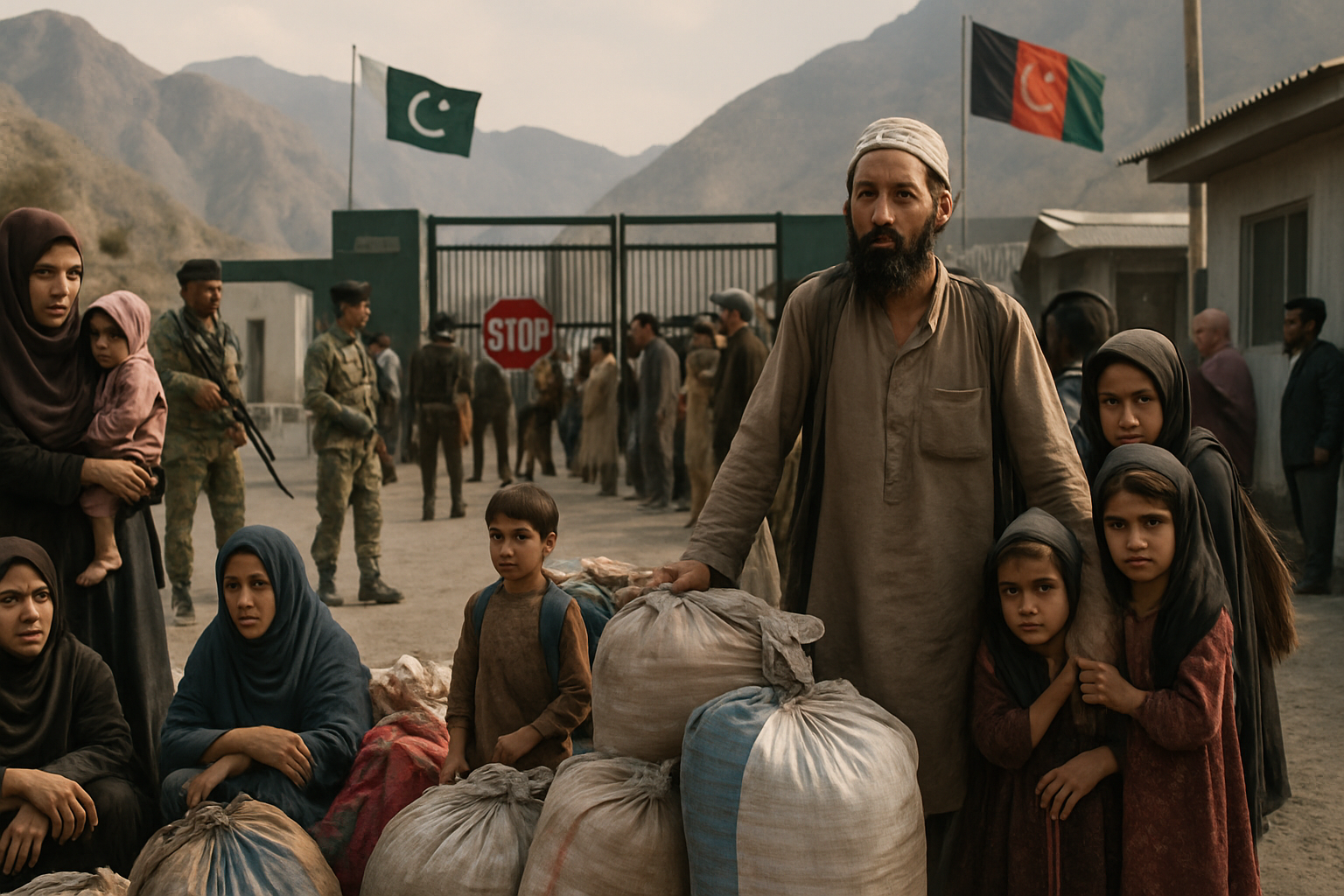
Hundreds of Afghan migrants have been detained by Pakistani authorities in a sweeping crackdown that coincides with the most serious military confrontation between Pakistan and Afghanistan since the Taliban's return to power in 2021.
Pakistani media outlets report that police have detained hundreds of Afghan nationals following escalating tensions and clashes with the Taliban government. According to Dawn newspaper, a local court in Peshawar on Sunday sent hundreds of Afghan nationals into judicial custody, with detainees having been arrested a day earlier from different parts of the region.
Military Escalation Reaches Critical Point
The mass arrests come as Pakistani Defense Minister Khawaja Mohammad Asif formally declared "open war" against Afghanistan's Taliban government, marking the most serious confrontation since the Taliban's August 2021 return to power. This unprecedented escalation has evolved from isolated border skirmishes into sustained military operations across multiple fronts.
The crisis began with a February 16 attack in Pakistan's Bajaur district, where 11 Pakistani soldiers were killed by a vehicle-borne improvised explosive device deployed by the banned Tehreek-e-Taliban Pakistan (TTP). Pakistan retaliated on February 22 with coordinated airstrikes targeting seven terrorist camps in Afghanistan's Nangarhar and Paktika provinces, claiming to have eliminated over 80 militants but causing significant civilian casualties, including eight schoolchildren.
"This is a historic moment that will define the regional security architecture for years to come"
— Regional Security Analyst
Cross-Border Strikes and Taliban Response
The situation dramatically escalated when Taliban forces claimed to have shot down Pakistani aircraft and captured multiple military installations. Afghan officials reported that Taliban forces had captured four Pakistani military bases, with 32 Pakistani soldiers allegedly killed by landmines and dozens wounded. Pakistani jets responded by striking the strategic Bagram Airfield, the former U.S. military base, marking an unprecedented expansion of military operations into Afghanistan's strategic installations.
According to Afghan sources, Taliban forces engaged Pakistani aircraft with anti-aircraft fire over Kabul itself – the first direct military action in Afghanistan's capital against Pakistan. Taliban spokesman Zabihullah Mujahid confirmed the engagement, stating that "anti-aircraft fire targeted Pakistani air force in Kabul."
Civilian Impact and Economic Devastation
The military confrontation has had severe consequences for civilian populations on both sides of the border. The latest Pakistani airstrikes targeted what officials described as militant hideouts but resulted in civilian casualties, including three children killed in a refugee camp in Afghanistan's Kunar province according to local officials.
The conflict has also caused catastrophic economic damage to bilateral relations. Trade between Pakistan and Afghanistan has collapsed by 59%, with Pakistani exports dropping from $550 million to just $228 million over seven months. This economic devastation affects border communities dependent on cross-border commerce and compounds Afghanistan's humanitarian crisis, where 88% of female-headed households are unable to meet minimum living requirements according to UN data.
International Mediation Attempts Fall Short
Despite multiple diplomatic interventions, including a Saudi-mediated prisoner exchange in February 2026 that saw the release of three Pakistani soldiers captured in October 2025 border clashes, confidence-building measures have proven insufficient to address the underlying security challenges.
Iran has offered mediation services, warning of regional destabilization risks, while Turkey's Foreign Minister Hakan Fidan launched diplomatic initiatives contacting both Pakistani and Afghan foreign ministers as well as Qatari and Saudi counterparts. However, these efforts have been overshadowed by the rapid military escalation.
The crisis occurs against the backdrop of Pakistan's acknowledgment of its diminished regional influence over Afghanistan compared to wealthier powers including Turkey, the UAE, Qatar, Saudi Arabia, and China, forcing increased reliance on military solutions.
Historical Context and Border Disputes
The current crisis is rooted in longstanding disputes over the 2,640-kilometer Durand Line, the colonial-era border established in 1893 that has never been formally recognized by Afghan governments. This porous mountainous frontier has provided sanctuary for militant groups, complicating bilateral relations and enabling cross-border terrorism.
Pakistan maintains that TTP leadership operates "with impunity from Afghan soil" despite Taliban assurances of preventing territorial use for attacks on neighboring countries. The sophisticated nature of recent attacks, including coordinated assaults and vehicle-borne improvised explosive devices, demonstrates retained operational capabilities despite sustained Pakistani counter-terrorism pressure that eliminated over 400 militants in Balochistan operations during February 2026 alone.
Regional Security Architecture Under Threat
The escalation represents the most serious test of the post-2021 South Asian security architecture, with implications extending far beyond bilateral relations. Chinese warnings at the UN Security Council about the continued presence of ISIS-K, al-Qaeda, and the East Turkestan Islamic Movement (ETIM) in Afghanistan contradict Taliban claims of having "defeated terrorism."
The crisis also highlights broader challenges in managing territorial sovereignty versus transnational terrorism in the 21st century. The success or failure of diplomatic containment efforts will influence how similar challenges are addressed globally, particularly in regions where counter-terrorism concerns intersect with governance limitations.
Humanitarian Crisis Deepens
Beyond the immediate military confrontation, the crisis has exacerbated Afghanistan's humanitarian emergency. The World Health Organization recently delivered medical oxygen to 23 hospitals across Afghanistan as the country faces its worst humanitarian crisis in 25 years. International aid cuts have forced hundreds of health center closures, creating a healthcare vacuum that particularly affects women and children.
The targeting of civilian areas during recent military operations, including strikes on religious institutions during the holy month of Ramadan, has raised serious questions about compliance with international humanitarian law and the protection of non-combatants.
Path Forward Uncertain
As the crisis enters its most dangerous phase, with capitals under attack and strategic installations targeted, the international community faces urgent pressure to develop effective conflict prevention mechanisms before the confrontation escalates into broader regional warfare.
The coming days will be critical in determining whether sustained diplomatic engagement can overcome military escalation or whether the region faces prolonged warfare between nuclear-armed neighbors. The framework's success or failure will provide a crucial template for managing complex multilateral negotiations despite fundamental disagreements, with implications for global conflict prevention mechanisms and international relations for decades to come.
The mass detention of Afghan migrants represents not just a humanitarian crisis but a symptom of the broader breakdown in Pakistan-Afghanistan relations, highlighting how regional conflicts increasingly impact civilian populations who become pawns in larger geopolitical struggles. As military operations continue to escalate, the plight of Afghan civilians caught between their homeland's instability and their host country's security concerns exemplifies the human cost of diplomatic failure in an increasingly interconnected world.