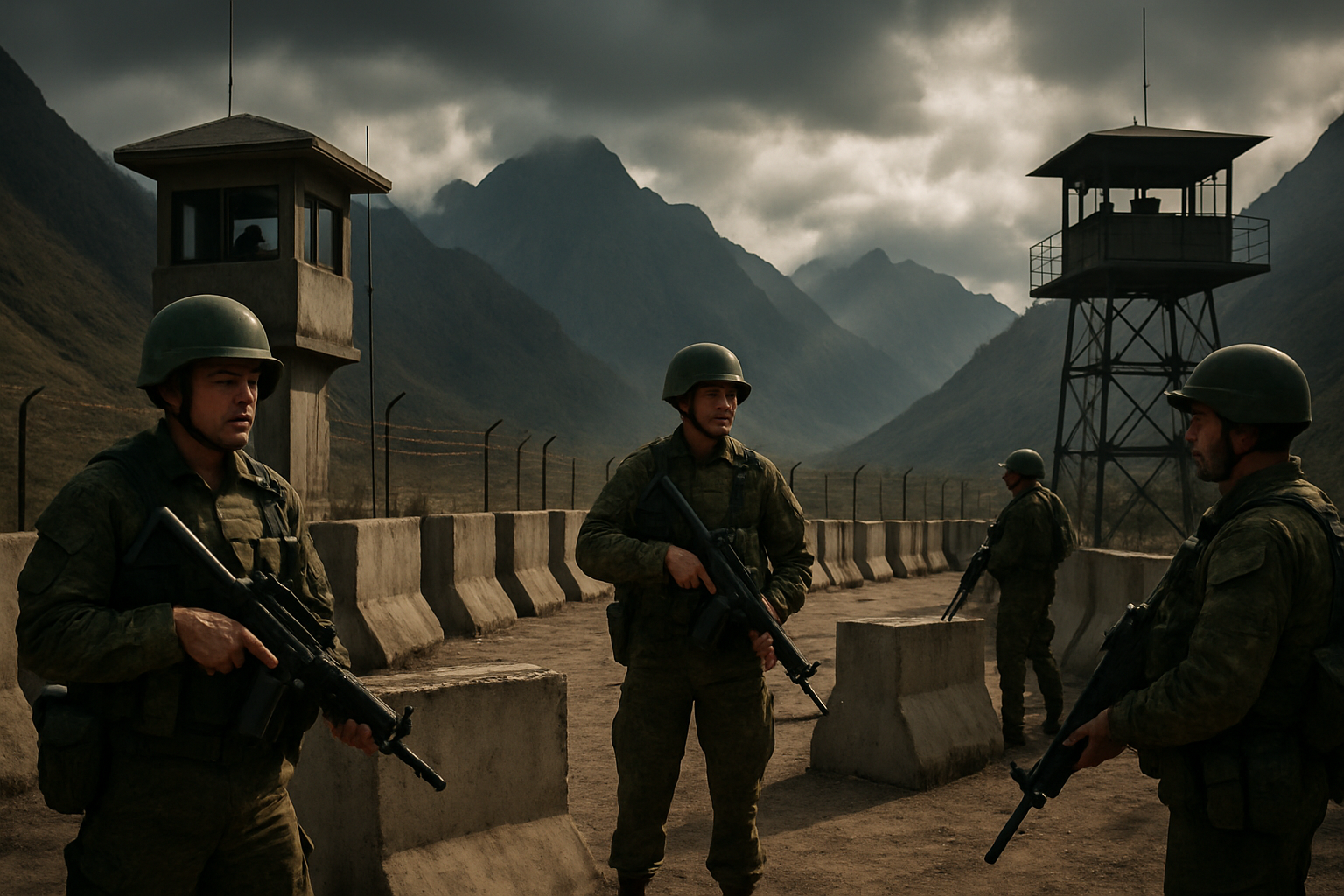
Afghanistan's Ministry of Defense announced Thursday that Afghan forces conducted retaliatory operations against Pakistani military positions along the disputed Durand Line, marking the latest escalation in cross-border tensions that have reached unprecedented levels since February 2026.
The operations took place over the past day and night along the Durand Line across several eastern and southern provinces, including Kandahar, Nangarhar, Kunar, Nuristan, Khost, Paktia, and Paktika, according to a statement from Afghanistan's Ministry of National Defense. Officials described the strikes as coordinated attacks targeting what they characterized as enemy positions and military infrastructure.
Airstrikes Target Pakistani Command Centers
Afghan air units conducted a significant airstrike at approximately 8 a.m. in the Kachlagh area of Pakistan's Balochistan province, targeting a command center belonging to the Frontier Corps. The ministry identified the target as the "Ghazaband" general command facility, claiming the strike successfully hit the command center.
The retaliatory operations represent the latest chapter in what has become the most serious military confrontation between Afghanistan and Pakistan since the Taliban's return to power in August 2021. The current crisis began with a February 16 attack in Pakistan's Bajaur district that killed 11 Pakistani soldiers, attributed to the Tehrik-e-Taliban Pakistan (TTP).
Escalation Timeline: From Airstrikes to "Open War"
The deteriorating situation reached a critical point on February 22, when Pakistan conducted airstrikes on seven terrorist camps in Afghanistan's Nangarhar and Paktika provinces. While Pakistan claimed to have eliminated over 80 militants, the strikes resulted in civilian casualties, including eight schoolchildren in Behsud district, according to UN documentation.
The crisis dramatically escalated on February 27, when Pakistani Defense Minister Khawaja Mohammad Asif formally declared "open war" against Afghanistan's Taliban government. This unprecedented declaration was followed by Pakistan's Operation Ghazab-ul-Haq, involving coordinated military strikes across multiple Afghan provinces, including the capital Kabul.
"The operations took place over the past day and night along the Durand Line and across several eastern and southern provinces."
— Afghanistan Ministry of National Defense Statement
The Durand Line Dispute
The 2,640-kilometer Durand Line, established by British colonial authorities in 1893, has remained a source of contention as no Afghan government has ever formally recognized the border. The Taliban government continues this policy of non-recognition, viewing the boundary as an artificial division of Pashtun tribal lands.
Pakistan maintains that militant groups, particularly the TTP, operate "with impunity from Afghan soil" and use the mountainous border regions as sanctuaries for planning attacks on Pakistani territory. Afghanistan disputes these claims, asserting that no armed groups operate from its territory against neighboring countries.
Regional Mediation Efforts
Despite multiple international mediation attempts, the crisis has continued to escalate. Saudi Arabia facilitated a prisoner exchange in February 2026, releasing three Pakistani soldiers captured during October 2025 border clashes. Iran, Turkey, and Russia have all offered mediation services, but confidence-building measures have proven insufficient to address the underlying security challenges.
Pakistan acknowledges that it has lost traditional influence over Afghanistan to wealthier regional powers, including Turkey, the UAE, Qatar, Saudi Arabia, and China. This diminished leverage has contributed to Pakistan's increasing reliance on military solutions to address cross-border terrorism concerns.
Economic and Humanitarian Impact
The ongoing conflict has had devastating economic consequences. Bilateral trade between the two countries has collapsed by 59%, with Pakistan's exports to Afghanistan falling from $550 million to $228 million over seven months. Traditional trade routes through Chaman-Spin Boldak and Torkham have faced repeated closures, severely impacting border communities dependent on cross-border commerce.
The crisis compounds Afghanistan's humanitarian situation, where 88% of female-headed households are unable to meet minimum living requirements according to UN data. The World Health Organization has delivered emergency medical oxygen to 23 hospitals amid the worst crisis the country has faced in 25 years.
International Concerns
The United Nations Assistance Mission in Afghanistan (UNAMA) has documented 146 civilian casualties since February 26, including 42 deaths and 104 injuries. The systematic targeting of civilian areas raises serious questions about compliance with international humanitarian law.
Chinese warnings at the UN Security Council about the presence of ISIS-K, al-Qaeda, and the East Turkestan Islamic Movement (ETIM) in Afghanistan contradict Taliban claims of having defeated terrorism. These security concerns add complexity to the regional dynamics and international efforts to engage constructively with Afghanistan.
Nuclear Dimensions
The involvement of nuclear-armed Pakistan adds a dangerous dimension to the crisis, requiring careful international monitoring to prevent escalation beyond conventional military operations. The international community faces pressure to develop effective conflict prevention mechanisms before the confrontation expands into a broader regional war.
Looking Ahead
The current escalation represents a critical test of whether innovative diplomatic frameworks can manage the intersection of territorial sovereignty and transnational terrorism in the 21st century. The success or failure of international mediation efforts will influence future approaches to regional conflict resolution and could set important precedents for similar disputes worldwide.
As both countries continue military operations along the disputed border, the coming days will be crucial in determining whether diplomatic engagement can overcome the cycle of retaliation and counter-retaliation that has brought these nuclear-armed neighbors to the brink of sustained warfare.
The crisis highlights the broader challenges facing the post-2021 South Asian security architecture, where counter-terrorism concerns intersect with Taliban governance limitations and Pakistan's legitimate security needs. The international community's response to this unprecedented escalation will likely influence regional stability and conflict resolution mechanisms for years to come.