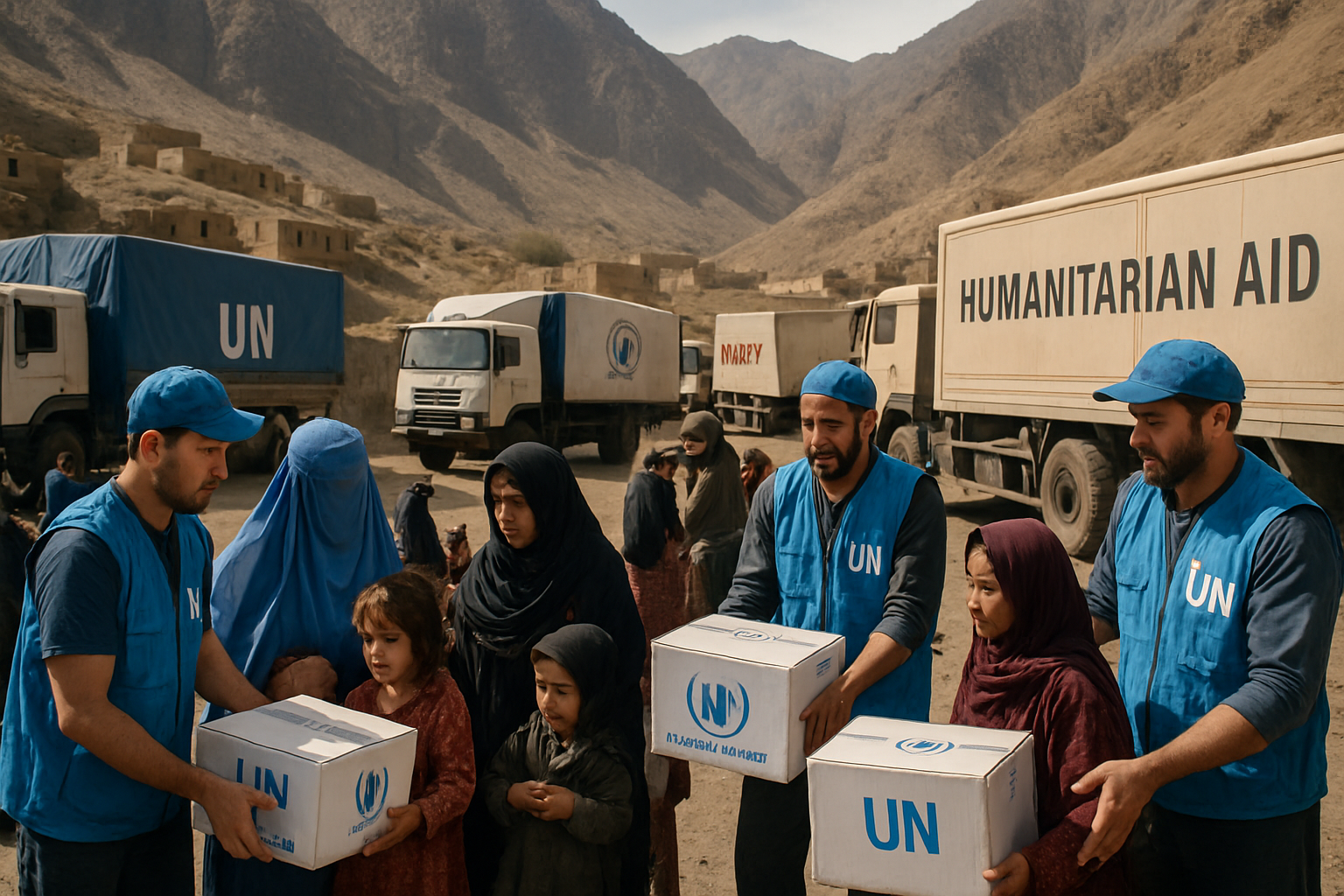
International humanitarian aid operations have finally reached Afghanistan's isolated Nuristan province after weeks of conflict-related blockades, while parallel efforts to develop the country as a Central Asian trade hub gain momentum despite ongoing regional tensions and severe humanitarian challenges.
The dual narrative of humanitarian crisis and economic development underscores the complex realities facing Afghanistan in April 2026, nearly five years after the Taliban's return to power. While aid organizations struggle to address basic needs amid systematic restrictions and funding shortfalls, strategic trade initiatives position Afghanistan as a crucial transit corridor connecting Central Asia to global markets.
Humanitarian Aid Breaks Through to Isolated Regions
The International Committee of the Red Cross (ICRC), working alongside the Afghan Red Crescent Society and World Food Programme, launched a critical multi-day operation to deliver urgently needed assistance to communities in eastern Nuristan Province. According to humanitarian agencies, approximately 136,000 people—representing roughly 17,000 households—in Kamdesh and Barg-e-Matal districts have faced severe shortages of food, healthcare, and essential household items due to insecurity and restricted access over the past two months.
The breakthrough comes after weeks of isolation caused by clashes between Pakistani forces and Taliban authorities along the disputed Durand Line. Access routes to these mountainous communities, which depend heavily on cross-border trade for essential supplies, had been repeatedly blocked during Pakistan's "Operation Ghazab-ul-Haq" military campaign launched in February 2026.
"Since early April, aid organizations have engaged in ongoing dialogue with all parties to the conflict to secure safe and unimpeded access to affected communities."
— Humanitarian Coordination Statement
The aid delivery represents a rare success story amid Afghanistan's broader humanitarian catastrophe. The UN describes the current crisis as the worst in 25 years, with 88% of female-headed households unable to meet minimum living requirements compared to 75% of the general population. The World Health Organization has been forced to deliver emergency medical oxygen to only 23 hospitals nationwide, while hundreds of health centers have closed due to funding cuts and security concerns.
Strategic Trade Initiatives Advance Despite Challenges
Parallel to the humanitarian crisis, Afghanistan has been aggressively pursuing regional trade integration. The most significant development is the US-backed "Silk S7+" initiative presented to Congress by the Newlines Institute. This proposal seeks to boost regional trade via Afghanistan, positioning it as a transit hub linking Central Asia, Pakistan, and global markets.
The initiative builds on remarkable progress achieved in 2026. Afghanistan has secured over $814 million in bilateral cooperation agreements with Central Asian partners, including $300 million in Uzbekistan agreements in February and an additional $514.8 million in connectivity frameworks in March. The Afghanistan-Central Asia Consultative Dialogue, launched in April, set an ambitious target of $10 billion in trade within 3-4 years, up from current levels of $2.7 billion.
A trilateral meeting in Tashkent between Afghanistan's Industry and Commerce Minister Nuruddin Azizi, Uzbekistan's Laziz Kudratov, and Kyrgyzstan's Deputy Minister Sanzhar Iskenderovich Asylkulov focused on facilitating transit procedures, increasing trade volumes, and expanding Afghan exports to Central Asian markets. The three sides agreed to establish a joint working group to oversee implementation of proposed initiatives.
Infrastructure Projects Create Regional Connectivity
The most transformative infrastructure development is the Uzbekistan-Afghanistan-Pakistan railway project, which enables landlocked Central Asian access to Pakistani ports via the China-Pakistan Economic Corridor (CPEC). This railway positions Afghanistan as a crucial transit hub in the broader Belt and Road Initiative framework.
Afghanistan-Iran trade relations have also expanded dramatically. Rail freight between the two countries increased 17-fold during the 1404 solar year, handling 650,000 tons of goods and 150,000 tons of transit cargo. This growth demonstrates Afghanistan's potential as a regional connectivity hub despite political complexities.
The physical infrastructure investments are supported by institutional frameworks designed to ensure sustainability. Regular consultation mechanisms, working groups, and investment committees provide continuity beyond individual meetings or political changes. These structures emphasize technology transfer and institutional capability building rather than simple commodity exchanges.
Implementation Challenges and Security Concerns
Despite remarkable economic cooperation momentum, significant challenges persist. The ongoing Pakistan-Afghanistan border crisis has severely disrupted traditional trade routes. Bilateral trade between the two countries collapsed by 59% over seven months, with Pakistani exports falling from $550 million to $228 million. The Chaman-Spin Boldak and Torkham crossings, vital for Afghanistan's external trade, have faced repeated closures.
International sanctions continue to complicate banking and financial transactions, limiting the scope of potential trade relationships. The humanitarian crisis also creates implementation challenges, as economic development occurs against a backdrop of severe poverty and systematic restrictions on women's participation in the workforce.
Security concerns remain significant. The Collective Security Treaty Organization (CSTO) has warned about the continued presence of militant groups including ISIS-K, al-Qaeda, and the East Turkestan Islamic Movement operating from Afghan territory. These warnings contradict Taliban claims that terrorism has been defeated within Afghanistan's borders, highlighting fundamental disconnects between Taliban assertions and international intelligence assessments.
International Response and Strategic Implications
The international community faces a complex balancing act in Afghanistan. Humanitarian organizations continue life-saving work despite political constraints, with the International Federation of Red Cross and Red Crescent Societies serving over 2 million people in 2025 through 128+ healthcare centers. However, funding shortfalls have forced organizations to turn away three out of four hungry and malnourished children—representing what critics call a fundamental failure of the global humanitarian architecture.
The UN Security Council approved only a three-month extension for the UN Assistance Mission in Afghanistan (UNAMA) versus the usual annual renewal, reflecting international frustration with the lack of human rights progress. This shortened mandate underscores growing pressure for policy changes while maintaining essential humanitarian services.
Regional powers are pursuing pragmatic engagement strategies. China's mediation efforts through Foreign Minister Wang Yi have produced the most sustained diplomatic intervention, including trilateral talks in Urumqi addressing regional stability concerns and Chinese investment protection. Turkey, Iran, and Saudi Arabia have also maintained various levels of engagement, reflecting the recognition that complete isolation is neither feasible nor effective.
Economic Development Versus Humanitarian Needs
The parallel tracks of economic development and humanitarian crisis highlight fundamental questions about international engagement strategies. While trade initiatives demonstrate Afghanistan's potential for regional integration, they occur against a backdrop of severe human rights restrictions and economic collapse that affects half the population.
The success of infrastructure and trade projects provides tangible benefits to participating countries, creating incentives for continued cooperation despite political disagreements. The Afghanistan-Central Asia trade framework offers supply chain diversification alternatives for participating nations while providing Afghanistan with crucial revenue sources.
However, the systematic exclusion of women from economic participation—affecting approximately half of Afghanistan's potential workforce—creates structural economic damage that undermines long-term development prospects. This contradiction between economic potential and human rights restrictions remains a central challenge for both Afghan authorities and international partners.
Looking Ahead: Sustainable Development or Crisis Management?
The April 2026 developments in Afghanistan represent a critical test of whether economic cooperation can transcend political complexities while addressing legitimate humanitarian concerns. The successful aid delivery to Nuristan Province demonstrates that practical cooperation is possible even during periods of regional tension. Similarly, the expanding trade relationships show that economic incentives can drive sustained engagement despite broader political disagreements.
The strategic significance extends beyond Afghanistan's borders. The country's position as a potential transit hub connecting Central Asia to global markets could transform regional trade patterns for decades. Success in building sustainable cooperation frameworks would provide templates for similar challenges worldwide where economic development intersects with complex political situations.
However, the humanitarian crisis cannot be separated from broader development questions. The current approach of maintaining economic cooperation while providing humanitarian assistance represents one model for engagement, but its long-term sustainability depends on addressing underlying governance challenges that create structural barriers to inclusive development.
As Afghanistan enters its fifth year under Taliban rule, the convergence of humanitarian emergency, economic opportunity, and regional integration challenges will likely determine not only the country's future trajectory but also provide precedents for international engagement in similar complex situations globally. The stakes extend far beyond Afghanistan's borders, potentially influencing templates for 21st-century diplomatic and development cooperation in challenging political environments.