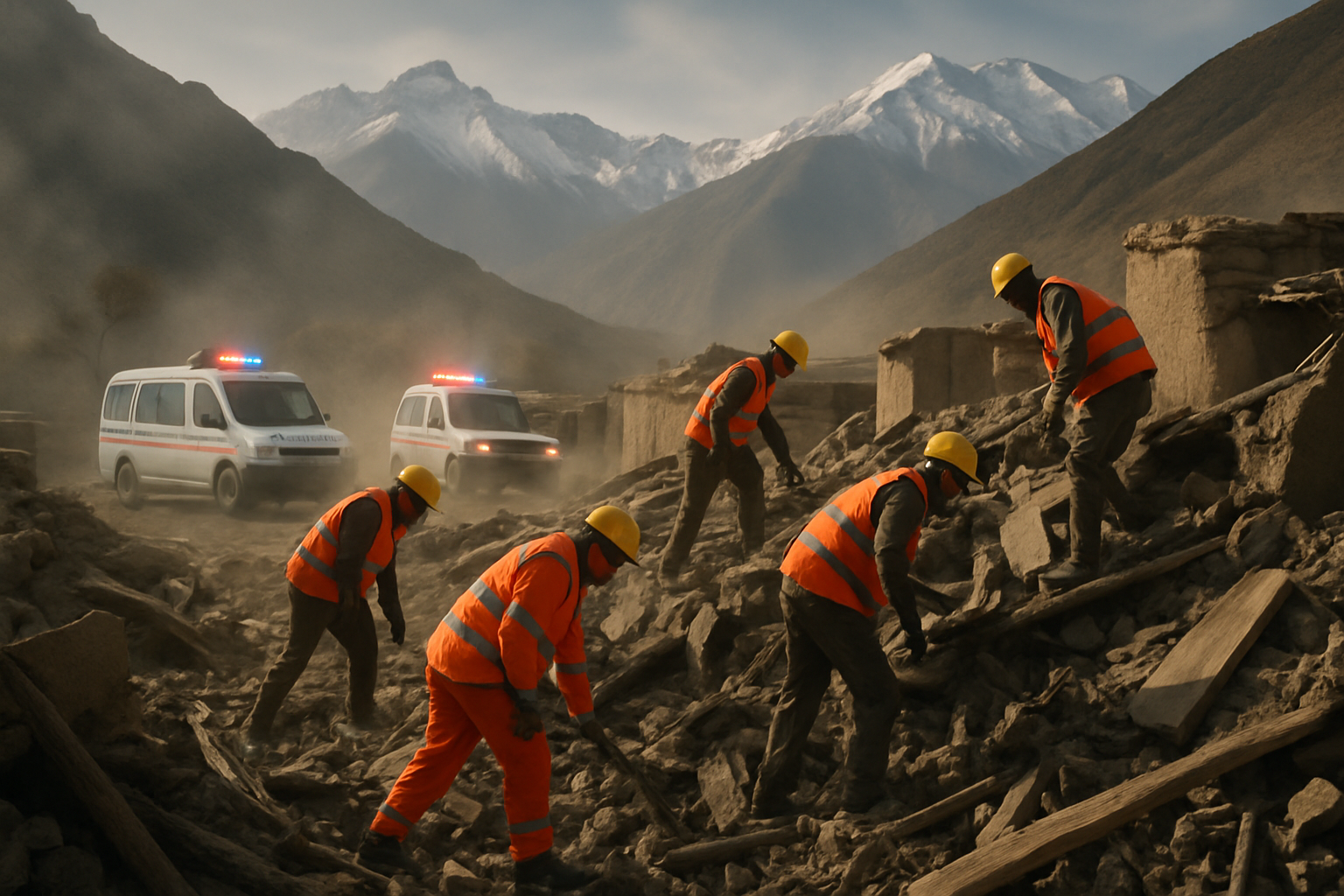
A magnitude 5.9 earthquake struck Afghanistan's Hindu Kush region Friday night, killing at least eight people including children when their house collapsed in Kabul's Bagrami district, according to Afghanistan's National Disaster Management Authority and international seismic monitoring stations.
The earthquake, which occurred at 177 kilometers depth according to the German Research Centre for Geosciences (GFZ), was felt across a vast area including Pakistan's capital Islamabad and India's New Delhi. The victims were members of a single family in the Gosfand Dara area of Bagrami district, with local sources reporting one additional person initially missing after the house collapse.
Regional Impact and Seismic Activity
The powerful tremors, striking the tectonically active Hindu Kush mountain region, were felt across multiple countries demonstrating the earthquake's significant reach. Witnesses reported strong ground shaking not only in Afghanistan's capital but also in major population centers hundreds of kilometers away, including Pakistan's Islamabad and India's New Delhi.
The earthquake's epicenter was located in the mountainous Hindu Kush region, an area known for frequent seismic activity due to the complex interaction between the Eurasian and Indian tectonic plates. This geological positioning makes Afghanistan one of the world's most earthquake-prone countries, averaging approximately 560 earthquake-related deaths annually according to historical data.
Afghanistan's Ongoing Seismic Vulnerability
This latest tragedy adds to Afghanistan's mounting earthquake casualties in recent months. The country has experienced a series of devastating seismic events, including a magnitude 6.3 earthquake in November 2025 that killed 27 people and destroyed hundreds of houses, and a February 2026 Hindu Kush earthquake that further highlighted the region's geological instability.
The February 2026 Kunar Province earthquake recovery crisis has left 25,000 children still living in temporary tents six months after the devastating August 31, 2025 earthquake that killed over 2,000 people and destroyed or damaged 8,000 homes. Heavy winter snowfall has damaged many tents, worsening conditions for displaced families who face an uncertain reconstruction timeline.
"The earthquake was felt strongly across the region, and we are working to assess the full extent of damage and casualties."
— National Disaster Management Authority spokesperson
Humanitarian Crisis Compounds Earthquake Impact
The earthquake strikes Afghanistan during its worst humanitarian crisis in 25 years, with 88% of female-headed households unable to meet minimum living requirements compared to 75% of the general population. International aid cuts have forced hundreds of health center closures, with the World Health Organization (WHO) delivering medical oxygen to only 23 hospitals as of February 2026.
The disaster management response comes amid ongoing challenges including the Taliban administration's restrictions on international aid operations and the country's severely strained healthcare system. The International Federation of Red Cross and Red Crescent Societies (IFRC) served over 2 million people in 2025, supporting 128+ healthcare centers, but capacity remains overwhelmed by successive disasters.
Geological Context and Regional Seismic Activity
Afghanistan's position at the intersection of major tectonic plates makes it particularly susceptible to earthquake activity. The Hindu Kush region, where Friday's earthquake occurred, represents one of the most seismically active areas in Central Asia, with the ongoing collision between the Indian and Eurasian plates generating frequent tremors.
Recent seismic activity across the broader region has included earthquakes in neighboring countries throughout early 2026. Algeria experienced a magnitude 3.5 earthquake in February, while Russia's Krasnodar region was hit by a magnitude 4.8 earthquake the same month. The Balkans region also experienced a magnitude 4.8 earthquake in North Macedonia that was felt across Kosovo and Albania.
Emergency Response and International Monitoring
Afghan authorities have appealed for citizens to remain cautious due to possible building instability and aftershock potential. The country's National Disaster Management Authority continues coordinating rescue operations despite limited resources and challenging conditions.
International seismological networks, including the German Research Centre for Geosciences and the United States Geological Survey (USGS), provide critical earthquake monitoring for the region. These systems enable rapid detection and analysis of seismic events, though the remote mountainous terrain often complicates immediate damage assessment.
Climate Change and Compound Disasters
The earthquake occurs during a period of unprecedented global climate volatility, with January 2026 marking the 18th consecutive month of global temperatures exceeding 1.5°C above pre-industrial levels. This creates additional environmental stresses for earthquake survivors, including increased heating needs, water disruptions, and agricultural challenges affecting displaced families in temporary shelters.
Emergency management experts have identified a fundamental shift toward "compound disasters" - multiple emergency types occurring simultaneously across geographic areas, challenging traditional resource allocation and mutual aid mechanisms designed for sequential rather than concurrent global crises.
Long-term Recovery Challenges
Afghanistan faces significant obstacles in earthquake recovery and preparedness. The combination of political instability, economic sanctions, limited international aid access, and ongoing security concerns creates a complex environment for disaster response and reconstruction efforts.
Many communities affected by previous earthquakes, particularly in remote mountainous areas like Kunar Province, have seen minimal reconstruction progress. Some villages may never be rebuilt due to geographical constraints, seismic risks, and limited resources, potentially requiring permanent relocation for affected communities.
The international community continues to provide humanitarian assistance despite political complexities, with countries like India recently delivering medical supplies and equipment to support treatment of disaster victims. However, sustained international attention and resources remain essential for addressing Afghanistan's ongoing vulnerability to natural disasters.