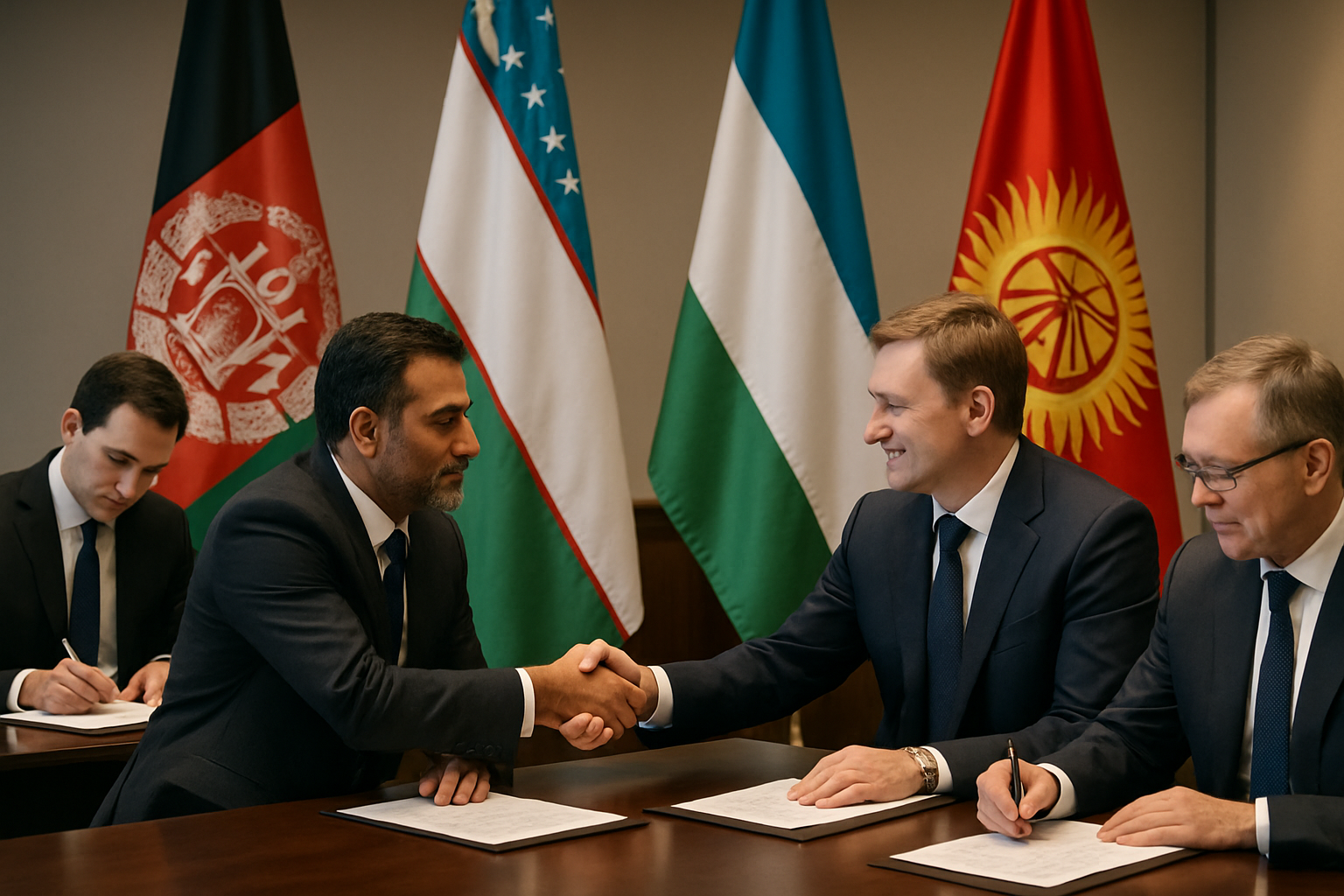
Afghanistan continues to expand its economic cooperation with Central Asian neighbors, with recent high-level meetings and business agreements marking significant progress in regional trade partnerships despite ongoing international challenges.
Three separate but interconnected developments this week highlight Afghanistan's growing economic integration with its northern neighbors. Business representatives from Afghanistan and Uzbekistan signed 10 trade agreements worth more than $65 million during a joint forum in Kokand, Uzbekistan's Fergana region, according to Afghanistan's Chamber of Commerce and Investment. Simultaneously, high-level diplomatic meetings focused on strengthening ties in both the health and trade sectors.
Healthcare Cooperation with Uzbekistan
Afghanistan's Minister of Public Health, Noor Jalal Jalali, held extensive talks with Abdullah Azizov, head of Uzbekistan's pharmaceutical industry development authority, in Kabul. The discussions centered on expanding cooperation across multiple health sector areas, including pharmaceutical trade facilitation, travel arrangements for Afghan patients seeking treatment in Uzbekistan, and enhanced capacity building for health workers.
"Sustained cooperation could help strengthen health systems and respond more effectively to the needs of the population."
— Noor Jalal Jalali, Afghanistan Minister of Public Health
The health sector partnership builds on a previously signed memorandum of understanding between the two countries and includes provisions for encouraging investment in pharmaceutical production within Afghanistan. Minister Jalali emphasized the critical importance of ensuring medicine quality and providing standardized healthcare services through improved coordination between the nations.
Kyrgyzstan Sets Ambitious Trade Target
In a separate but equally significant development, Afghanistan's Minister of Industry and Commerce, Nooruddin Azizi, met with Kyrgyzstan's Deputy Foreign Minister Kairat Tursunkulov in Kabul to discuss expanding economic and trade relationships. The meeting, also attended by Kyrgyzstan's ambassador to Afghanistan Turdakun Sadykov, focused on strengthening bilateral trade cooperation.
Both sides welcomed the steady growth in trade between Afghanistan and Kyrgyzstan in recent years and established a strategic goal of increasing bilateral trade to reach $1 billion. Deputy Foreign Minister Tursunkulov described the two nations as "brotherly countries" with strong cultural connections and extended a formal invitation for Minister Azizi to visit Kyrgyzstan to further enhance collaboration.
Minister Azizi expressed appreciation for Kyrgyzstan's participation in the recent Afghanistan–Central Asia consultative meeting and underlined the importance of expanding bilateral trade and economic cooperation beyond current levels.
Building on Previous Momentum
These recent developments build on substantial progress made earlier in 2026. In February, Afghanistan and Uzbekistan signed 25 comprehensive trade agreements worth $300 million, followed by an additional $514.8 million in agreements signed in March during a major connectivity conference. The February framework included preferential trade arrangements covering eight Afghan export items and six Uzbek products.
The momentum reflects Afghanistan's participation in the Afghanistan–Central Asia Consultative Dialogue launched in April 2026, which brought together representatives from five Central Asian nations. Foreign Minister Amir Khan Muttaqi announced an ambitious $10 billion trade target within 3-4 years, up from current levels estimated at $2.7 billion in 2025.
Strategic Infrastructure Development
The trade partnerships are supported by significant infrastructure developments designed to enhance regional connectivity. The Uzbekistan-Afghanistan-Pakistan railway project enables Central Asian access to Pakistani ports via the Gwadar port and China-Pakistan Economic Corridor (CPEC) framework, positioning Afghanistan as a crucial transit hub connecting Central Asia to global markets.
Afghanistan's rail freight connections with Iran increased dramatically during the 1404 solar year (March 2025-February 2026), with 650,000 tons of goods transported including 150,000 tons of transit cargo from third countries—representing a 17-fold increase over previous levels.
Regional Economic Integration Context
Afghanistan's expanding trade relationships occur within the broader context of Central Asia's emergence as a strategic economic region. Kazakhstan secured a World Bank Group partnership framework for 2026-2031 with up to $1 billion in annual financing, while Uzbekistan's banking sector has shown robust growth with a 604 trillion soums loan portfolio representing a 13% increase.
The success of Afghanistan's regional partnerships demonstrates pragmatic economic cooperation transcending political complexities. Regular consultation mechanisms, working groups, and investment committees provide institutional frameworks for sustained partnership development beyond individual meetings.
Challenges and Implementation
Despite the positive developments, implementation faces significant challenges. Afghanistan continues to deal with humanitarian pressures, with UN Development Programme reports indicating that 88% of female-headed households cannot meet minimum living requirements compared to 75% of the general population.
International sanctions and banking restrictions complicate financial transactions, while border tensions with Pakistan affecting regional stability demonstrate the complex environment in which these partnerships must operate. However, the continued expansion of trade relationships suggests that economic cooperation provides a pathway for sustainable engagement.
Looking Ahead
The recent agreements represent more than simple commercial transactions—they establish templates for 21st-century diplomatic innovation demonstrating that economic cooperation can transcend political complexities. The institutional mechanisms being developed, including regular consultations, technical working groups, and joint investment committees, provide continuity beyond individual agreements.
As Central Asian nations increasingly position themselves as strategic economic players on the global stage, Afghanistan's integration into regional trade networks offers supply chain diversification alternatives and strengthens institutional cooperation frameworks. The success of these partnerships could influence similar regional integration efforts worldwide, demonstrating how practical cooperation can balance sovereignty concerns with collaborative benefits.
The convergence of healthcare cooperation with Uzbekistan, ambitious trade targets with Kyrgyzstan, and substantial business agreements represents Afghanistan's comprehensive approach to regional economic integration. As these partnerships mature, they may provide valuable lessons for sustainable development cooperation in complex geopolitical environments.