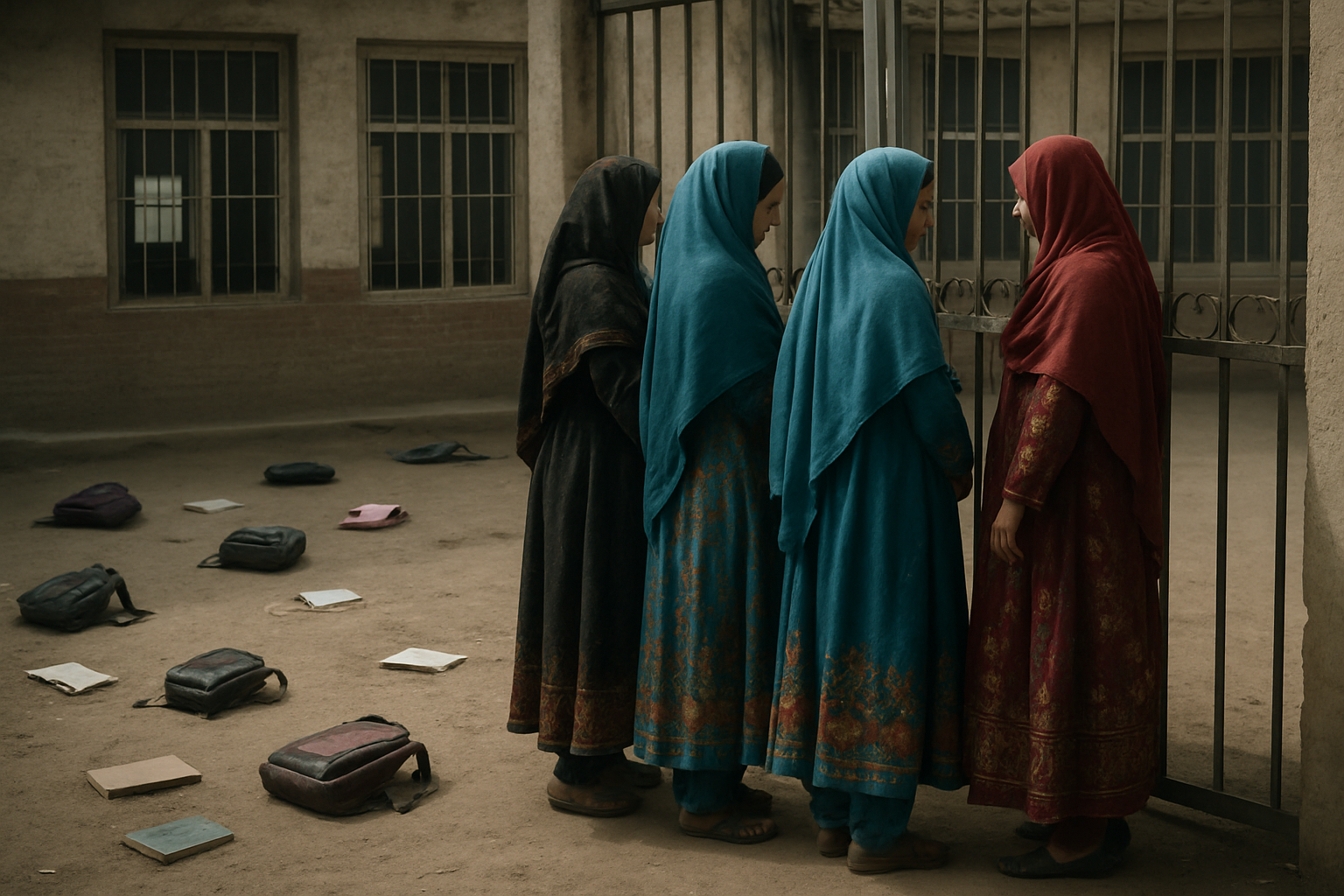
A devastating new report by the Afghanistan Human Rights Center documents the systematic deterioration of human rights across the country, with women, journalists, activists and former security personnel bearing the brunt of escalating repression that has created what experts describe as a "widening climate of fear" nearly five years after the Taliban's return to power.
The comprehensive assessment, released as international attention focuses on Afghanistan's unprecedented humanitarian crisis, reveals how restrictions initially framed as temporary measures have evolved into a systematic dismantling of civil liberties that now affects every aspect of Afghan society. The report comes as Afghanistan ranks dead last—181st out of 181 countries—in the Georgetown Institute's Women, Peace and Security Index, marking the most severe rollback of women's rights in modern history.
Women and Girls Face Harshest Restrictions
The report identifies women and girls as facing "the harshest forms" of systematic violation, with restrictions extending far beyond the widely publicized education bans. According to UN Development Programme assessments, 88% of female-headed households are unable to meet minimum living requirements, compared to 75% of the general population—a disparity that underscores how gender-specific policies have created acute economic vulnerability.
Former Afghanistan Human Rights Commission chief Sima Samar issued a stark warning during a recent online event, arguing that "men in Afghanistan have failed to meaningfully resist the continued denial of education to girls and women." Samar emphasized that "years of silence have deepened the country's social and human rights crisis," particularly as the fifth anniversary of the education ban approaches.
"The systematic exclusion affects approximately half of Afghanistan's potential labor force since August 2021, creating structural economic damage that affects the entire population."
— UN Special Rapporteur Richard Bennett
The economic implications extend far beyond individual hardship. The systematic workforce exclusion affects approximately half of Afghanistan's potential labor force, creating what UN Special Rapporteur Richard Bennett describes as "structural economic damage affecting the entire population." This deliberate removal of women from economic participation has contributed to a collapse in bilateral trade—Pakistan-Afghanistan commerce has dropped by 59%, from $550 million to $228 million over seven months.
Healthcare System on Brink of Collapse
Perhaps nowhere is the crisis more acute than in Afghanistan's devastated healthcare system. The World Health Organization delivered medical oxygen to only 23 hospitals in February 2026—12 in Kabul and 11 across the provinces—highlighting the system's near-total collapse. Hundreds of health centers have been forced to close due to international aid cuts during what WHO describes as the "worst humanitarian crisis in 25 years."
The situation is further complicated by Taliban Order No. 12, which banned women from working with national and international civil society organizations. This restriction has created what Bennett warns is an "acute shortage of female medical professionals" at a time when cultural and religious norms require female patients to be treated by female healthcare providers.
The International Federation of Red Cross and Red Crescent Societies (IFRC) managed to serve 2+ million people in 2025, supporting 128+ healthcare centers, but the exclusion of female staff severely hampers the ability to reach vulnerable populations, particularly women and children who comprise the majority of those in need.
Mines and Unexploded Ordnance Crisis
Adding another layer to Afghanistan's humanitarian emergency, UN Special Rapporteur Richard Bennett has called for increased international funding for mine clearance and unexploded ordnance removal. His appeal, timed with the International Day for Mine Awareness and Assistance in Mine Action on April 4, emphasizes that Afghanistan remains "one of the world's most heavily contaminated countries."
The presence of landmines and unexploded ordnance particularly affects rural communities, limiting agricultural productivity and restricting freedom of movement in a country where 88% of female-headed households already struggle to meet basic living requirements. The contamination represents decades of conflict but has become more dangerous as traditional demining programs face funding shortfalls.
International Response and Accountability
The international community's response has evolved significantly since the Taliban's return to power. The UN Security Council recently approved only a three-month extension of the UN Assistance Mission in Afghanistan (UNAMA) mandate—a dramatic departure from the usual annual renewals—reflecting mounting frustration with the lack of progress on human rights.
UN Women has condemned the Taliban's systematic restrictions as "serious violations of human rights" that deepen gender-based violence and worsen humanitarian conditions. The organization's Special Representative Susan Ferguson has described the cumulative effect of these policies as creating an environment where fundamental human rights are systematically denied.
"The restrictions violate fundamental human rights and potentially constitute crimes under international law, challenging both international human rights frameworks and authentic Islamic principles."
— International Legal Experts
International legal experts argue that the systematic nature of these restrictions violates fundamental human rights and potentially constitutes crimes under international law. The restrictions, they contend, challenge both international human rights frameworks and what global Islamic scholars describe as authentic Islamic principles that emphasize education and women's participation in society.
Regional Security Implications
The human rights crisis intersects with broader regional security concerns that complicate international engagement. Despite Taliban claims of having defeated terrorism, Chinese representatives at the UN have warned about the continued presence of ISIS-K, al-Qaeda, and the East Turkestan Islamic Movement (ETIM) operating from Afghan territory.
These security concerns have been highlighted by recent border clashes between Pakistan and Afghanistan that resulted in 289 civilian casualties and displaced over 115,000 people since late February. The violence has disrupted traditional trade routes and further isolated Afghanistan from regional economic integration.
Humanitarian Crisis Deepens
The convergence of human rights restrictions, economic collapse, and security challenges has created what aid organizations describe as a perfect storm of humanitarian need. The World Food Programme has been forced to turn away three out of four hungry and malnourished children due to budget shortfalls—a situation that represents a fundamental failure of the global humanitarian architecture when organizations must choose which children to help based on funding rather than need.
UNICEF reports treating 610,000 severely malnourished children in the past year, while the overall humanitarian picture continues to deteriorate. The systematic exclusion of women from humanitarian work has made it increasingly difficult for aid organizations to reach vulnerable populations, particularly women and children who make up the majority of those requiring assistance.
The Path Forward
As Afghanistan approaches the fifth anniversary of the Taliban's return to power in August 2026, the international community faces critical decisions about engagement strategies. The recent three-month UNAMA extension reflects a broader recalibration of international approaches, with some countries advocating for increased humanitarian engagement while others maintain that meaningful relations must be contingent on governance and human rights improvements.
The case of Afghanistan has become what observers describe as a global test of international commitment to gender equality and human rights in the 21st century. The systematic nature of the restrictions, their comprehensive scope, and their devastating impact on the population represent challenges that extend far beyond national boundaries to fundamental questions about human dignity and equality.
Former President Hamid Karzai has warned that continued restrictions could "seriously damage Afghanistan's stability and future progress," describing education as a "basic pillar" of development. His warnings underscore how the current crisis affects not only individual rights but the country's long-term prospects for stability and prosperity.
International Cooperation and Innovation
Despite the challenging political environment, some forms of international cooperation continue. Organizations like the IFRC and various UN agencies have adapted their operations to provide services while navigating political constraints. The $9.4 million JICA-UNOPS climate resilience agreement demonstrates that certain forms of technical cooperation can continue even amid diplomatic tensions.
However, the fundamental challenge remains the systematic exclusion of half the population from public life, economic participation, and basic services. Until this core issue is addressed, experts warn that Afghanistan will continue to face interconnected crises that affect not only its own population but regional and global stability.
As the international community prepares for the next phase of engagement with Afghanistan, the reports released this week serve as a stark reminder that the human rights situation continues to deteriorate across multiple dimensions, demanding both immediate humanitarian action and long-term strategies for protecting the fundamental rights of all Afghans.