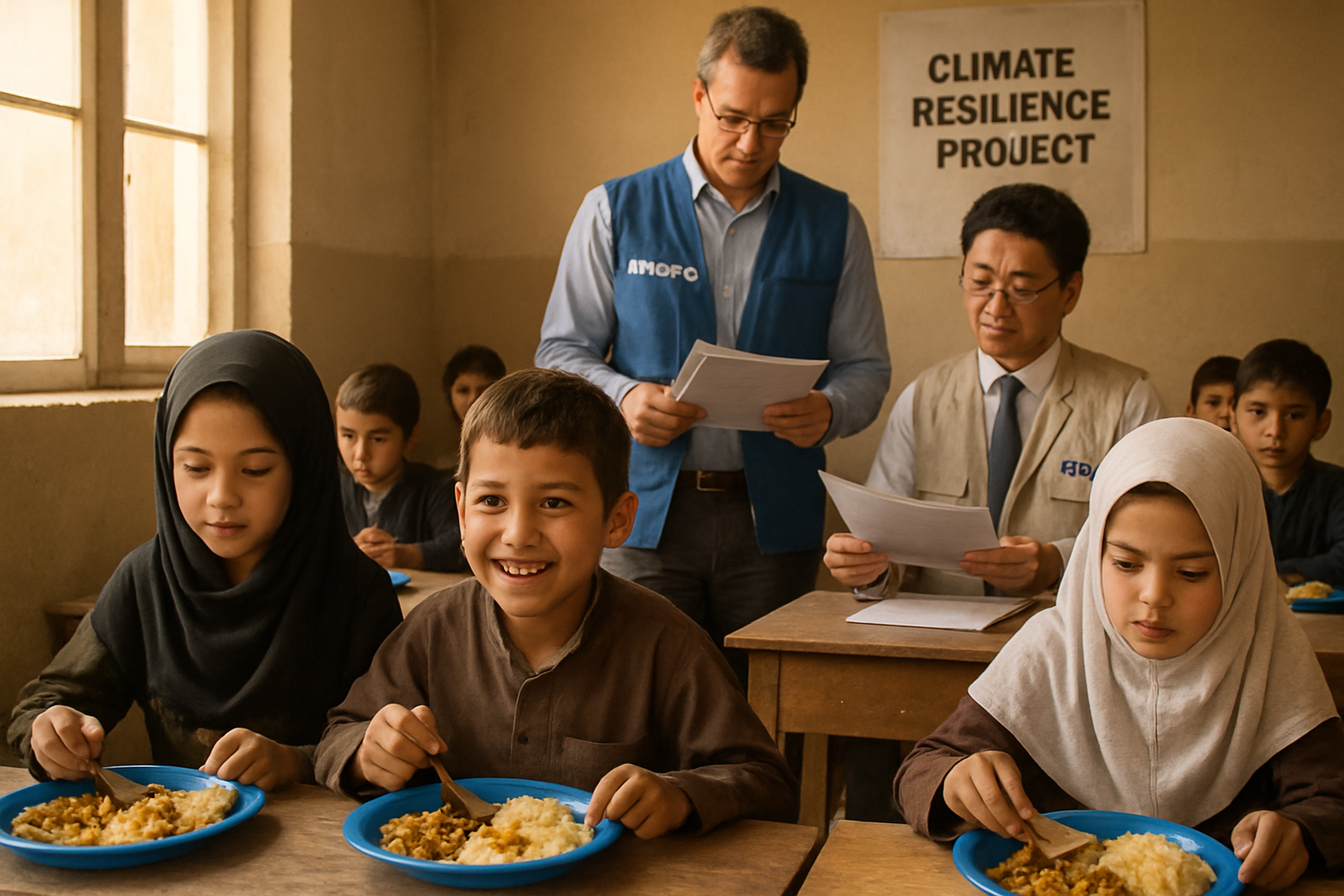
Afghanistan received significant international support in February 2026 as Japan and the United Nations Office for Project Services (UNOPS) committed $10 million for climate resilience projects, while the World Food Programme provided school meals to 880,000 children nationwide amid the country's implementation of new anti-drug legislation.
The multi-pronged humanitarian and development assistance comes as Afghanistan continues to face what the United Nations has described as one of the worst humanitarian crises in 25 years, with hundreds of health centers forced to close due to international aid cuts affecting women and children most severely.
Major Climate Adaptation Investment
Japan's International Cooperation Agency (JICA) and UNOPS signed a landmark $9.4 million grant agreement aimed at strengthening climate adaptation and disaster preparedness across vulnerable Afghan communities. The partnership, valued at 1.474 billion Japanese yen, was formalized by UNOPS Afghanistan Country Director Katy Ann Webley and JICA Afghanistan Chief Representative Sota Tosaka.
The project, focused primarily in Kabul province, aims to improve local communities' capacity to cope with climate change impacts and natural disasters. This represents one of the largest climate resilience investments in Afghanistan since the Taliban's return to power in 2021, demonstrating continued international commitment to addressing humanitarian needs despite political complexities.
"This initiative will run for two years and focuses on improving community disaster response capacity in Afghanistan."
— JICA Afghanistan Office
School Feeding Programme Reaches Nearly One Million Children
The World Food Programme announced that it successfully provided school meals to approximately 880,000 children across Afghanistan during 2025 through its nationwide nutrition programme. This massive undertaking supports education access amid worsening hunger and economic hardship affecting millions of Afghans.
The school feeding initiative represents a critical lifeline for Afghan families struggling with food insecurity, while simultaneously encouraging school attendance in a country where educational access, particularly for girls, remains severely restricted under current policies.
WFP emphasized that the programme aims to address both immediate nutritional needs and longer-term educational outcomes, providing essential calories and nutrients to children while creating incentives for families to send their children to school despite economic pressures.
New Drug Laws Impose Stricter Penalties
Afghanistan implemented new penalties for drug use and trafficking under recently introduced penal code provisions, imposing prison terms as drug consumption patterns shift toward synthetic substances. Under the Taliban's updated legal framework, individuals using narcotic substances can face up to six months in prison depending on their condition and circumstances.
Drug sellers face significantly tougher punishment under the new regulations, reflecting the Taliban administration's continued emphasis on counter-narcotics efforts. The implementation comes as Afghanistan has dramatically reduced opium cultivation to near-zero levels per Supreme Leader decree, achieving what international observers describe as unprecedented success in counter-narcotics operations.
The legal changes occur as drug consumption patterns in Afghanistan shift toward synthetic substances, requiring adapted enforcement approaches. Regional neighbors have noted spillover effects from Afghanistan's security situation, with Pakistan conducting major counter-terrorism operations in Balochistan that resulted in over 400 militant casualties in February 2026.
Broader Humanitarian Context
These developments unfold against the backdrop of Afghanistan's complex humanitarian and security landscape. Recent memory from our coverage shows that WHO delivered critical medical oxygen supplies to 23 hospitals across Afghanistan in early February, addressing severe healthcare shortages that forced hundreds of health center closures nationwide.
The international community continues to grapple with balancing humanitarian assistance with political concerns. China recently warned the UN Security Council about severe terrorist threats in Afghanistan, citing continued presence of ISIS-K, al-Qaeda, and other militant groups, despite Taliban claims of having defeated such organizations.
Afghanistan's diplomatic engagement has shown some positive developments, with Azerbaijan recently releasing 14 Afghan nationals from its prisons following efforts by Afghanistan's embassy in Baku, representing functional bilateral relationship management despite the country's complex international status.
International Aid Architecture
The February 2026 aid commitments demonstrate evolving international approaches to Afghanistan assistance. Japan's climate resilience investment reflects recognition that humanitarian needs extend beyond immediate food and medical aid to include long-term adaptation capacity building.
The JICA-UNOPS partnership model provides a framework for development assistance that focuses on technical capacity building and community-level resilience rather than direct government-to-government aid, allowing international partners to maintain humanitarian engagement while navigating political sensitivities.
WFP's school feeding programme represents one of the few large-scale international operations continuing to function effectively in Afghanistan, providing both immediate humanitarian relief and supporting longer-term development objectives through education incentives.
Economic and Social Implications
The combined impact of climate adaptation investment, school feeding programmes, and drug law enforcement reflects Afghanistan's multifaceted challenges requiring coordinated responses. Economic hardship continues to affect household food spending, with families struggling to meet basic nutritional needs amid limited employment opportunities.
International aid cuts have created a healthcare vacuum particularly affecting women and children, making programmes like WFP's school feeding initiative increasingly critical for public health outcomes. The climate resilience investment acknowledges Afghanistan's vulnerability to natural disasters, which disproportionately affect already vulnerable populations.
The new drug laws, while demonstrating administrative capacity, also highlight the complex social challenges facing Afghanistan as traditional opium-based economies transition and synthetic drug use patterns emerge, requiring comprehensive public health approaches alongside law enforcement.
Looking Forward
Afghanistan's February 2026 developments illustrate the intersection of humanitarian assistance, climate adaptation, and governance challenges in a complex post-conflict environment. The international community's continued engagement through organizations like WFP, UNOPS, and JICA demonstrates sustained commitment to addressing civilian needs despite political uncertainties.
The success of these programmes will depend on continued international funding, effective implementation in challenging security conditions, and the development of sustainable local capacity. As Afghanistan faces what experts describe as convergent humanitarian, security, and climate challenges, coordinated international responses become increasingly critical for supporting the Afghan population's basic needs and long-term resilience.