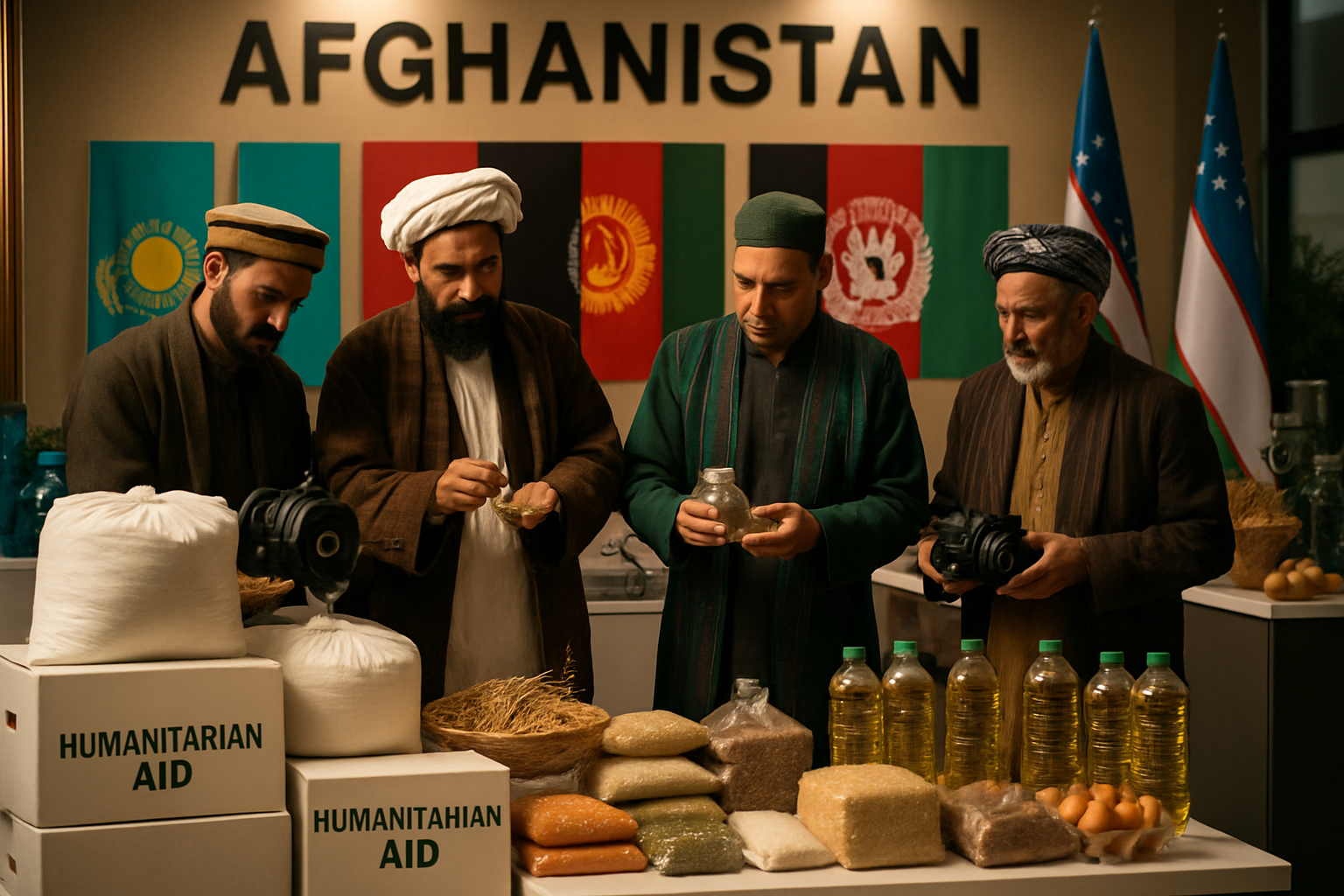
Afghanistan demonstrated its economic potential at a major Central Asian trade exposition while simultaneously receiving critical humanitarian funding, highlighting the complex dual reality of a nation striving for regional integration amid one of the world's most severe humanitarian crises.
The country's participation in INNOPROM Central Asia, one of the region's largest industrial platforms, saw Minister of Industry and Commerce Nuruddin Azizi lead a delegation to Uzbekistan showcasing Afghanistan's industrial capabilities. More than 60 Afghan companies participated, representing sectors including cotton, coal, pharmaceuticals, and agricultural products, signaling Afghanistan's determination to strengthen regional trade ties despite ongoing challenges.
Trade Expansion Amid Economic Hardship
The exhibition brings together government officials, investors, and manufacturers from across Central Asia and beyond, including participants from Russia, Belarus, Kazakhstan, Kyrgyzstan, and Tajikistan. Afghanistan's strong showing builds on the remarkable $814 million in bilateral cooperation agreements secured with Central Asian partners throughout 2026, including a foundational $300 million framework with Uzbekistan in February and additional $514.8 million in connectivity agreements in March.
This economic momentum occurs against the backdrop of Afghanistan's positioning as a strategic transit hub. The Afghanistan-Iran rail freight system has increased 17-fold, handling 650,000 tons of goods including 150,000 tons of transit cargo from third countries. Meanwhile, the planned Uzbekistan-Afghanistan-Pakistan railway project promises to enable Central Asian access to Pakistani ports via the China-Pakistan Economic Corridor (CPEC).
The Afghanistan-Central Asia Consultative Dialogue has set an ambitious target of $10 billion in trade within 3-4 years, up from current levels of $2.7 billion, demonstrating the region's commitment to deeper economic integration despite political complexities.
Humanitarian Crisis Deepens
While Afghanistan pursues regional trade opportunities, the humanitarian situation remains dire. The Afghanistan Humanitarian Fund (AHF) allocated $73.5 million through eight targeted disbursements in 2025, providing critical assistance to millions affected by crises including earthquakes, displacement, and cross-border returns.
The fund's flexible funding mechanisms enabled both rapid emergency response and longer-term humanitarian programs, reaching vulnerable communities including women, men, and children across the country. However, the scale of need continues to outpace available resources, with 88% of female-headed households unable to meet minimum living requirements compared to 75% of the general population.
Healthcare infrastructure remains severely compromised, with the World Health Organization delivering emergency medical oxygen to only 23 hospitals nationwide—12 in Kabul and 11 across provinces. Hundreds of health centers have closed due to funding cuts, creating critical gaps in medical service delivery during what UN officials describe as the worst humanitarian crisis in 25 years.
Climate Pressures Mount
Adding to Afghanistan's challenges, a recent webinar series hosted by the United Nations Assistance Mission in Afghanistan (UNAMA) highlighted the escalating impact of climate change on humanitarian needs and livelihoods. The six-part series brought together Afghan experts, humanitarian workers, and international stakeholders to examine mounting environmental pressures and explore potential responses.
Afghanistan is widely regarded as one of the countries most vulnerable to climate change, with severely limited capacity to manage its effects. The discussions emphasized that nearly 70 percent of the population depends on climate-sensitive agriculture, leaving livelihoods exposed to shifting weather patterns.
Recent devastating weather events underscore these vulnerabilities. Floods across 20+ provinces in early April killed 99 people and injured 154 others, according to the National Disaster Management Authority. The disasters occurred during the 22nd consecutive month of global temperatures exceeding 1.5°C above pre-industrial levels—the longest sustained warming period in recorded history.
Infrastructure Vulnerabilities Exposed
The climate disasters have exposed critical infrastructure weaknesses. Traditional mud-brick and stone construction methods are proving inadequate for intensified precipitation and extreme weather events. Emergency response capabilities remain constrained by limited resources, poor infrastructure, and restricted international access.
Traditional building techniques, designed for historical climate patterns, cannot withstand the new reality of climate change-intensified weather. The convergence of natural disasters, economic collapse, and systematic restrictions creates compound emergencies that sequential-crisis management systems struggle to address effectively.
Regional Diplomatic Complexities
Afghanistan's economic aspirations face additional challenges from regional tensions. A separate Pentagon review of the U.S. military withdrawal from Afghanistan, expected to be finalized in coming months, continues to influence international perceptions and policy approaches toward the country.
Despite these political complexities, Afghanistan's regional partners appear committed to pragmatic economic engagement. The success of trade relationships demonstrates that economic cooperation can transcend political differences when there are clear mutual benefits and proper institutional frameworks in place.
Chinese warnings about the continued presence of ISIS-K, al-Qaeda, and the East Turkestan Islamic Movement (ETIM) complicate the security picture, contradicting Taliban claims that terrorism has been defeated within Afghanistan's borders. These security concerns require careful management to maintain the confidence of regional trading partners.
International Engagement Models
The current situation in Afghanistan presents a template for how the international community might engage with complex political situations while addressing urgent humanitarian needs. The dual approach—maintaining economic cooperation while providing humanitarian assistance—demonstrates a practical framework for managing competing priorities.
The success of organizations like the Afghanistan Humanitarian Fund and the International Federation of Red Cross and Red Crescent Societies, which served over 2 million people in 2025 through 128+ healthcare centers, shows that effective humanitarian work can continue even in challenging political circumstances.
Looking Forward
Afghanistan's participation in regional economic initiatives while grappling with severe humanitarian and climate challenges illustrates the complexity of 21st-century development challenges. The country's determination to maintain economic relationships and pursue regional integration, despite overwhelming internal difficulties, demonstrates remarkable resilience.
The convergence of climate disasters, humanitarian emergencies, and economic opportunities in Afghanistan serves as a preview of challenges facing vulnerable nations worldwide as environmental pressures intensify. The international community's response—balancing economic engagement with humanitarian support—may provide important lessons for managing similar situations globally.
Success in Afghanistan will depend on sustained international cooperation, enhanced coordination between humanitarian and economic initiatives, and recognition that climate adaptation must be central to any long-term development strategy. The window for building resilient systems is narrowing rapidly as environmental pressures continue to mount, making coordinated action more urgent than ever.