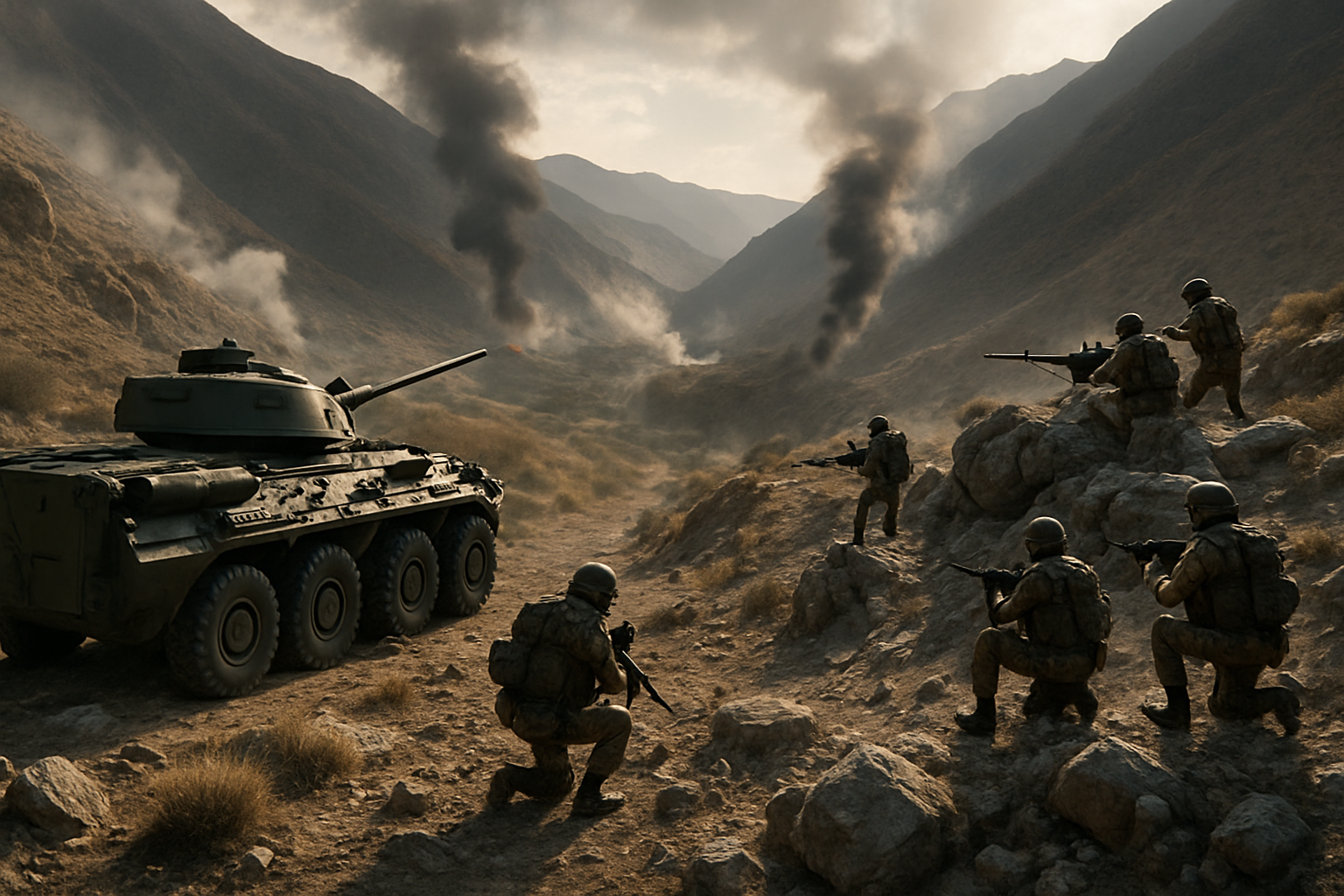
Afghanistan launched unprecedented large-scale military operations against Pakistani positions along the disputed Durand Line on Thursday, with Taliban spokesman Zabihullah Mujahid claiming 40 Pakistani soldiers killed and 15 military posts captured in what represents the most serious border escalation in recent months.
The cross-border offensive, described by Mujahid as retaliation for recent Pakistani airstrikes, marks a dramatic escalation in the deteriorating relationship between the neighboring countries. Pakistani forces quickly responded with their own counter-operations, with Information Minister Attaullah Tarar confirming two Pakistani security personnel killed and at least 36 Taliban operatives eliminated in the ensuing clashes.
Taliban Claims Major Battlefield Success
Taliban spokesman Zabihullah Mujahid announced the large-scale operation through social media, stating that Taliban forces had "launched extensive operations targeting Pakistani military centers and installations along the Durand Line" in response to recent Pakistani violations. The operation was described as encompassing multiple provinces along the Afghanistan-Pakistan border, including Khost, Paktia, and Nuristan.
Afghan military sources told Al Jazeera that 13 border outposts were captured during the operations, though Pakistan denied that any posts were seized. The conflicting casualty figures and territorial claims highlight the disputed nature of the confrontation, with both sides providing dramatically different accounts of the fighting.
"Afghan forces opened fire on posts in Pakistan's mountainous northwest, sparking more than two hours of fighting before Pakistani troops retaliated."
— Pakistani Official, speaking anonymously
Pakistani Counter-Response and Casualties
Pakistani authorities swiftly responded to the Taliban offensive, with the Ministry of Information and Broadcasting confirming that Pakistan forces "destroyed multiple posts and equipment in Afghanistan" in what they characterized as an "immediate and effective response" to the Taliban's "unprovoked action."
Information Minister Attaullah Tarar provided updated casualty figures, stating that two Pakistani security personnel were martyred while at least 36 Taliban operatives were killed during the ongoing clashes. Three Pakistani security personnel were also reported injured, with additional casualties reported on the Afghan side.
Videos shared by both Afghan and Pakistani security forces showed nighttime combat operations, with footage revealing Humvees moving through mountainous terrain illuminated by muzzle flashes and tracer rounds arcing across the border region.
Context of Escalating Border Tensions
The latest confrontation represents the culmination of weeks of escalating tensions following a series of cross-border incidents. On February 22, Pakistan conducted airstrikes on seven terrorist camps in Afghanistan's Nangarhar and Paktika provinces, killing over 80 militants according to Pakistani sources but also resulting in significant civilian casualties, including 18 civilians and eight schoolchildren.
Those Pakistani airstrikes were themselves retaliation for the February 16 Bajaur district attack that killed 11 Pakistani soldiers in a coordinated assault by the banned Tehreek-i-Taliban Pakistan (TTP) using a vehicle-borne improvised explosive device.
The cycle of violence has been exacerbated by the broader context of cross-border terrorism, with Pakistan maintaining that TTP leadership operates "with impunity from Afghan soil" despite Taliban assurances to the contrary. China's warnings to the UN Security Council about the presence of ISIS-K, al-Qaeda, and ETIM in Afghanistan have further complicated the security picture.
International Mediation Efforts Fall Short
The current escalation has occurred despite recent diplomatic efforts to reduce tensions between the two countries. In February 2026, Saudi Arabia successfully mediated the release of three Pakistani soldiers who had been captured by the Taliban during October 2025 border clashes, in what was seen as a confidence-building measure coinciding with Ramadan.
However, these diplomatic gestures have proven insufficient to address the underlying security challenges. Pakistan has acknowledged its diminished regional influence compared to wealthier powers including Turkey, the UAE, Qatar, Saudi Arabia, and China, leading to an increased reliance on military solutions.
Economic Consequences of Border Crisis
The military escalation has coincided with a devastating collapse in bilateral trade between the two countries. Pakistan's exports to Afghanistan have plunged by 59%, dropping from over $550 million to just $228 million in the first seven months of the current fiscal year, according to State Bank data.
This trade collapse represents one of the steepest bilateral trade drops in recent regional history, affecting multiple sectors and border communities that depend on cross-border commerce. Traditional trade routes through Chaman-Spin Boldak and Torkham have faced repeated closures due to security concerns.
Regional and International Implications
The escalation has drawn international attention, with Iran's Foreign Ministry offering mediation services and warning that the conflict could affect the broader region. UN Special Rapporteur Richard Bennett has expressed grave concern over civilian casualties in previous cross-border incidents.
The fighting represents a critical test of the Taliban's governance capabilities and Pakistan's resolve in addressing cross-border terrorism through military means. The situation has broader implications for regional stability, particularly given Afghanistan's strategic location and the ongoing humanitarian crisis affecting the country.
"Afghan Taliban regime's unprovoked action along the Pakistan–Afghanistan border given an immediate and effective response. Afghan Taliban miscalculated and opened unprovoked fire on multiple locations across Pakistan Afghanistan border."
— Pakistan Ministry of Information and Broadcasting
Durand Line Disputes
The current conflict is taking place along the Durand Line, the disputed 2,640-kilometer border between Afghanistan and Pakistan established in 1893. The Taliban and previous Afghan governments have never formally recognized this colonial-era boundary, viewing it as an artificial division of Pashtun tribal lands.
The mountainous and largely unmarked border has been the site of numerous clashes over the years, with both sides claiming violations by the other. The difficult terrain and limited government control in border regions have provided sanctuary for various militant groups, complicating bilateral relations and regional security.
Humanitarian Impact
The escalation comes as Afghanistan continues to face the worst humanitarian crisis in 25 years, with the UN Development Programme reporting that 88% of female-headed households are unable to meet minimum living requirements. International aid cuts have forced the closure of hundreds of health centers, creating a severe healthcare vacuum.
The border communities most affected by the fighting are among the most vulnerable populations in both countries, with limited access to basic services and economic opportunities already restricted by the ongoing security situation.
Looking Ahead
The success or failure of current military operations may determine whether the two countries pursue diplomatic solutions or further military escalation. Pakistan has indicated it will maintain its tough security policy toward Afghanistan, while the Taliban's threats of "measured and appropriate response" suggest potential for further confrontation.
The international community faces pressure to develop effective conflict prevention mechanisms before the situation deteriorates into a broader regional confrontation. The crisis tests whether innovative diplomatic frameworks can address the complex intersection of territorial sovereignty, cross-border terrorism, and regional security in the 21st century.
As both countries maintain their military positions along the disputed border, the coming days will be critical in determining whether this latest escalation can be contained or whether it represents the beginning of a more sustained military confrontation between the neighboring nations.