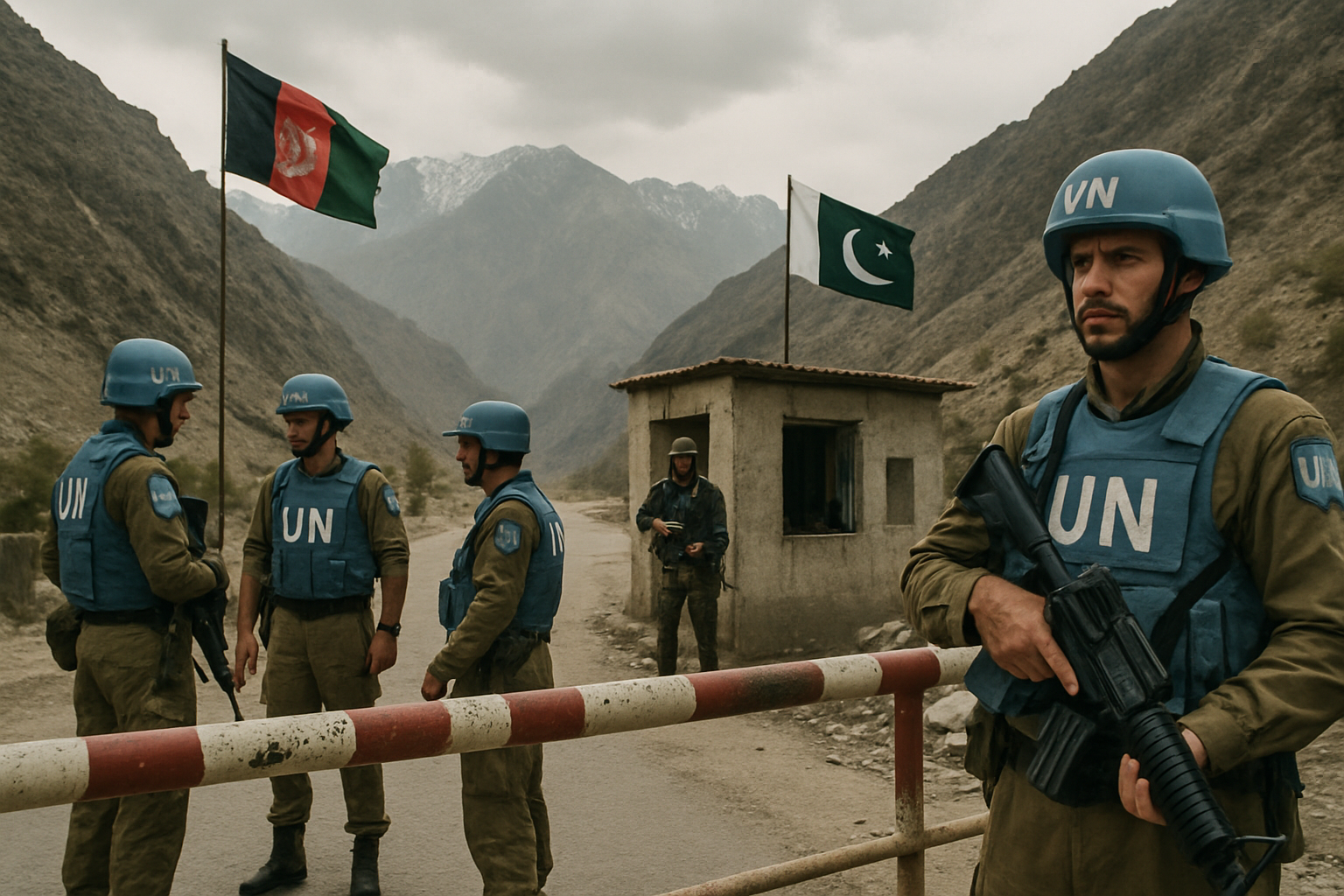
The United Nations has confirmed at least 185 Afghan civilians were killed or wounded during cross-border fighting between Taliban forces and Pakistan from February 26 to March 5, marking the deadliest escalation in the Afghanistan-Pakistan border crisis since the Taliban's return to power in 2021.
The casualties, documented by the United Nations Assistance Mission in Afghanistan (UNAMA), included 56 killed and 129 wounded, primarily from airstrikes and indirect fire during sustained clashes along the disputed 2,640-kilometer Durand Line. More than half of the victims were women and children, according to UNAMA's report released Friday.
Russian Diplomatic Intervention
As the humanitarian toll mounts, international mediation efforts have intensified. Russian Foreign Minister Sergey Lavrov held telephone discussions with Afghanistan's Foreign Minister Amir Khan Muttaqi, urging that "differences between Kabul and Islamabad should be resolved through political and diplomatic means."
The Russian Foreign Ministry statement emphasized discussions on "the prospects for reducing military and political tensions in relations between Afghanistan and Pakistan," representing the latest in a series of regional diplomatic initiatives aimed at containing the crisis.
Mass Deportations Amid Military Confrontation
The escalation has extended beyond military operations to civilian populations. Pakistani police detained more than 250 undocumented Afghan nationals in Karachi during security operations, reflecting the broader deterioration in bilateral relations since Pakistan's Defense Minister Khawaja Asif declared "open war" against the Taliban government on February 27.
This represents the most serious Pakistan-Afghanistan military confrontation since the Taliban's return to power, evolving from isolated border skirmishes into sustained warfare affecting both nations' capitals and strategic installations.
Crisis Timeline and Escalation
The current crisis began with a February 16 attack in Pakistan's Bajaur district, where Tehreek-e-Taliban Pakistan (TTP) militants killed 11 Pakistani soldiers using a vehicle-borne improvised explosive device. Pakistan responded on February 22 with airstrikes on seven alleged terrorist camps in Afghanistan's Nangarhar and Paktika provinces, claiming to have killed over 80 militants but also causing civilian casualties, including eight schoolchildren.
The Taliban government condemned the strikes as violations of Afghan sovereignty and international law, threatening a "measured and appropriate response." This led to an unprecedented escalation, with both sides conducting cross-border military operations targeting each other's infrastructure and military installations.
"The path of talks remains open, and we seek resolution through mutual understanding and respect."
— Zabihullah Mujahid, Taliban Spokesperson
Economic Devastation
The military confrontation has devastated bilateral trade, which has collapsed by 59% over seven months. Pakistan's exports to Afghanistan plummeted from $550 million to $228 million, severely affecting border communities dependent on cross-border commerce.
Traditional trade routes through Chaman-Spin Boldak and Torkham have faced repeated closures, compounding Afghanistan's humanitarian crisis where 88% of female-headed households are unable to meet minimum living requirements, according to UN data.
Failed Mediation Attempts
Despite numerous diplomatic interventions, confidence-building measures have proven insufficient. A Saudi-mediated prisoner exchange in February 2026, which saw the release of three Pakistani soldiers from Taliban custody, failed to address underlying security challenges.
Iran has offered mediation services, warning that the escalation could destabilize the broader region. Turkey's Foreign Minister Hakan Fidan has also launched mediation initiatives, contacting both Pakistani and Afghan officials as well as counterparts from Qatar and Saudi Arabia.
The Durand Line Dispute
At the heart of the conflict lies the contested Durand Line, the 2,640-kilometer colonial-era border established by Britain in 1893. Afghan governments have never formally recognized this boundary, viewing it as an artificial division of Pashtun tribal territories.
Pakistan maintains that TTP militants operate "with impunity from Afghan soil," while the Taliban denies providing sanctuary to militant groups. The porous mountainous terrain along the border has historically provided refuge for various armed groups, complicating efforts to control cross-border movement.
International Security Concerns
Chinese representatives have warned the UN Security Council about the presence of ISIS-K, al-Qaeda, and East Turkestan Islamic Movement (ETIM) militants in Afghanistan, contradicting Taliban claims of having "defeated terrorism." These warnings highlight the broader international security implications of the Afghanistan-Pakistan crisis.
Pakistan has acknowledged its diminished regional influence over Afghanistan compared to wealthier powers such as Turkey, the UAE, Qatar, Saudi Arabia, and China, leading to increased reliance on military solutions to address security concerns.
Humanitarian Impact
The World Health Organization has delivered emergency medical oxygen to 23 hospitals as medical facilities struggle to treat the wounded. Hundreds of health centers have closed due to funding cuts and security concerns, creating a healthcare vacuum in border regions.
The targeting of civilian areas, including religious institutions, during the holy month of Ramadan has raised serious international humanitarian law concerns. Emergency services have been overwhelmed, with rescue operations continuing in areas where civilians remain trapped under rubble from bombardments.
Nuclear Dimension
The involvement of nuclear-armed Pakistan adds a dangerous dimension to the crisis, requiring careful international monitoring to prevent escalation beyond conventional military operations. The confrontation represents the most serious test of South Asian security architecture since Pakistan developed nuclear weapons.
Regional Implications
The crisis extends beyond bilateral relations, testing the broader post-2021 regional security framework. Success or failure in diplomatic containment will influence approaches to territorial sovereignty versus transnational terrorism challenges globally, potentially setting precedents for 21st-century conflict resolution.
The international community faces mounting pressure to develop effective conflict prevention mechanisms before the confrontation expands into a broader regional war with implications extending far beyond South Asia.
Path Forward
As diplomatic efforts intensify, the coming days will be critical in determining whether international mediation can overcome the cycle of military escalation. The crisis has demonstrated the limitations of traditional confidence-building measures when fundamental security and sovereignty disputes remain unresolved.
The Taliban government has maintained that "the path of talks remains open," while Pakistan continues to demand concrete measures against militant groups operating from Afghan territory. The success of current Russian and Turkish mediation efforts may determine whether the crisis can be contained through diplomatic means or will continue to escalate toward a broader regional confrontation.
The Afghanistan-Pakistan border crisis has evolved into a comprehensive challenge requiring innovative diplomatic frameworks that balance legitimate security concerns with territorial integrity, civilian protection, and international law compliance – a template that could influence conflict resolution mechanisms worldwide.