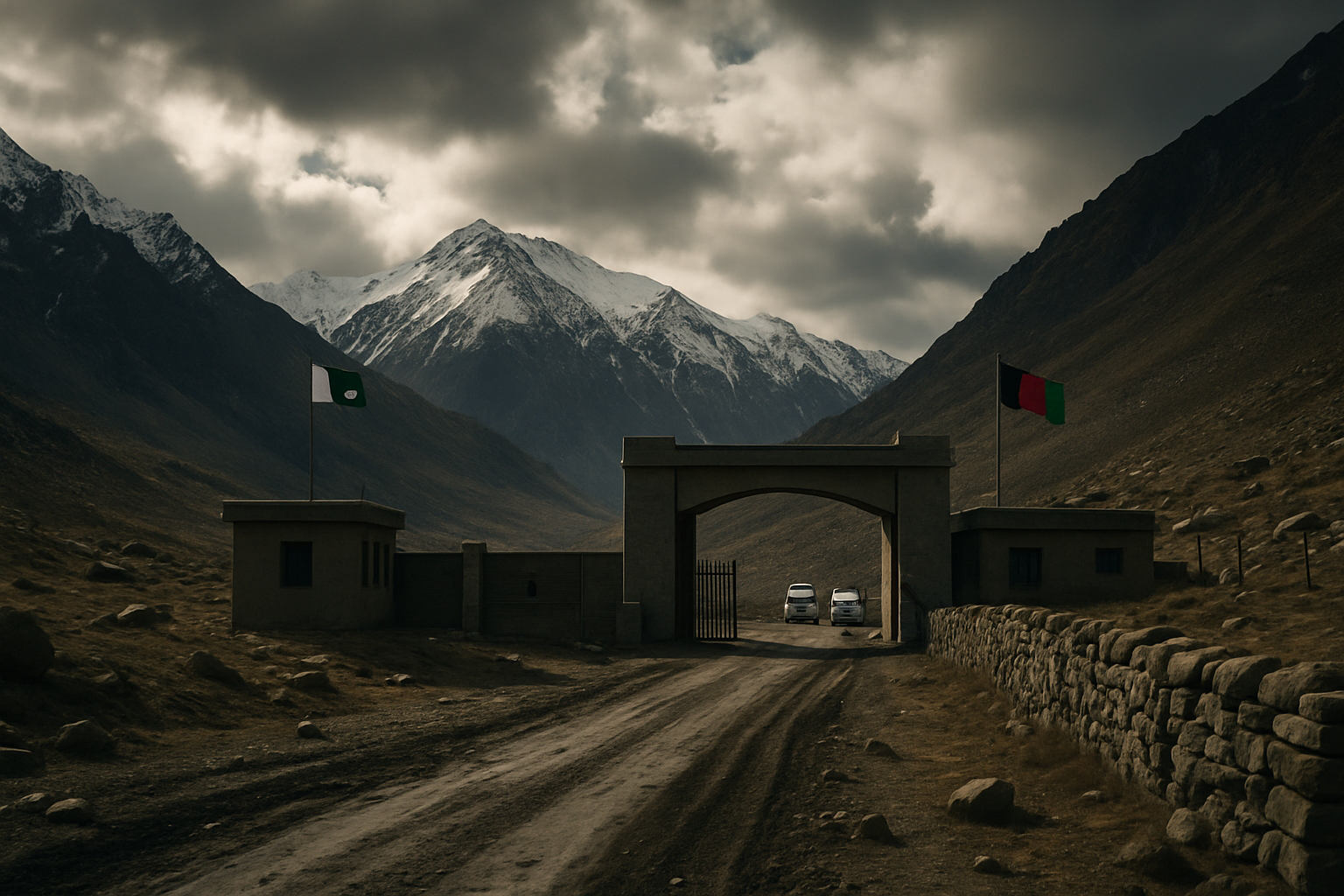
Nine days of devastating cross-border warfare between Afghanistan and Pakistan have escalated into the most serious military confrontation since the Taliban's return to power, with Afghanistan's Defense Ministry claiming to have killed 327 Pakistani soldiers in its retaliatory "Radd-ul-Zulm" operation while the United Nations reports 185 civilian casualties from the ongoing violence.
The conflict, which began with a February 16 attack by the Pakistani Taliban (TTP) that killed 11 Pakistani soldiers, has now spiraled into sustained military operations across multiple provinces along the disputed 2,640-kilometer Durand Line border. Afghanistan's massive public response came to a head on Friday as hundreds of residents gathered at Kabul's Eidgah Mosque to condemn what they termed Pakistan's "aggression" against their nation.
The protests, which spread across several Afghan provinces, carried strong condemnations of Pakistani airstrikes and voiced support for the Islamic Emirate's defensive actions. Organizers declared that the Afghan people are united against any form of aggression and will defend their country's territorial integrity alongside security forces.
Afghanistan's Military Claims and "Radd-ul-Zulm" Operation
In a major escalation of rhetoric and claimed military success, Afghanistan's Ministry of National Defense announced on Friday that 327 Pakistani soldiers have been killed and hundreds more wounded since the launch of the retaliatory "Radd-ul-Zulm" (Response to Oppression) operation. The ministry said Afghan forces conducted "large-scale strikes" over the past week in direct response to Pakistani military attacks on Afghan territory.
The operation represents Afghanistan's most comprehensive military response to cross-border attacks since the Taliban government took power in August 2021. Defense Ministry spokesman Enayatullah Khwarazmi stated that Afghan forces have been conducting coordinated operations across multiple border provinces, claiming significant tactical victories against Pakistani positions.
"The continuation of Pakistan's attacks on the Afghan people is not acceptable under any circumstances," Khwarazmi said in a statement. "Our forces have responded with precision and strength to defend our sovereignty and our people."
Mounting Civilian Death Toll
The humanitarian cost of the escalating conflict continues to mount, with the United Nations Assistance Mission in Afghanistan (UNAMA) reporting 185 civilian casualties recorded between February 26 and March 5. According to UNAMA's latest update, 56 civilians were killed and 129 others injured as a result of indirect fire, airstrikes, and ground operations across the border regions.
The civilian casualties include women and children caught in the crossfire of military operations that have expanded beyond traditional border skirmishes into sustained warfare. Medical facilities across affected provinces report being overwhelmed with wounded civilians, while rescue operations continue in areas where people remain trapped under rubble from destroyed buildings.
The conflict's humanitarian impact extends beyond immediate casualties, with the World Food Programme warning that the escalating violence is severely restricting humanitarian aid access to Afghanistan, where 88% of female-headed households already struggle to meet minimum living requirements.
Public Outrage and National Unity
Friday's protests across Afghanistan demonstrated the depth of public anger over the Pakistani military actions. The gatherings, held simultaneously in multiple provinces, saw participants condemning what they characterized as violations of Afghanistan's national sovereignty and supporting the Islamic Emirate's right to defend the country.
Protesters specifically called on the Pakistani people to condemn their government's attacks on Afghanistan and work to prevent further assaults. The demonstrations reflected a rare moment of apparent unity between the Taliban government and Afghan citizens in opposition to external military pressure.
The protest organizers emphasized that Afghans across all provinces stand ready to defend their territorial integrity, describing the current crisis as an attack on Afghanistan's sovereignty that requires a unified national response.
International Concerns and Mediation Efforts
The escalating conflict has drawn international attention and concern from regional powers and global organizations. Multiple countries, including Saudi Arabia, Iran, and Turkey, have offered mediation services to help de-escalate the crisis and prevent broader regional instability.
The United Nations has called for immediate cessation of hostilities and protection of civilians, emphasizing the need for all parties to uphold international humanitarian law principles of distinction, proportionality, and precautionary measures in military operations.
Regional analysts note that the conflict tests the post-2021 South Asian security architecture and could have implications far beyond the immediate border regions. The involvement of nuclear-armed Pakistan adds an additional layer of international concern about potential escalation.
Economic and Trade Disruption
The military confrontation has severely disrupted bilateral trade between the neighboring countries, with a documented 59% collapse in Pakistan's exports to Afghanistan over the past seven months—from $550 million to just $228 million. This dramatic reduction in trade affects border communities that depend heavily on cross-border commerce for their livelihoods.
Traditional trade routes through the Chaman-Spin Boldak and Torkham border crossings have faced repeated closures, compounding Afghanistan's already severe humanitarian crisis. The economic disruption comes at a particularly difficult time for Afghanistan, where millions of people face food insecurity and lack access to basic services.
Historical Context and Durand Line Disputes
The current crisis is rooted in long-standing disputes over the Durand Line, the 2,640-kilometer border established by British colonial authorities in 1893. Afghanistan has never formally recognized this boundary, considering it an artificial division of Pashtun tribal lands that separates families and communities.
Pakistan maintains that terrorist groups, particularly the Tehrik-e-Taliban Pakistan (TTP), operate "with impunity from Afghan soil" despite Taliban assurances that no armed groups are allowed to use Afghan territory for attacks against neighboring countries. This fundamental disagreement about cross-border militant activities has been a persistent source of tension between the two countries.
The porous nature of the mountainous border, combined with limited government control in remote areas and complex tribal dynamics, provides challenges for both countries in managing cross-border movement and preventing militant activities.
Looking Ahead: Diplomatic Solutions or Further Escalation
As the conflict enters its second week, the international community faces mounting pressure to develop effective mechanisms for preventing broader regional confrontation. The crisis represents a critical test of whether innovative diplomatic frameworks can manage the intersection of territorial sovereignty concerns and transnational terrorism challenges in the 21st century.
The success or failure of current mediation efforts could provide a template for addressing similar regional conflicts worldwide, where issues of sovereignty, security, and humanitarian protection intersect in complex ways.
Both countries face the challenge of balancing legitimate security concerns with respect for territorial integrity and civilian protection. The coming days will be crucial in determining whether diplomatic engagement can overcome the current military escalation or if the region faces a prolonged period of instability with far-reaching consequences for millions of people on both sides of the border.
The international community's response to this crisis will also test the effectiveness of current conflict prevention mechanisms and may influence how similar territorial and security disputes are addressed in other parts of the world.