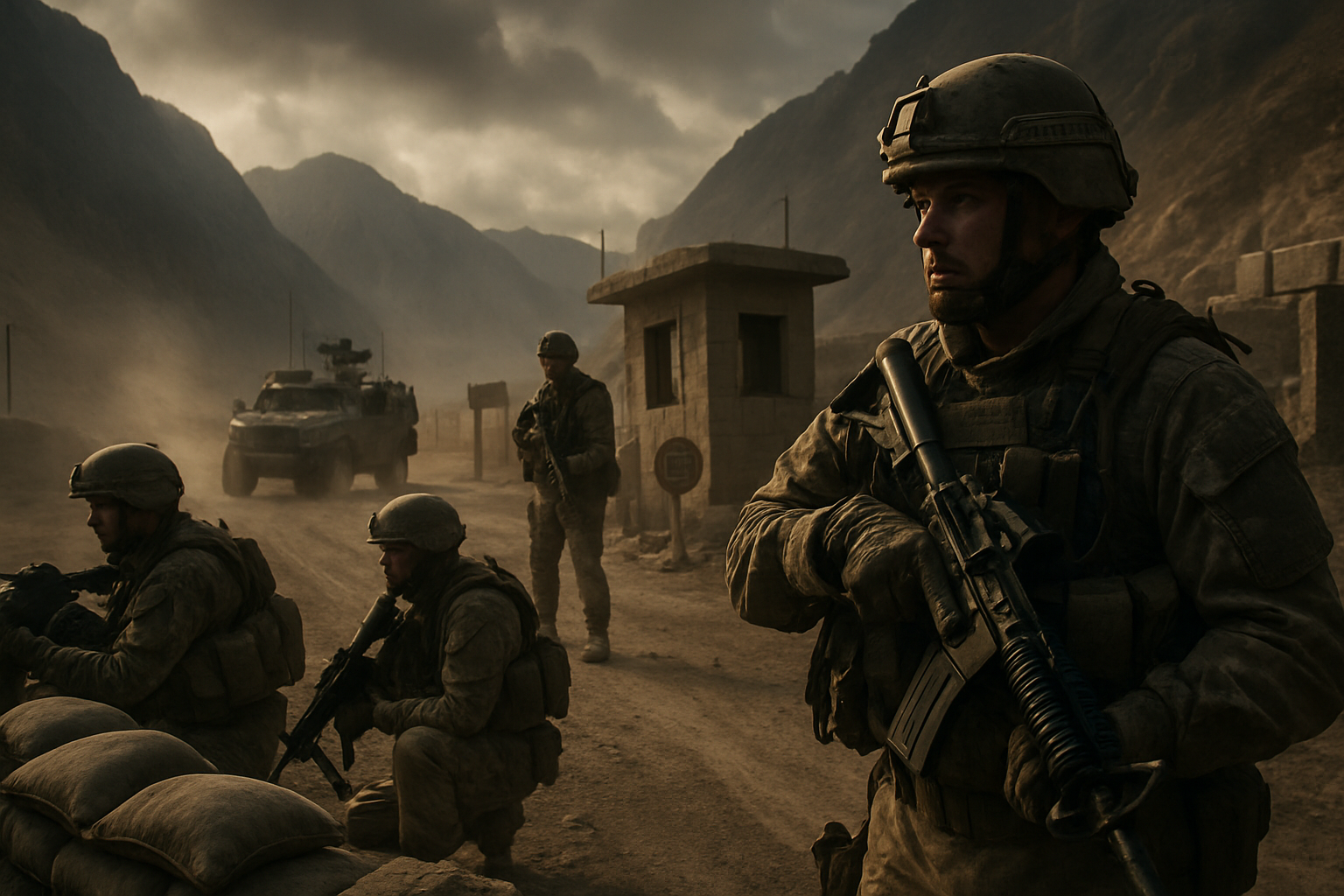
Fighting between Afghan Taliban forces and Pakistani military has entered its fifth day, marking the most serious cross-border confrontation since the Taliban's return to power in August 2021, with explosions echoing across Kabul and casualties mounting on both sides.
The conflict, which began following Pakistan's "open war" declaration by Defense Minister Khawaja Asif on February 27, has evolved from targeted airstrikes into sustained territorial battles along the disputed 2,640-kilometer Durand Line border.
Current Military Operations
Pakistani fighter jets have conducted extensive bombing campaigns across multiple Afghan provinces, including Paktika, Paktia, Khost, and Kunar. Taliban spokesperson Zabihullah Mujahid confirmed that Pakistani aircraft targeted Taliban border brigade positions near Jalalabad in Nangarhar province, while local sources reported strikes on military installations throughout eastern Afghanistan.
AFP journalists in Kabul heard multiple explosions and gunfire on Tuesday morning, with anti-aircraft fire visible across the capital as Taliban forces attempted to intercept Pakistani aircraft. Similar reports emerged from Jalalabad, where heavy weapons fire and explosions disrupted the early morning hours.
The Taliban have responded with their own military operations, conducting what they describe as "successful" retaliatory airstrikes targeting Pakistani military installations in Miranshah and Spinwam during overnight operations.
International Response and Mediation Attempts
Prominent Indian Islamic scholar Salman Nadwi has entered the diplomatic discourse, releasing a 13-minute video statement criticizing Pakistan's military establishment as "oppressive" and "unjust." Nadwi characterized the Taliban's actions as legitimate defense of their territory and governance system against what he termed "military aggression."
"The country's armed forces prioritize foreign interests over the welfare of their own population. Afghanistan's authorities are acting to defend their territory and governance system."
— Salman Nadwi, Islamic Scholar
Multiple international actors have attempted mediation, including Qatar, Saudi Arabia, Iran, and Turkey. However, these efforts have failed to prevent the escalation, with Pakistan maintaining its position that cross-border terrorism from Afghan soil justifies military action.
Historical Context and Root Causes
The current crisis traces back to February 16, when a Taliban Tehreek-e-Pakistan (TTP) attack in Bajaur district killed 11 Pakistani soldiers using a vehicle-borne improvised explosive device. Pakistan responded on February 22 with airstrikes targeting seven terrorist camps in Afghan territory, claiming to have eliminated over 80 militants but causing civilian casualties including eight schoolchildren.
The Durand Line, established by British colonial authorities in 1893, remains a source of perpetual tension. No Afghan government has ever formally recognized this border, viewing it as an artificial division of Pashtun tribal territories. The mountainous, porous terrain provides sanctuary for various militant groups, complicating bilateral relations.
Pakistan acknowledges that its traditional influence in Afghanistan has diminished compared to wealthier regional powers including Turkey, the UAE, Qatar, Saudi Arabia, and China. This shift has increased Pakistan's reliance on military solutions to address security concerns.
Economic and Humanitarian Impact
The conflict has devastated bilateral trade, which has collapsed by 59% with Pakistan's exports to Afghanistan dropping from $550 million to $228 million over seven months. Traditional trade routes through Chaman-Spin Boldak and Torkham face repeated closures, affecting border communities dependent on cross-border commerce.
The economic disruption compounds Afghanistan's existing humanitarian crisis, where 88% of female-headed households cannot meet minimum living requirements according to UN data. The World Health Organization has delivered emergency medical oxygen to 23 hospitals as the healthcare system struggles under the dual pressure of the ongoing crisis and international aid cuts.
Strategic Implications
The confrontation represents a critical test of the Taliban's governance capabilities and their ability to control militant groups operating from Afghan territory. China has warned the UN Security Council about the presence of ISIS-K, al-Qaeda, and the East Turkestan Islamic Movement in Afghanistan, contradicting Taliban claims of having defeated terrorism.
Pakistan eliminated over 400 militants in Balochistan operations during February 2026 alone, demonstrating the broader scope of counter-terrorism challenges facing the region. The sophisticated tactics employed by groups like TTP, including coordinated assaults and vehicle-borne explosives, highlight their retained operational capabilities despite sustained military pressure.
Regional Security Architecture
The crisis tests the post-2021 South Asian security framework and may establish precedents for managing territorial sovereignty versus transnational terrorism challenges in the 21st century. The involvement of nuclear-armed Pakistan adds a dangerous dimension requiring careful international monitoring to prevent escalation beyond conventional operations.
International mediation efforts, including Saudi-mediated prisoner exchanges and Iranian offers of dialogue facilitation, have proven insufficient to address the underlying security challenges. The failure of confidence-building measures suggests that more comprehensive diplomatic frameworks are needed.
Ongoing Developments
As fighting enters its fifth day, both sides report continued military operations with no signs of de-escalation. The Taliban maintain that they are defending Afghan sovereignty and territorial integrity, while Pakistan insists on its right to protect its citizens from cross-border terrorism.
The international community faces increasing pressure to develop effective conflict prevention mechanisms before the confrontation expands into a broader regional crisis. Success or failure in diplomatic containment will influence how similar territorial sovereignty and transnational terrorism challenges are managed globally.
The coming days will be critical in determining whether sustained diplomatic engagement can overcome military escalation or if the region faces a prolonged period of instability with implications extending far beyond the immediate border area.