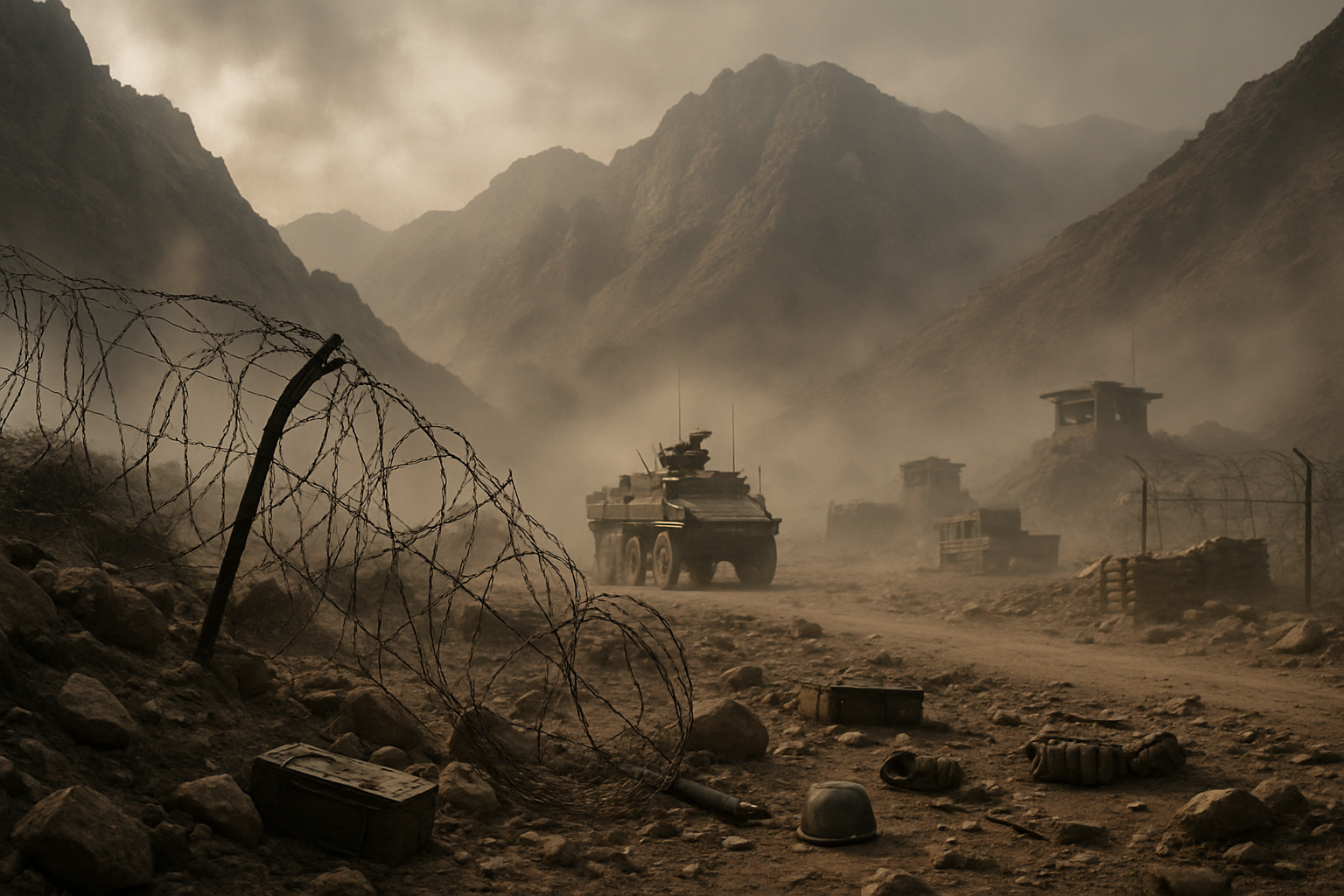
Fresh armed clashes have erupted between Taliban forces and Pakistani military units along the volatile Afghanistan-Pakistan border in Paktia and Khost provinces, marking a dangerous escalation in tensions that have severely restricted humanitarian aid access to millions of vulnerable Afghans.
The latest confrontations, reported overnight along the disputed Durand Line, come as the World Food Programme (WFP) issued urgent warnings about Afghanistan's deepening hunger crisis, with 88% of female-headed households unable to meet minimum living requirements. The border fighting has created a humanitarian emergency that international aid organizations describe as one of the most severe access crises in the region.
Escalating Military Confrontation
Local sources in both Paktia's Dand Patan District and Khost's Zazi Maidan District reported intense fighting involving heavy weapons fire throughout Thursday night. The clashes represent a continuation of what Pakistani Defense Minister Khawaja Asif declared "open war" against Afghanistan's Taliban government in February 2026 - the most serious military confrontation since the Taliban's return to power in August 2021.
The current crisis began with a devastating February 16 attack in Pakistan's Bajaur district that killed 11 Pakistani soldiers in a coordinated assault by the banned Tehreek-i-Taliban Pakistan (TTP). Pakistan responded with airstrikes on seven alleged terrorist camps in Afghanistan's Nangarhar and Paktika provinces, claiming to have eliminated over 80 militants but causing significant civilian casualties, including eight schoolchildren.
"War has never been our first option, but anyone who sets eyes on Afghan soil with ill intent has been met with a firm response."
— Enayatullah Khowarzmi, Taliban Defense Ministry Spokesperson
The Taliban have responded with their own military operations, claiming to have captured four Pakistani military bases and shooting down Pakistani aircraft, though these claims have been disputed by Islamabad. The conflict has evolved from isolated border skirmishes into sustained warfare involving multiple corps of the Afghan military using what Taliban officials describe as "advanced military equipment including laser-guided systems."
Humanitarian Crisis Deepens
The ongoing military confrontation has created a catastrophic humanitarian situation that extends far beyond the immediate combat zones. The WFP warns that border fighting is disrupting critical food aid deliveries to Afghanistan, which already faces one of the world's most severe hunger crises.
According to UN data, 88% of female-headed households in Afghanistan are unable to meet minimum living requirements, a dramatic increase from the 75% rate among the general population. The Taliban's employment restrictions on women since August 2021 have affected nearly half the workforce, compounding an economic collapse that has left millions dependent on international humanitarian assistance.
The World Health Organization has been forced to deliver emergency medical oxygen to 23 hospitals across the conflict zone, while hundreds of health centers have been forced to close due to funding cuts and security concerns. Traditional trade routes through the Chaman-Spin Boldak and Torkham border crossings face repeated closures, further restricting the flow of essential supplies.
Economic Devastation Along the Border
The military escalation has caused severe economic disruption, with bilateral trade between Pakistan and Afghanistan collapsing by 59%. Pakistani exports to Afghanistan plummeted from over $550 million to just $228 million over the first seven months of the current fiscal year, devastating border communities that depend on cross-border commerce.
This economic collapse affects millions of people on both sides of the 2,640-kilometer colonial-era boundary, known as the Durand Line, which has never been formally recognized by Afghan governments since its establishment by British colonial authorities in 1893. The porous mountainous terrain along this disputed border has long provided sanctuary for militant groups, complicating bilateral relations and security operations.
International Mediation Efforts Falter
Despite intensive international mediation attempts, diplomatic solutions have proven insufficient to address the underlying security challenges. Saudi Arabia mediated a prisoner exchange in February 2026 that saw the release of three Pakistani soldiers captured during October 2025 border clashes, but this confidence-building measure failed to prevent the current escalation.
Iran has offered mediation services, warning of regional destabilization risks, while Turkish Foreign Minister Hakan Fidan has launched diplomatic initiatives involving Pakistani and Afghan foreign ministers, plus Qatari and Saudi counterparts. However, Pakistan maintains that the TTP operates "with impunity from Afghan soil" despite Taliban assurances about controlling militant groups.
Russian Special Envoy Zamir Kabulov has also entered mediation efforts, meeting with Afghan Ambassador Gul Hasan Hasan in Moscow and stressing that disputes should be resolved through dialogue rather than military action. Chinese officials have warned the UN Security Council about the presence of ISIS-K, al-Qaeda, and ETIM militant groups in Afghanistan, contradicting Taliban claims of having "defeated terrorism."
Regional and Global Implications
The Afghanistan-Pakistan border crisis represents a critical test of the post-2021 South Asian security architecture, with nuclear-armed Pakistan's involvement adding dangerous dimensions that require careful international monitoring. Pakistani Defense Minister Khawaja Asif has acknowledged Pakistan's diminished regional influence compared to wealthier powers such as Turkey, the UAE, Qatar, Saudi Arabia, and China, leading to increased reliance on military solutions.
The conflict occurs against a backdrop of broader regional instability, including the collapse of the New START nuclear treaty between the United States and Russia in February 2026 - the first time in over 50 years that no formal nuclear constraints exist between the superpowers. UN Secretary-General António Guterres has warned that nuclear risks are at their highest level in decades.
International observers note that the success or failure of diplomatic containment efforts in this crisis could influence how territorial sovereignty disputes intersect with transnational terrorism challenges globally, potentially setting precedents for 21st-century conflict resolution mechanisms.
Civilian Impact and International Law Concerns
The military operations have raised serious concerns about violations of international humanitarian law, particularly the targeting of civilian areas during military strikes. The UN Assistance Mission in Afghanistan (UNAMA) has documented 146 civilian casualties, including 42 deaths and 104 injuries, since the current escalation began in late February.
Pakistan's February 22 airstrikes targeted what officials described as terrorist camps but resulted in civilian deaths, including the tragic killing of eight schoolchildren in Nangarhar's Behsud district. The timing of these strikes during Ramadan added additional religious sensitivities to the crisis, with Taliban officials describing the operations as violations of both international law and Islamic principles.
Medical facilities in the conflict zone report being overwhelmed by casualties, while rescue operations continue for civilians trapped under rubble from destroyed buildings. The pattern of civilian casualties has prompted calls from human rights organizations for thorough investigations and accountability measures.
Looking Forward: Diplomatic Solutions vs. Military Escalation
As the crisis enters its second month, the international community faces mounting pressure to develop effective conflict prevention mechanisms before the situation escalates into a broader regional confrontation. The failure of traditional diplomatic approaches has highlighted the need for innovative frameworks that can address the complex intersection of territorial sovereignty, transnational terrorism, and humanitarian concerns.
The Taliban government has filed complaints with the UN Security Council through Afghanistan's acting permanent representative Naseer Ahmad Faiq, while maintaining that "the path of talks remains open" for resolution through "mutual understanding and respect." However, Pakistan's continued military operations suggest that diplomatic solutions alone may be insufficient without concrete action to address cross-border terrorism.
The crisis represents a comprehensive challenge to regional stability that extends beyond the bilateral relationship between Afghanistan and Pakistan. Success in resolving these tensions through diplomatic means could provide a template for managing similar conflicts where security concerns intersect with sovereignty disputes, while failure could lead to prolonged military confrontation with implications for global security architecture.
As humanitarian needs continue to mount and military tensions show no signs of abating, the coming weeks will prove crucial in determining whether innovative diplomatic engagement can overcome the cycle of violence that has trapped millions of civilians in an increasingly desperate situation along one of the world's most volatile borders.