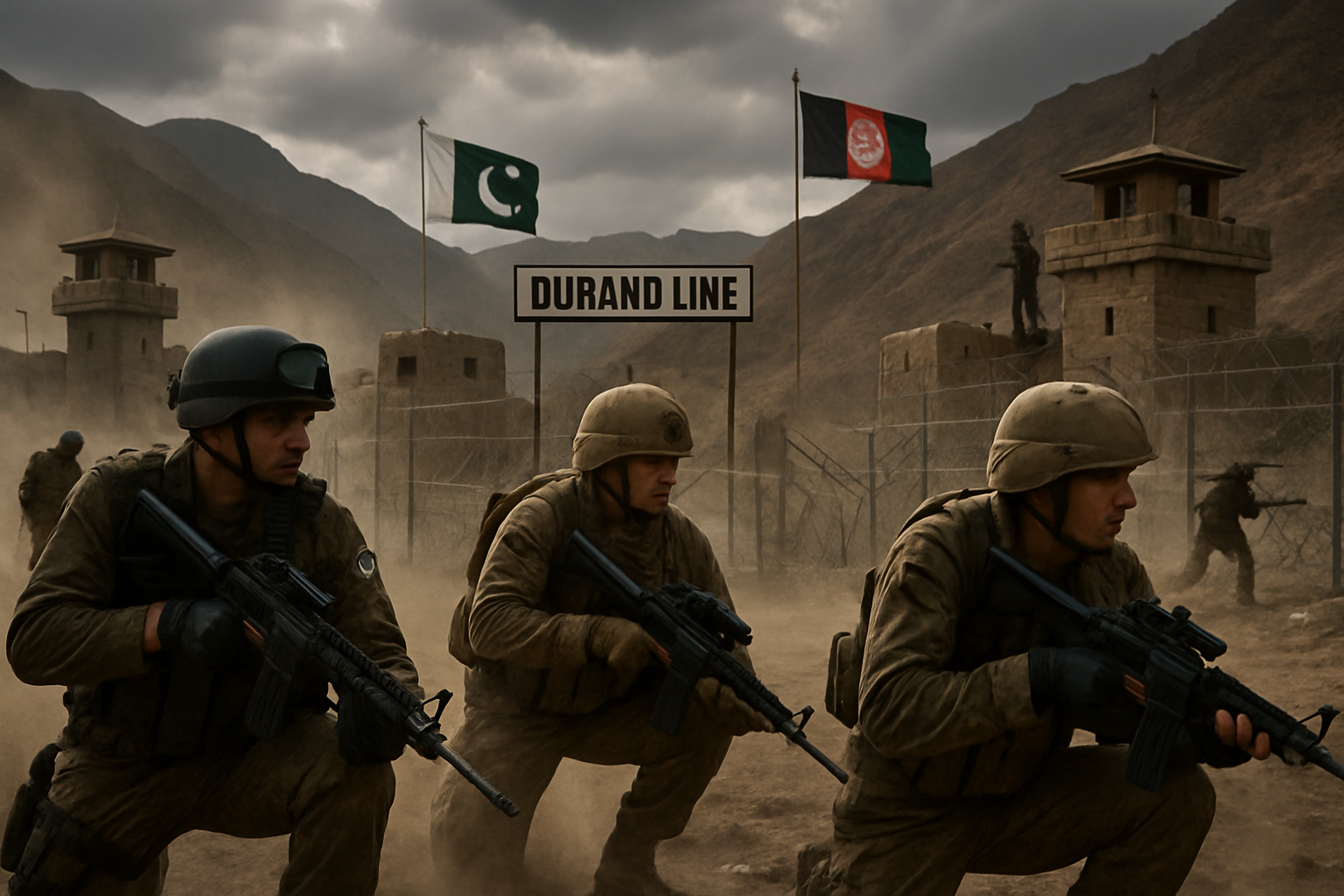
Military confrontations between Afghanistan and Pakistan have erupted into the most serious cross-border warfare since the Taliban's return to power in 2021, with Afghan forces claiming to have captured four Pakistani military bases and shot down military aircraft while Pakistani jets conducted strikes deep into Afghan territory, including the capital Kabul.
The latest escalation represents a dramatic intensification of what Pakistani Defense Minister Khawaja Mohammad Asif declared "open war" against Afghanistan's Taliban government on February 27, 2026. The conflict has now evolved from isolated border skirmishes into sustained military operations involving heavy weapons, cross-border airstrikes, and territorial capture.
Taliban Claims Major Military Victories
Afghanistan's Taliban defense ministry issued extraordinary claims Sunday of significant military successes against Pakistani forces. Taliban defense spokesperson Enayatullah Khwarazmi announced that Afghan forces had captured four Pakistani military bases during retaliatory operations and claimed that 32 Pakistani soldiers were killed by landmine explosions, with dozens more wounded.
In a separate but equally dramatic development, Taliban forces engaged Pakistani military aircraft operating over Kabul before dawn Sunday, marking the first time the Afghan capital has been directly involved in military action against Pakistan. Taliban government spokesperson Zabihullah Mujahid confirmed the engagement, stating: "Anti-aircraft fire targeted the Pakistani air force in Kabul. Residents should not be worried."
"Our forces carried out coordinated retaliatory strikes overnight in the eastern provinces of Nangarhar, Paktia and Khost, using advanced military equipment including laser-guided systems."
— Afghanistan Ministry of Defense Statement
The Taliban's defense ministry described the operations as "intense and targeted" responses involving units from the 203rd Mansouri Corps, 201st Corps and 205th Al-Badr Corps. According to their claims, two Pakistani drones were shot down and several military assets destroyed during the exchanges.
Pakistani Airstrikes Target Afghan Capital and Strategic Sites
Pakistani forces conducted their own cross-border operations, with fighter jets striking targets including the strategic Bagram Airfield in Parwan province during overnight operations. The attack on Bagram, a former major U.S. military base, represents the most significant strike on Afghan military infrastructure since the current crisis began.
Pakistani military sources claimed their operations targeted Taliban military facilities across multiple provinces, with previous Pakistani airstrikes on February 22 reportedly killing over 80 militants while causing civilian casualties including eight schoolchildren in Behsud district.
The geographical scope of the conflict has expanded dramatically beyond traditional border regions, with Pakistani aircraft now operating over Afghanistan's capital and Taliban forces engaging them with anti-aircraft fire in residential areas of Kabul.
Civilian Casualties Mount Amid Escalation
Afghan authorities reported that Pakistani overnight strikes on Saturday killed civilians in residential areas of Nangarhar and Paktia provinces. Hamdullah Fitrat, deputy spokesman for the Islamic Emirate, said drone strikes hit civilian homes in the Ghani Khil district of Nangarhar province, destroying four houses and killing two people, including a woman, with two others wounded.
In Paktia province's Dand Patan district, a mortar round struck a residential house, killing one civilian and injuring another. These civilian casualties add to the mounting humanitarian toll of the conflict, which has seen systematic targeting of populated areas despite international humanitarian law prohibitions.
The conflict has also severely disrupted civilian life along the border, with heavy fighting reported at the Torkham crossing, a vital commercial gateway between the two countries. Sections of the border fence along the disputed Durand Line have been destroyed, and Pakistani facilities and outposts have been damaged in the exchanges.
Economic Devastation and Trade Collapse
The military escalation has coincided with a catastrophic collapse in bilateral trade between the neighboring countries. Pakistan's exports to Afghanistan have plummeted by 59% over seven months, dropping from over $550 million to just $228 million, according to State Bank data.
This trade collapse represents one of the steepest bilateral trade drops in recent regional history, severely affecting border communities that depend on cross-border commerce. Traditional trade routes through Chaman-Spin Boldak and Torkham face repeated closures, compounding Afghanistan's humanitarian crisis where 88% of female-headed households are unable to meet minimum living requirements.
Historical Context and Durand Line Disputes
The current crisis has deep historical roots in disputes over the 2,640-kilometer Durand Line, the colonial-era border established by Britain in 1893 that has never been formally recognized by any Afghan government. The porous mountainous terrain provides sanctuary for militant groups and complicates bilateral relations.
The immediate trigger for the current escalation was a February 16 attack in Pakistan's Bajaur district that killed 11 Pakistani soldiers, carried out by the banned Tehreek-i-Taliban Pakistan (TTP) using a vehicle-borne improvised explosive device. Pakistan responded with airstrikes on February 22 targeting what it claimed were seven terrorist camps in Afghanistan.
Pakistan maintains that TTP leadership operates "with impunity from Afghan soil" despite Taliban assurances that they would not allow Afghan territory to be used for attacks against neighboring countries. The Taliban categorically denies providing sanctuary to militant groups while Pakistan has eliminated over 400 militants in counter-terrorism operations in Balochistan during February 2026 alone.
International Mediation Efforts Failing
Despite extensive international mediation efforts, the conflict continues to escalate. Saudi Arabia had successfully mediated a prisoner exchange in February 2026, securing the release of three Pakistani soldiers captured during October 2025 border clashes. Iran has offered mediation services, warning of broader regional escalation risks.
Turkish Foreign Minister Hakan Fidan launched a mediation initiative, contacting both Pakistani FM Ishaq Dar and Afghan FM Amir Khan Muttaqi, as well as Qatari and Saudi counterparts. However, these confidence-building measures have proven insufficient to address the underlying security challenges driving the conflict.
Pakistan acknowledges that it has lost traditional influence over Afghanistan to wealthier regional powers including Turkey, UAE, Qatar, Saudi Arabia, and China, increasing its reliance on military solutions to border security challenges.
Nuclear-Armed Neighbors on Collision Course
The escalation between nuclear-armed neighbors has raised serious concerns about regional stability. Chinese officials have warned the UN Security Council about severe terrorist threats from Afghanistan, citing the presence of ISIS-K, al-Qaeda, and ETIM, contradicting Taliban claims of having "defeated terrorism."
The conflict represents the most serious Pakistan-Afghanistan confrontation in decades and is testing the post-2021 South Asian security architecture. Success or failure of diplomatic containment efforts will influence how territorial sovereignty and transnational terrorism challenges are managed globally in the 21st century.
"If militants continue operating freely from Afghan soil, Pakistan would not hesitate to take military action."
— Khawaja Mohammad Asif, Pakistani Defense Minister
Taliban Governance Under Scrutiny
The crisis presents a critical test of the Taliban's governance capabilities and their commitment to preventing Afghan territory from being used for attacks against neighboring countries. The Taliban has maintained that "the path of talks remains open" and has called for resolution through "mutual understanding and respect."
However, the escalation to "open war" declarations and territorial captures represents a fundamental departure from diplomatic frameworks toward aggressive military confrontation. The Taliban's ability to control militant groups operating from Afghan soil while maintaining sovereignty over their territory faces unprecedented challenges.
Regional and Global Implications
The Afghanistan-Pakistan conflict has implications far beyond the immediate region. The pattern of cross-border terrorism, territorial disputes, and military escalation provides a template for how similar challenges might unfold in other parts of the world where governance limitations intersect with security concerns.
International observers are closely monitoring whether diplomatic mechanisms can prevent broader regional confrontation or if sustained military escalation will become the norm. The outcome may influence how the international community approaches territorial sovereignty versus transnational terrorism challenges in an increasingly complex global security environment.
The crisis also highlights the fragility of post-conflict stability arrangements and the challenges facing international efforts to engage with de facto governments while addressing legitimate security concerns. As both nations edge closer to full-scale warfare, the coming days will be decisive in determining whether diplomatic solutions can prevail over military escalation.