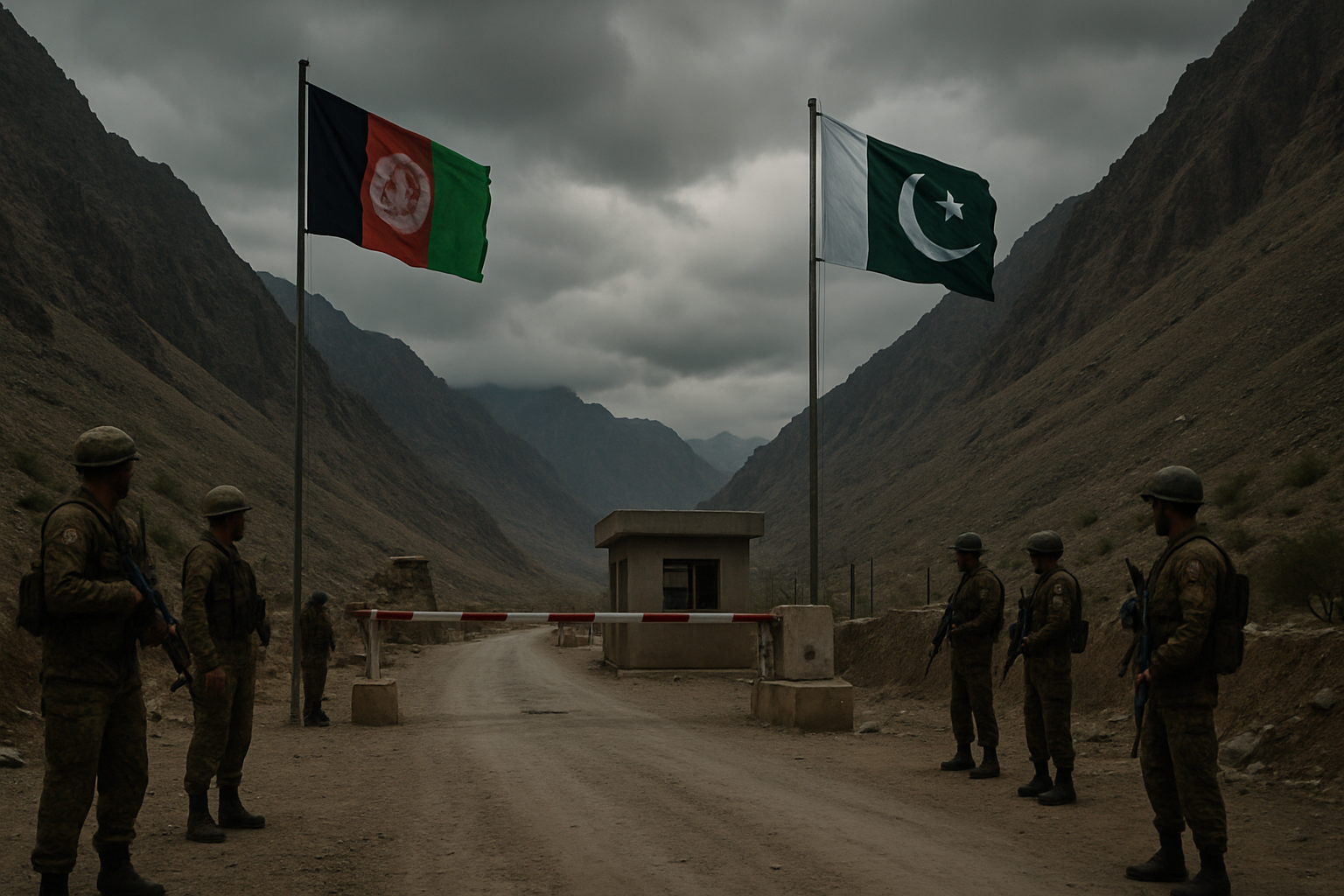
Border tensions between Afghanistan and Pakistan have reached a critical juncture as fresh military clashes erupted in Nangarhar province, coinciding with a devastating 59% collapse in bilateral trade that threatens regional economic stability.
Taliban and Pakistani forces clashed in Nangarhar province's Nazian district on Tuesday, according to Taliban information and culture chief Zabihullah Noorani, who confirmed fighting between Taliban fighters and Pakistani border guards. The confrontation began after Pakistani forces allegedly opened fire first, marking the latest escalation in increasingly volatile border relations.
The military tensions come as economic data reveals the scale of deteriorating bilateral relations. Pakistan's exports to Afghanistan plunged from over $550 million to just $228 million in the first seven months of the current fiscal year, according to State Bank of Pakistan figures—a devastating 59% drop that reflects the deep trade disruptions plaguing the relationship.
Pattern of Escalating Military Confrontations
The latest Nangarhar clashes represent part of a disturbing pattern of cross-border military incidents that have intensified dramatically in recent months. The confrontation follows February 22, 2026 Pakistani airstrikes on seven terrorist camps in Afghanistan's Nangarhar and Paktika provinces, which killed at least 18 civilians including eight schoolchildren.
Those strikes came in retaliation for the February 16 Bajaur district attack that killed 11 Pakistani soldiers in a coordinated assault by Tehreek-e-Taliban Pakistan (TTP) militants using vehicle-borne improvised explosive devices. The cycle of retaliation has created an increasingly dangerous spiral of violence along the disputed border.
"The confrontation began after Pakistani forces allegedly opened fire first, creating another flashpoint in our already strained relations."
— Zabihullah Noorani, Taliban Information Chief, Nangarhar
Pakistan maintains that TTP leadership operates "with impunity from Afghan soil" despite repeated Taliban assurances about controlling militant groups. Defense Minister Khawaja Asif has repeatedly threatened military action if cross-border attacks continue, representing a significant hardening of Pakistan's position.
Economic Collapse Undermines Regional Stability
The dramatic trade decline reveals the economic dimensions of the crisis extending far beyond military confrontations. The 59% drop in Pakistani exports to Afghanistan—from over $550 million to $228 million—represents one of the steepest bilateral trade collapses in recent regional history.
The trade disruption affects multiple sectors and communities dependent on cross-border commerce. Traditional trade routes through key border crossings like Chaman-Spin Boldak and Torkham have faced repeated closures and restrictions, disrupting supply chains built over decades of economic cooperation.
This economic deterioration coincides with Afghanistan's worst humanitarian crisis in 25 years, with 88% of female-headed households unable to meet minimum living requirements according to UN Development Programme assessments. The trade collapse further compounds Afghanistan's economic isolation while damaging Pakistan's export markets.
Historical Context of Border Disputes
The current crisis builds on a complex history of Afghanistan-Pakistan border tensions rooted in the disputed Durand Line—the 2,640-kilometer border drawn by British colonial authorities in 1893 but never fully accepted by successive Afghan governments.
Recent memory includes October 2025 border clashes that resulted in Pakistani soldier captures, leading to a Saudi-mediated prisoner exchange in February 2026 where the Taliban released three Pakistani soldiers as a Ramadan diplomatic gesture. However, such confidence-building measures have proven insufficient to address underlying security challenges.
Pakistan has acknowledged its diminished regional influence in Afghanistan to wealthier powers including Turkey, UAE, Qatar, Saudi Arabia, and China. This reduced leverage has increased Pakistan's reliance on military solutions rather than diplomatic engagement, complicating relationship management.
Cross-Border Terrorism Complicates Relations
The security dimension centers on cross-border militant activities, particularly by TTP and ISIS-K groups that Pakistan alleges operate from Afghan territory. Pakistani forces have conducted intensive counter-terrorism operations, eliminating over 400 militants in Balochistan province alone during February 2026.
Recent attacks demonstrate the sophisticated tactics employed by militant groups, including the February 6 Islamabad mosque bombing that killed 31 people and wounded 169 others—an attack claimed by ISIS-K that specifically targeted Shia Muslims during Friday prayers.
Chinese officials have warned the UN Security Council about severe terrorist threats from Afghanistan, citing continued presence of ISIS-K, al-Qaeda, and ETIM groups, contradicting Taliban claims of having "defeated terrorism" on Afghan soil.
International Mediation Efforts Face Challenges
Despite the escalating tensions, regional mediators continue diplomatic efforts. Saudi Arabia successfully facilitated the February 2026 prisoner exchange, demonstrating its growing role as a neutral mediator in regional disputes. Iran has also offered mediation services through Foreign Ministry spokesman Esmaeil Baghaei.
However, these diplomatic initiatives face significant obstacles when underlying security challenges persist. The pattern suggests that goodwill gestures and prisoner exchanges, while valuable for confidence-building, remain insufficient to address the fundamental disagreements over territorial sovereignty and cross-border security.
"We are seeing a comprehensive challenge to regional stability that requires innovative diplomatic frameworks balancing legitimate security concerns with territorial integrity and civilian protection."
— Regional Security Analyst
Civilian Cost of Border Tensions
The human cost of deteriorating relations extends beyond military casualties to affect civilian populations on both sides of the border. The February 22 Pakistani airstrikes resulted in civilian casualties including schoolchildren, raising serious international humanitarian law concerns.
Trade disruptions have particularly impacted border communities whose livelihoods depend on cross-border commerce. Merchants, transporters, and small businesses face severe economic hardship as traditional trade routes become unreliable or completely blocked.
The restriction of movement affects families separated by the border and disrupts cultural and social connections that have existed for generations across the artificial colonial boundary.
Regional and Global Implications
The Afghanistan-Pakistan crisis has implications extending far beyond bilateral relations. The border instability affects regional security architecture and tests the Taliban's governance capabilities in controlling militant groups operating from Afghan territory.
The crisis also demonstrates the challenges facing post-2021 Afghanistan's international engagement, where the Taliban government seeks recognition and economic cooperation while facing allegations of providing sanctuary to terrorist groups.
For Pakistan, the situation represents a test of balancing legitimate security concerns with diplomatic engagement approaches. The country's acknowledged loss of traditional influence in Afghanistan to wealthier regional powers complicates its policy options.
Path Forward Requires Sustained Engagement
Resolution of the Afghanistan-Pakistan border crisis will require sustained diplomatic engagement addressing both immediate security concerns and underlying structural issues. The territorial sovereignty challenges intersect with transnational terrorism concerns in ways that demand innovative approaches.
Success will likely depend on several factors: Taliban's demonstrated capability and willingness to control militant groups operating from Afghan soil; Pakistan's commitment to diplomatic solutions alongside security measures; continued regional mediation by neutral parties like Saudi Arabia; and international support for confidence-building measures that address root causes rather than just symptoms.
The coming weeks will prove critical in determining whether diplomatic innovation can arrest the escalating violence or whether the crisis will continue deteriorating, potentially affecting broader regional stability and economic cooperation initiatives.
The stakes extend beyond bilateral relations to encompass regional security architecture, international law enforcement credibility, and the viability of diplomatic solutions to complex territorial and security disputes in the 21st century.