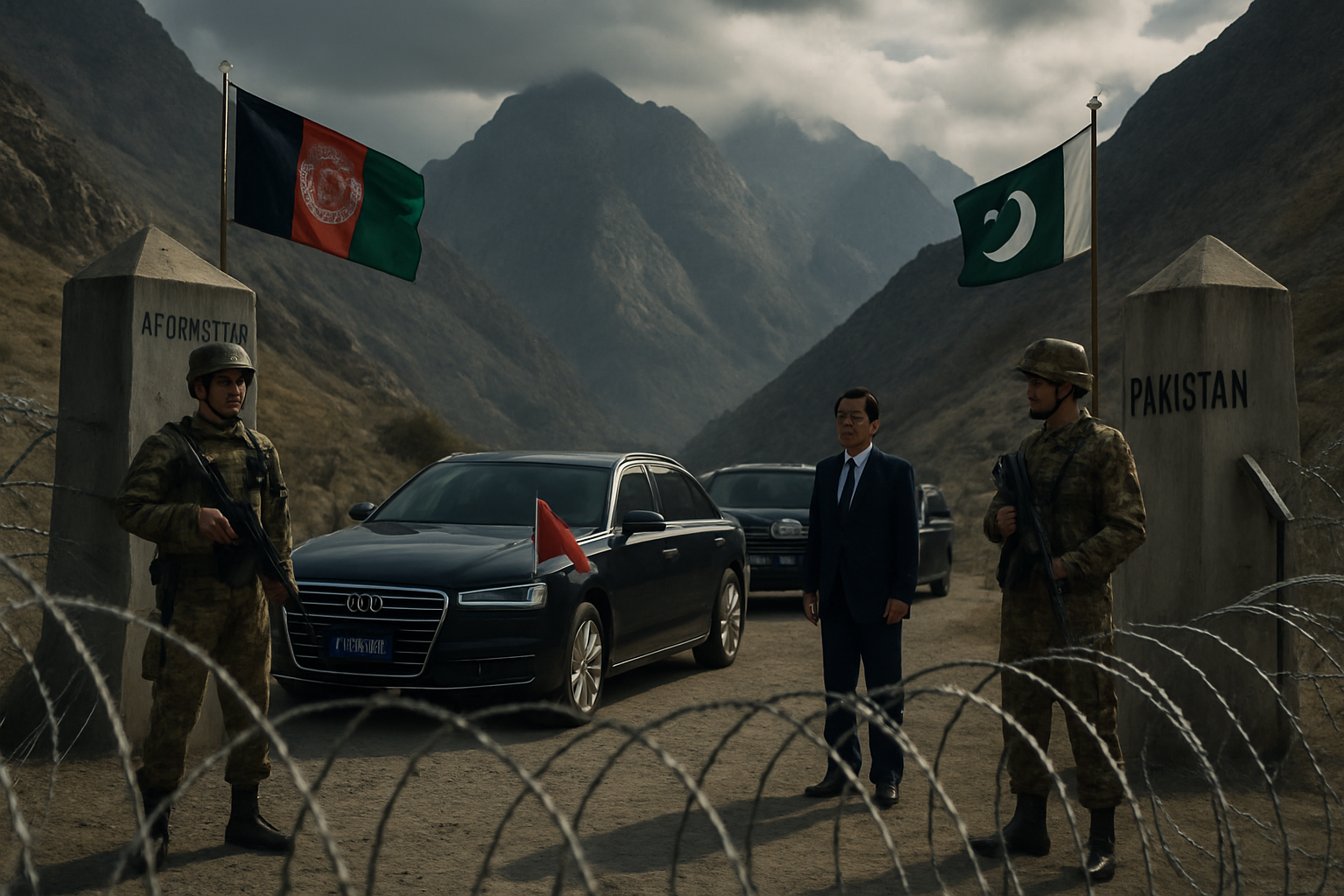
The Afghanistan-Pakistan border crisis has reached a critical juncture as both nations exchange cross-border military strikes while China emerges as a key diplomatic mediator, attempting to de-escalate the most serious confrontation since the Taliban's return to power in 2021.
On Sunday, Afghanistan's Ministry of National Defense announced a retaliatory airstrike on a Pakistani military camp in Wana, South Waziristan, in response to overnight Pakistani attacks on Kandahar. Taliban spokesperson Enayatullah Khwarizmi confirmed that Afghan air forces targeted the Special Service Group (SSG) building and other critical facilities at the camp, claiming "heavy human and material losses" among Pakistani soldiers.
Escalating Cross-Border Operations
The latest strikes represent a dangerous escalation in what began as a cycle of retaliatory attacks in February 2026. Pakistani forces have been conducting "Operation Ghazab lil-Haq," launched in late February following what Pakistan described as "unprovoked firing" by Afghan Taliban forces that killed Pakistani security personnel.
According to Pakistani state media, overnight strikes in Afghanistan's Kandahar province targeted "terrorist hideouts and military infrastructure," with operations aimed at facilities allegedly used by Afghan Taliban and affiliated terrorist groups to launch attacks against Pakistani civilians.
The Taliban government has responded with its own military operations, with Afghan forces claiming to have captured a Pakistani military post in Khost province. Deputy spokesperson for Strategic Communications Sadeequllah Nasrat announced that Afghan defensive forces had seized the Pakistani position known as the "Jani Khel" post, marking a significant territorial gain in the ongoing confrontation.
China Steps Forward as Mediator
Amid the escalating tensions, China has positioned itself as a crucial mediator in the crisis. Chinese Foreign Minister Wang Yi expressed Beijing's readiness to assist in resolving the tensions during a phone call with Afghanistan's Foreign Minister Amir Khan Muttaqi. China's special envoy for Afghanistan has been actively shuttling between Kabul and Islamabad to encourage dialogue and reconciliation.
"China hopes both sides maintain calm, conduct face-to-face talks as soon as possible, establish a ceasefire, and resolve disputes through dialogue."
— Chinese Ministry of Foreign Affairs Statement
The Chinese intervention reflects Beijing's growing concern about regional stability, particularly given its significant investments in both countries through the Belt and Road Initiative and China-Pakistan Economic Corridor (CPEC). Analysts note that sustained conflict between these neighbors could jeopardize Chinese strategic and economic interests in the region.
International Condemnation and Regional Concerns
India has strongly condemned Pakistan's cross-border military operations in Afghanistan, with Ministry of External Affairs spokesperson Randeep Jaiswal describing the strikes as "aggressive actions" that resulted in civilian casualties and infrastructure damage. The Indian criticism adds another layer of complexity to the regional dynamics surrounding the conflict.
Pakistan's Foreign Office immediately rejected India's criticism as "absurd, unwarranted and shamefully hypocritical," defending its operations as "legitimate, targeted and precise actions against terrorist organizations." This exchange highlights how the Afghanistan-Pakistan crisis is becoming entangled with broader regional geopolitical tensions.
Humanitarian Crisis Deepens
The ongoing military confrontation has created a severe humanitarian emergency along the disputed border. According to the UN Office for the Coordination of Humanitarian Affairs (OCHA), 16,370 families have been newly displaced across 10 Afghan provinces since the fighting began, with 185 civilian casualties documented by the UN Assistance Mission in Afghanistan (UNAMA) between February 26 and March 5.
The World Health Organization has been forced to deliver emergency medical oxygen to only 23 hospitals across Afghanistan, while hundreds of health centers have closed due to funding cuts and security concerns. The crisis compounds Afghanistan's existing humanitarian emergency, where 88% of female-headed households are unable to meet minimum living requirements.
Economic Devastation and Trade Collapse
The military confrontation has resulted in catastrophic economic consequences for both countries. Bilateral trade has collapsed by 59%, with Pakistan's exports to Afghanistan dropping from $550 million to $228 million over seven months. Traditional trade routes through Chaman-Spin Boldak and Torkham have faced repeated closures, severely impacting border communities dependent on cross-border commerce.
This economic devastation particularly affects Afghanistan, which was already grappling with international sanctions and aid cuts following the Taliban's takeover. The disruption of trade routes has further isolated Afghanistan's economy and worsened the humanitarian situation for millions of civilians.
The Durand Line Dispute
At the heart of the current crisis lies the long-standing dispute over the Durand Line, the 2,640-kilometer border established during British colonial rule in 1893. Afghanistan has never formally recognized this boundary, viewing it as an artificial division of Pashtun tribal areas.
Pakistan maintains that the Tehreek-e-Taliban Pakistan (TTP) operates "with impunity from Afghan soil," using the porous mountainous terrain for sanctuary while launching attacks on Pakistani security forces. The Taliban government categorically denies providing sanctuary to militant groups, maintaining that it does not allow its territory to be used against neighboring countries.
Regional Security Architecture Under Stress
The current crisis represents the most serious test of the post-2021 South Asian security architecture since the Taliban's return to power. Multiple international mediation efforts have been launched, including initiatives by Saudi Arabia, Iran, Turkey, and Russia, but with limited success in addressing the underlying security challenges.
Pakistan acknowledges that its traditional influence in Afghanistan has diminished compared to wealthier regional powers like Turkey, the UAE, Qatar, Saudi Arabia, and China. This shift in regional dynamics has forced Pakistan to rely more heavily on military solutions rather than diplomatic leverage.
Looking Ahead: Diplomatic Solutions or Prolonged Confrontation
Despite the military escalation, Taliban officials have maintained that "the path of talks remains open," with leadership seeking resolution through "mutual understanding and respect." However, Pakistan has indicated there is "no rush" to end its military campaign, creating uncertainty about the prospects for immediate de-escalation.
The success or failure of China's mediation efforts, along with other international initiatives, will likely determine whether this crisis can be contained through diplomatic means or whether it will evolve into a prolonged regional confrontation with far-reaching implications for South Asian stability.
The coming days will be critical in determining whether diplomatic frameworks can effectively manage the intersection of territorial sovereignty disputes and transnational terrorism concerns—a challenge that serves as a template for 21st-century conflict resolution in an increasingly complex global security environment.