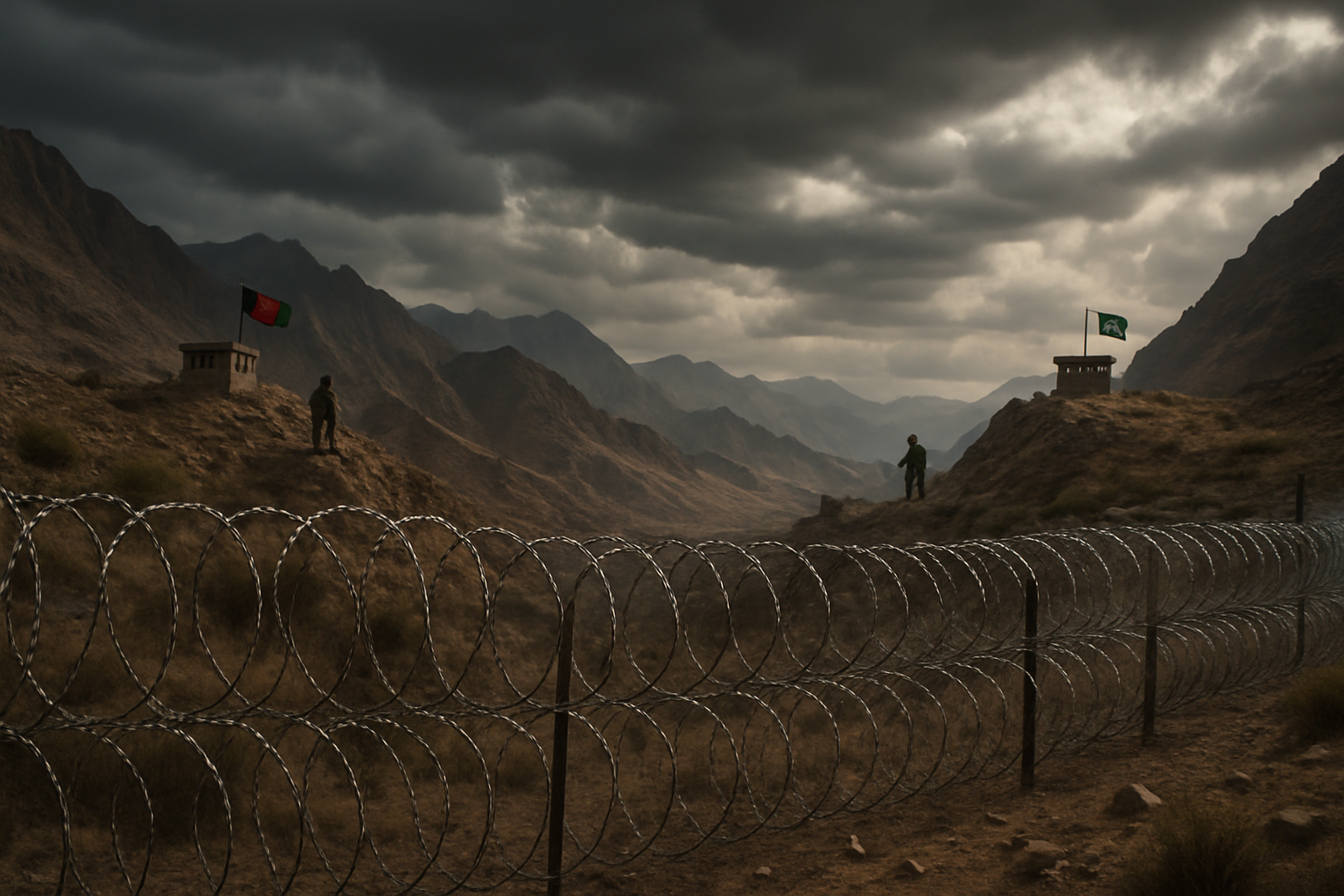
Cross-border tensions between Afghanistan and Pakistan have escalated dramatically as Taliban deputy minister Mohammad Naeem Wardak claimed that Taliban forces have crossed the disputed Durand Line and are engaged in "intense fighting" inside Pakistani territory, marking a dangerous new phase in the deteriorating relationship between the neighboring countries.
The extraordinary claims, made via social media platform X, come amid a broader regional crisis that has seen the Afghanistan-Pakistan border become a flashpoint for military confrontation, economic collapse, and humanitarian disaster. The developments follow months of escalating tensions that have already seen both nations exchange declarations of "open war" and conduct cross-border military operations.
Taliban Claims Cross-Border Military Operations
Mohammad Naeem Wardak, the Taliban's deputy minister for finance and administration at the foreign ministry, alleged that Taliban forces are currently engaged in clashes at Pakistani military bases across the border. His statements represent one of the most provocative public claims made by Taliban officials regarding direct military action inside Pakistani territory.
The claims come against a backdrop of sustained military confrontation that began with a series of terrorist attacks and retaliatory strikes. The crisis escalated dramatically in February 2026 when Pakistani Defense Minister Khawaja Mohammad Asif formally declared "open war" against Afghanistan's Taliban government, following what Pakistan described as cross-border terrorism from Afghan soil.
"The Taliban forces have crossed the Durand Line and are engaged in intense fighting inside Pakistani territory at military bases across the border."
— Mohammad Naeem Wardak, Taliban Deputy Minister
Deadly Protests Rock Pakistan
Separately, Pakistan is grappling with deadly demonstrations following reports of the killing of Iran's Supreme Leader Ayatollah Ali Khamenei in alleged joint U.S. and Israeli strikes. The protests by Khamenei supporters turned violent, with casualty reports varying between 17 and 34 people killed nationwide as police forces met demonstrations with force across multiple cities.
The protests have added another layer of complexity to Pakistan's already strained security situation, as the country simultaneously deals with cross-border tensions with Afghanistan while managing internal unrest related to regional geopolitical developments.
Historical Context of Border Tensions
The current crisis represents the culmination of decades-old disputes over the 2,640-kilometer Durand Line, established by British colonial authorities in 1893. No Afghan government has ever formally recognized this boundary, viewing it as an artificial division of Pashtun tribal lands. The Taliban government continues this position, considering the border illegitimate and contributing to ongoing sovereignty disputes.
The situation deteriorated significantly following a February 16, 2026, attack in Pakistan's Bajaur district that killed 11 Pakistani soldiers. The attack, carried out by the banned Tehreek-e-Taliban Pakistan (TTP) using a vehicle-borne improvised explosive device, prompted Pakistan to conduct retaliatory airstrikes on February 22 targeting seven terrorist camps in Afghanistan's Nangarhar and Paktika provinces.
While Pakistan claimed to have killed over 80 militants in these strikes, the operations also resulted in civilian casualties, including eight schoolchildren in Behsud district. The Taliban government condemned the attacks as violations of Afghan sovereignty and threatened a "measured and appropriate response."
Economic Devastation and Humanitarian Crisis
The military confrontation has precipitated a devastating economic collapse in bilateral relations. Trade between the two countries has plummeted by 59%, with Pakistani exports to Afghanistan dropping from over $550 million to just $228 million in the first seven months of the current fiscal year. This dramatic decline has severely affected border communities dependent on cross-border commerce.
The economic crisis compounds Afghanistan's already dire humanitarian situation, where 88% of female-headed households are unable to meet minimum living requirements according to UN data. Traditional trade routes through Chaman-Spin Boldak and Torkham crossings have faced repeated closures, further strangling economic activity.
International Mediation Efforts Fall Short
Despite multiple international mediation attempts, diplomatic solutions have proven elusive. Saudi Arabia facilitated a prisoner exchange in February 2026, securing the release of three Pakistani soldiers held by the Taliban since October 2025 border clashes. Iran and Turkey have also offered mediation services, warning of broader regional implications if the crisis continues to escalate.
However, these confidence-building measures have been insufficient to address the underlying security challenges. Former U.S. special envoy for Afghanistan Zalmay Khalilzad has criticized Pakistan's military leadership, arguing that it "fundamentally misreads Afghanistan and wrongly assumes it can force Kabul to accept its demands through military pressure."
"Pakistan's demands from Afghanistan are so unreasonable that even the government of Pakistan is embarrassed to articulate them."
— Zalmay Khalilzad, Former U.S. Special Envoy
Military Escalation and Strategic Implications
The military dimension of the crisis has evolved from airstrikes to what appears to be sustained territorial confrontations. According to Taliban sources, Afghanistan's Air Force has conducted retaliatory operations targeting key Pakistani military installations, including Nur Khan Airbase in Rawalpindi, the 12th Division headquarters in Quetta, and the Khwazai Camp in Mohmand Agency.
Pakistani military operations, designated "Operation Ghazab-ul-Haq," have resulted in what Pakistan claims are hundreds of Taliban casualties, while the Taliban disputes these figures and reports successful counter-operations against Pakistani forces.
The escalation represents the most serious Pakistan-Afghanistan confrontation since the Taliban's return to power in August 2021, testing the post-2021 South Asian security architecture and raising concerns about the involvement of nuclear-armed neighbors in sustained military conflict.
Regional and Global Implications
The crisis occurs within a broader context of regional instability, with Pakistan acknowledging its diminished influence over Afghanistan compared to wealthier regional powers including Turkey, the UAE, Qatar, Saudi Arabia, and China. This shift has pushed Pakistan toward military solutions as traditional diplomatic leverage has eroded.
China has warned the UN Security Council about the presence of ISIS-K, al-Qaeda, and ETIM militants in Afghanistan, contradicting Taliban claims of having defeated terrorism. These warnings highlight the transnational security implications of the Afghanistan-Pakistan confrontation, with potential spillover effects across the region.
The international community faces mounting pressure to develop effective conflict prevention mechanisms before the situation deteriorates into a broader regional confrontation. The crisis serves as a critical test of 21st-century diplomatic frameworks for managing territorial sovereignty disputes intersecting with transnational terrorism concerns.
Humanitarian Concerns and Civilian Impact
Beyond the military and political dimensions, the crisis has exacted a heavy toll on civilian populations on both sides of the border. Recent strikes have targeted civilian areas, including religious institutions during the holy month of Ramadan, raising serious international humanitarian law concerns.
Medical facilities have been overwhelmed treating wounded civilians, while rescue operations continue for those trapped in damaged buildings. The pattern of civilian casualties has prompted calls from international organizations for immediate adherence to the principles of distinction, proportionality, and precaution under international humanitarian law.
Border communities, merchants, and transporters face severe hardship from trade disruptions and repeated crossing closures. The cultural and social connections that have traditionally linked populations across the colonial-era boundary are being severely strained by the ongoing crisis.
Looking Forward: Diplomatic Innovation Required
The Afghanistan-Pakistan border crisis represents a comprehensive challenge to regional stability that requires innovative diplomatic frameworks. Success will depend on the Taliban government's capability to control militant groups operating from Afghan territory, Pakistan's willingness to prioritize diplomatic engagement over military solutions, and sustained international support for mediation efforts.
The coming weeks will be critical in determining whether diplomatic mechanisms can prevent a broader regional confrontation or if the situation will continue to deteriorate toward sustained military escalation. The crisis serves as a template for addressing 21st-century challenges where territorial sovereignty concerns intersect with transnational terrorism, making its resolution significant far beyond the immediate region.
As both nations grapple with internal challenges and external pressures, the international community's ability to facilitate a peaceful resolution will have implications for conflict prevention mechanisms globally and set precedents for managing similar disputes in an increasingly interconnected world.