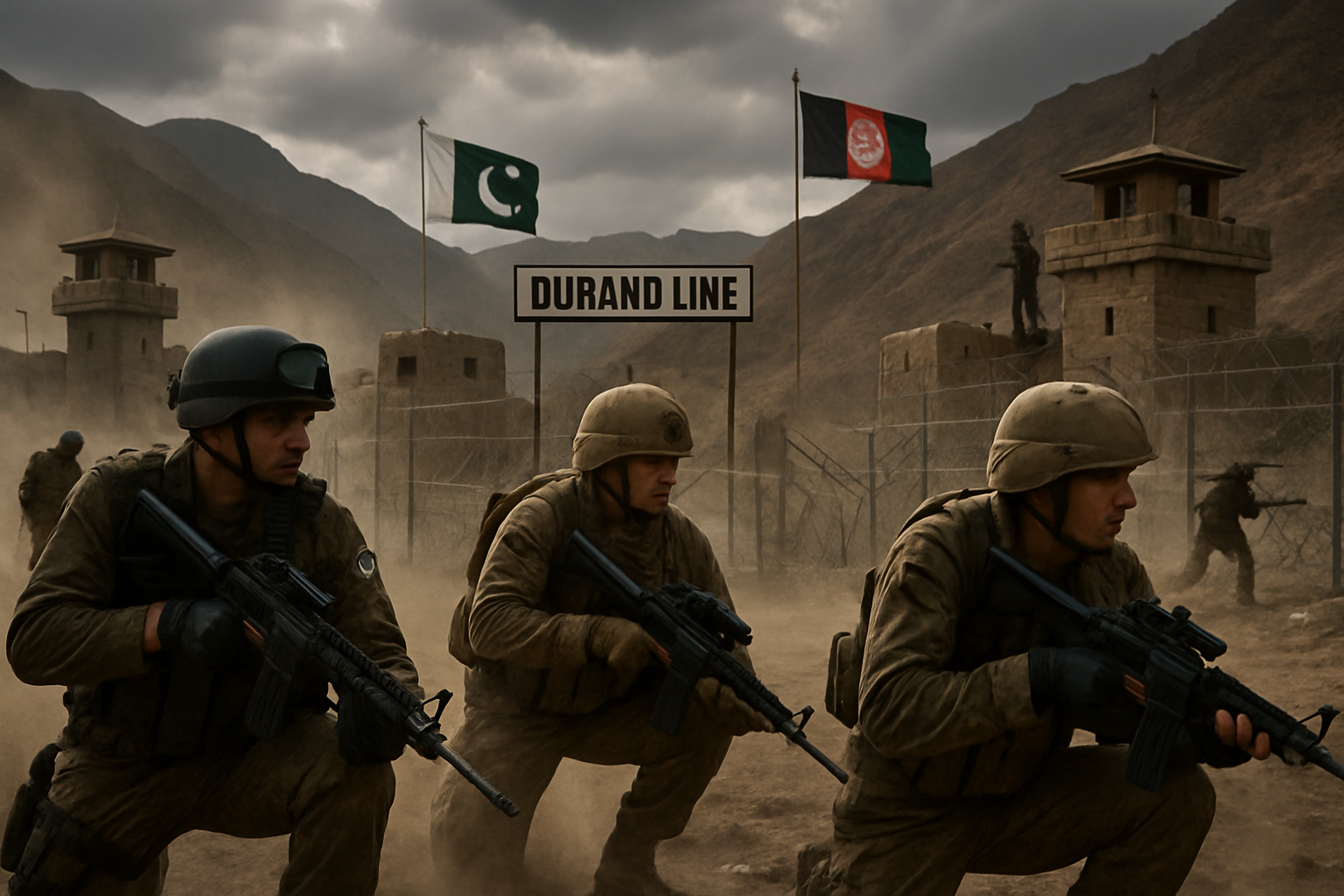
Afghanistan's Defense Ministry announced that Taliban forces captured a Pakistani military post along the disputed Durand Line, claiming 14 Pakistani soldiers were killed and 11 others wounded during intense cross-border fighting that has brought the neighboring countries to the brink of sustained warfare.
The Taliban's Ministry of Defense issued a statement Saturday describing the operation as a defensive response to what it termed "crimes of the Pakistani military regime" in border areas of Kunar and Nangarhar provinces. The announcement represents the latest escalation in a month-long military confrontation that began with a February 16 terrorist attack in Pakistan's Bajaur district.
Disputed Military Claims and Counter-Accusations
Taliban officials claim their forces destroyed one armored tank and a military vehicle belonging to Pakistani troops during the fighting. However, Pakistan's Ministry of Information and Broadcasting swiftly rejected these assertions, calling them "false as always, fabricated and designed to mislead Afghan internal public opinion."
The Pakistani military's fact-checking account described the Taliban claims as part of a pattern of misinformation from "terror sponsors" who are "unfortunately first-hand experiencing and suffering under these terror sponsors." Pakistan maintains that no military posts have been captured despite the Taliban's public declarations.
"This latest claim of the so-called Ministry of Defence of the Afghan Taliban Regime regarding capturing some post and made up damages etc., is false as always, fabricated and designed to mislead Afghan internal public opinion."
— Pakistan Ministry of Information and Broadcasting
Drone Attacks and Civilian Casualties
The border violence has expanded beyond conventional military exchanges to include drone warfare targeting civilian areas. Pakistan's Inter-Services Public Relations (ISPR) confirmed that Afghan Taliban forces launched "rudimentary" drones that injured at least four people, including two children, in attacks on Quetta, Kohat, and Rawalpindi.
The Pakistani military successfully intercepted the drones through electronic countermeasures, preventing them from reaching their intended targets. However, the attacks represent a dangerous escalation as they targeted populated civilian areas far from the border region.
"These attacks were aimed at inducing fear in the public and remind us of the terrorist mindset which drives the Afghan Taliban," the ISPR statement noted, emphasizing the deliberate targeting of non-combatant populations.
Chinese Diplomatic Intervention
As tensions reach a critical point, China has emerged as a key diplomatic mediator, with Foreign Minister Wang Yi holding urgent telephone discussions with Afghan Acting Foreign Minister Amir Khan Muttaqi. The Chinese Foreign Ministry emphasized the need for disputes between the two sides to be "resolved through consultation and negotiation."
China's intervention carries significant weight given its substantial economic investments in both countries, particularly through the China-Pakistan Economic Corridor (CPEC) and growing trade relationships with Afghanistan. Beijing's call for restraint reflects concerns that sustained warfare could destabilize the broader region and threaten Chinese strategic interests.
Historical Context of the Durand Line Dispute
The current crisis is rooted in the century-old dispute over the Durand Line, a 2,640-kilometer border established by British colonial authorities in 1893. No Afghan government has ever formally recognized this boundary, viewing it as an artificial division of Pashtun tribal lands that has created ongoing tensions between the neighboring countries.
The porous mountainous terrain along the border has provided sanctuary for various militant groups, complicating efforts by both governments to maintain security. Pakistan maintains that the Tehreek-e-Taliban Pakistan (TTP) operates "with impunity from Afghan soil," while Taliban authorities deny providing sanctuary to militant organizations.
Economic Devastation and Humanitarian Impact
The military confrontation has had severe economic consequences, with bilateral trade collapsing by 59% over the past seven months. Pakistani exports to Afghanistan have plummeted from $550 million to just $228 million, affecting border communities dependent on cross-border commerce.
Traditional trade routes through Chaman-Spin Boldak and Torkham have faced repeated closures, compounding Afghanistan's humanitarian crisis. According to UN data, 88% of female-headed households in Afghanistan are unable to meet minimum living requirements, a situation that has been exacerbated by the border disruptions.
International Mediation Efforts
Multiple countries have attempted to mediate the crisis, including Saudi Arabia, Iran, Turkey, and Russia. Despite these efforts, including a Saudi-mediated prisoner exchange in February 2026 that secured the release of three Pakistani soldiers, confidence-building measures have proven insufficient to address the underlying security challenges.
The failure of diplomatic initiatives has led Pakistan to acknowledge its diminished regional influence compared to wealthier powers such as Turkey, the UAE, Qatar, Saudi Arabia, and China. This shift has increased Pakistan's reliance on military solutions rather than traditional diplomatic leverage.
Regional Security Implications
The Afghanistan-Pakistan border crisis represents the most serious military confrontation between the countries since the Taliban's return to power in August 2021. The conflict tests the post-2021 South Asian security architecture and raises concerns about potential spillover effects throughout the region.
Chinese warnings at the UN Security Council about the presence of ISIS-K, al-Qaeda, and the East Turkestan Islamic Movement (ETIM) in Afghanistan contradict Taliban claims of having "defeated terrorism" and highlight the complex security challenges facing the region.
"War has never been our first option, but anyone who sets eyes on Afghan soil with ill intent has been met with a firm response."
— Taliban Defense Ministry Spokesperson Enayatullah Khwarazmi
Nuclear Dimension and International Concerns
The involvement of nuclear-armed Pakistan adds a particularly dangerous dimension to the crisis, requiring careful international monitoring to prevent escalation beyond conventional military operations. The international community faces increasing pressure to develop effective conflict prevention mechanisms before the confrontation spreads to other regions.
Pakistan President Asif Ali Zardari has warned that Afghanistan has "crossed a red line" with its drone attacks, suggesting that Pakistan may be prepared to escalate its military response if the attacks continue. This rhetoric indicates that both sides may be moving toward a more sustained and dangerous phase of the conflict.
Looking Ahead: Diplomatic Solutions vs. Military Escalation
The coming days will be critical in determining whether international mediation can prevent a broader regional confrontation or if the crisis will escalate into prolonged military conflict. The Taliban maintains that the "path of talks remains open" while seeking "mutual understanding and respect," but Pakistan has indicated there is "no rush" to end its military campaign.
The success or failure of diplomatic efforts in resolving this crisis may provide a template for 21st-century conflict resolution, particularly in situations where counter-terrorism concerns intersect with territorial sovereignty disputes. As the international community watches closely, the stakes extend far beyond the immediate border region to encompass broader questions of regional stability and international law.
The crisis represents a comprehensive challenge requiring innovative diplomatic frameworks that balance legitimate security concerns with respect for territorial integrity, civilian protection, and international law compliance. Without such frameworks, the region risks sliding into a prolonged confrontation with implications extending far beyond the Afghanistan-Pakistan border.