Two children were killed and six others wounded when Pakistani forces shelled the Sarkano district of Afghanistan's eastern Kunar province on Wednesday evening, marking the latest casualties in a border crisis that has now entered its seventh week and claimed hundreds of civilian lives.
The attack, which reportedly occurred around 5 p.m. local time, struck residential areas according to Afghan officials, deepening concerns over the mounting civilian toll from what has become the most serious Pakistan-Afghanistan confrontation since the Taliban's return to power in August 2021.
The violence comes as diplomatic efforts intensify to resolve the crisis, with China hosting high-level trilateral talks in the northwestern city of Urumqi between Pakistani and Afghan officials under an established diplomatic mechanism.
Diplomatic Push Amid Continued Violence
Despite the ongoing military operations, a five-member Taliban delegation led by Mohibullah Wasiq, the Afghan Foreign Ministry's chief of staff, joined talks with Pakistani officials in China. The Afghan delegation includes senior officials from the defense and interior ministries as well as intelligence representatives, while Pakistan is represented by Special Representative Mohammad Sadiq.
According to Pakistani officials familiar with the discussions, the meeting focused on "sharing perspectives on the latest escalation" rather than serving as a formal mediation effort. China has been pushing for confidence-building measures, including the reopening of crucial trade routes that have been repeatedly closed during the crisis.
Chinese Foreign Minister Wang Yi has maintained active mediation efforts, with special envoys shuttling between Kabul and Islamabad as Beijing seeks to manage a crisis that threatens regional stability and China's strategic interests, including the China-Pakistan Economic Corridor (CPEC) investments.
Escalating Humanitarian Crisis
The latest casualties in Kunar add to a devastating humanitarian toll that has emerged since the crisis began on February 16 with a Tehrik-e-Taliban Pakistan (TTP) attack in Bajaur that killed 11 Pakistani soldiers. According to the United Nations Assistance Mission in Afghanistan (UNAMA), the conflict has resulted in 185 civilian casualties, with 56 killed and 129 wounded, the majority being women and children.
The UN Office for the Coordination of Humanitarian Affairs (OCHA) reports that 16,370 families have been newly displaced across 10 Afghan provinces, with Paktia province alone accounting for 7,000 displaced families, while Kunar and Khost provinces each have 3,500 and 2,500 displaced families respectively.
The World Health Organization has been forced to deliver emergency oxygen supplies to only 23 hospitals, while hundreds of health centers have closed due to security concerns and funding shortages. This compounds an already severe humanitarian crisis in Afghanistan, where 88% of female-headed households are unable to meet minimum living requirements.
Economic Warfare and Trade Collapse
The border crisis has precipitated a dramatic collapse in bilateral trade, with Pakistani exports to Afghanistan dropping 59% from $550 million to $228 million over seven months. Traditional trade routes, including the Chaman-Spin Boldak and Torkham crossings, have faced repeated closures, devastating border communities dependent on cross-border commerce.
In remote mountainous regions like Nuristan province, residents and tribal elders have appealed to Taliban officials to intervene and reopen roads blocked by Pakistan, creating critical supply shortages for essential goods, medical supplies, and humanitarian aid.
The Durand Line Dispute
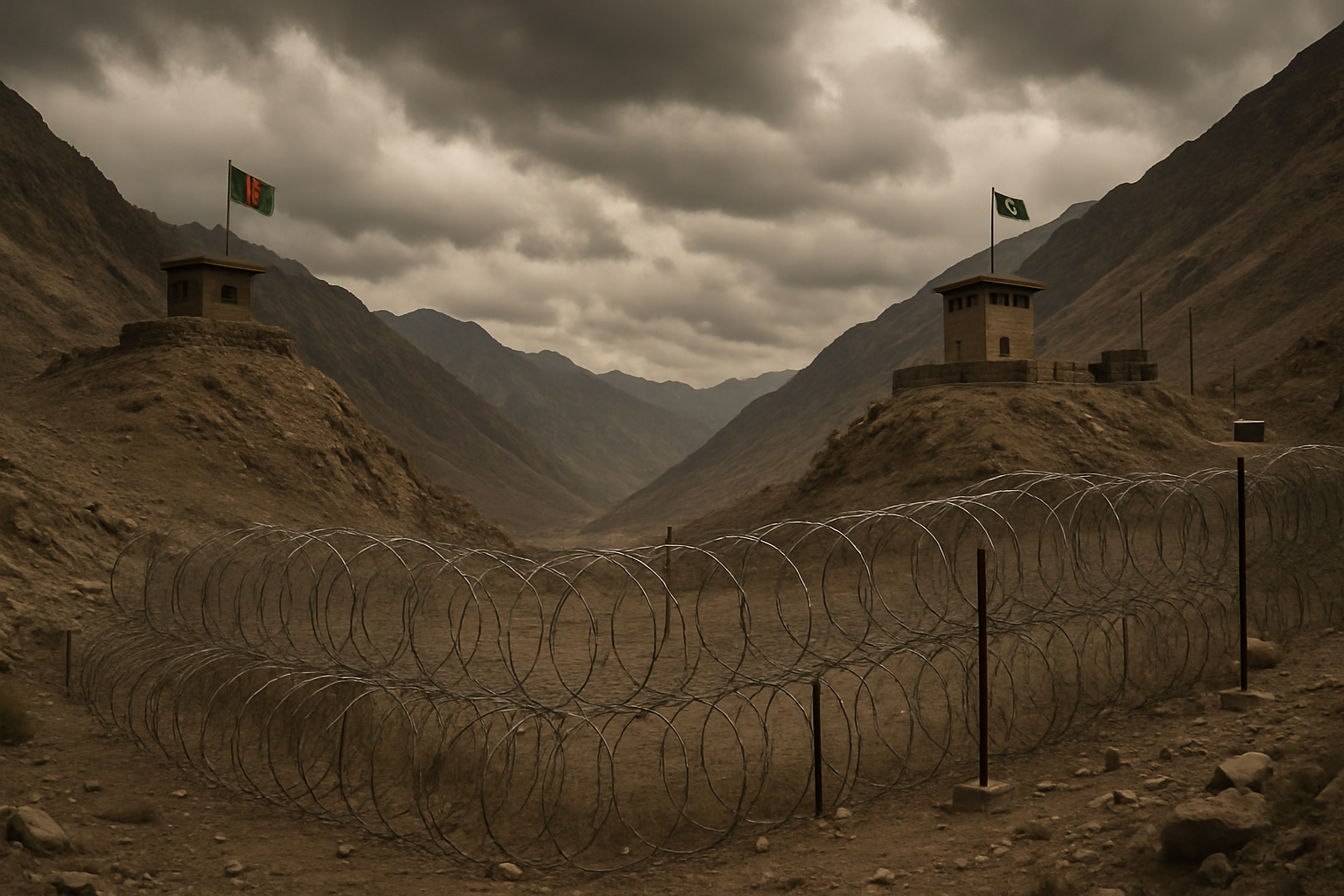
At the heart of the crisis lies the fundamental dispute over the 2,640-kilometer Durand Line, the colonial-era border established by the British in 1893 that has never been recognized by any Afghan government. Afghanistan views the boundary as an artificial division of Pashtun tribal areas, while Pakistan maintains it as its legitimate international border.
Pakistan continues to assert that the TTP operates "with impunity from Afghan soil," using the porous mountainous terrain along the border to launch attacks. The Taliban government categorically denies providing sanctuary to militant groups, insisting that it does not allow Afghan territory to be used for attacks against neighboring countries.
Military Escalation Timeline
The current crisis began with the February 16 TTP attack in Bajaur that used a vehicle-borne improvised explosive device to kill 11 Pakistani soldiers. Pakistan responded on February 22 with airstrikes targeting seven alleged terrorist camps in Nangarhar and Paktika provinces, claiming to have killed more than 80 militants but also causing civilian casualties, including eight schoolchildren.
The conflict reached unprecedented levels on February 27 when Pakistani Defense Minister Khawaja Mohammad Asif formally declared "open war" against the Taliban government, launching Operation Ghazab lil-Haq (Operation Divine Retribution). The military campaign has since expanded beyond border regions to strategic installations, including strikes on Bagram Airfield and facilities in Kabul.
Taliban forces have responded with their own "Rad al-Zulm" (Response to Oppression) operations, claiming significant military victories including the capture of Pakistani border posts and conducting drone strikes on Pakistani military facilities.
International Mediation Efforts
Multiple international actors have attempted to mediate the crisis, with mixed results. Saudi Arabia, Qatar, and Turkey achieved a temporary breakthrough in March through faith-based diplomacy, securing a brief ceasefire during Eid al-Fitr (March 18-23) by leveraging religious and cultural considerations during Ramadan.
However, the ceasefire was violated almost immediately, with Pakistani forces reportedly firing artillery shells into Kunar province within hours of the truce announcement. The violation highlighted the fragility of temporary measures when underlying structural issues remain unresolved.
Iran, Turkey, and Russia have all offered mediation services, while religious scholars, including prominent clerics from both countries, have issued joint appeals calling for an extended ceasefire until Eid al-Adha. The International Union of Muslim Scholars condemned attacks during Ramadan as violations of Islamic principles and international law.
Nuclear Implications and Regional Security
The involvement of nuclear-armed Pakistan adds a dangerous dimension to the crisis, requiring careful international monitoring to prevent escalation beyond conventional operations. The confrontation represents the most serious test of the post-2021 South Asian security architecture since the Taliban's return to power.
Pakistan acknowledges its diminished influence in Afghanistan compared to wealthier powers such as Turkey, the UAE, Qatar, Saudi Arabia, and China, leading to an increased reliance on military solutions. This shift has been accompanied by warnings from Chinese officials at the UN about the presence of ISIS-K, al-Qaeda, and the East Turkestan Islamic Movement (ETIM) in Afghanistan, contradicting Taliban claims of having defeated terrorism.
Looking Ahead
As the crisis enters its seventh week, the Taliban maintains that "the path of talks remains open" and seeks resolution through "mutual understanding and respect." Pakistan, however, has indicated there is "no rush" to end the military campaign until concrete anti-militant measures are implemented by the Taliban government.
The current trilateral talks in China represent a critical test of whether innovative diplomatic frameworks can manage the complex intersection of territorial sovereignty and transnational terrorism challenges that define 21st-century conflicts. The success or failure of these mediation efforts will have implications that extend far beyond the bilateral relationship, potentially serving as a template for conflict resolution mechanisms globally.
The ongoing violence, exemplified by Wednesday's tragic killing of children in Kunar, underscores the urgent need for a sustainable peace framework that addresses the root causes of the conflict while protecting civilian populations caught in the crossfire of this dangerous escalation between nuclear-armed neighbors.