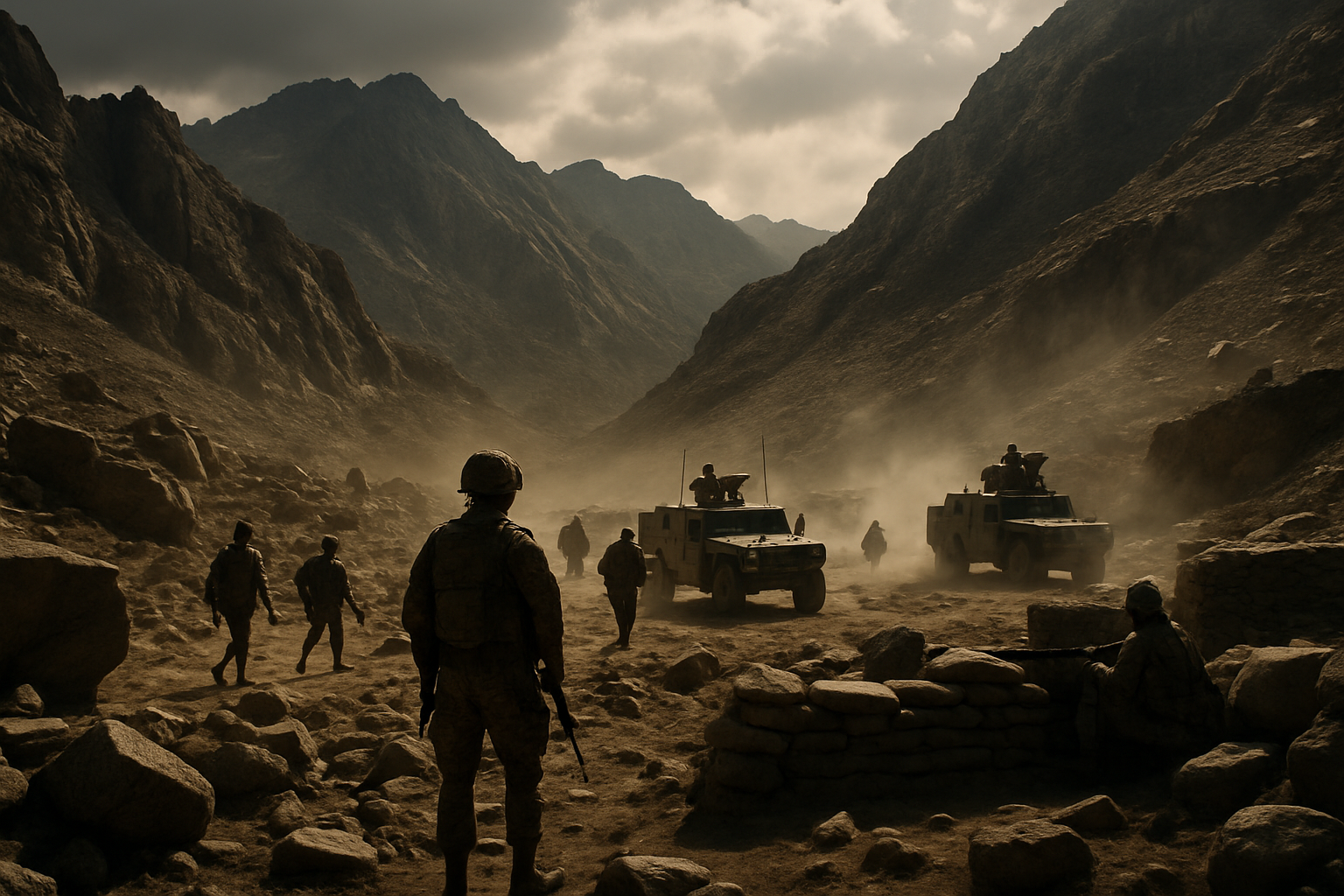
Fresh military clashes erupted along Afghanistan's eastern border with Pakistan on Thursday evening, marking the latest escalation in a deteriorating security situation that has plagued the region since February 2026.
Local sources report fighting between Taliban forces and Pakistani military units in the strategic border provinces of Khost and Paktia, while Taliban officials have accused Pakistani forces of conducting attacks targeting civilian areas across multiple provinces.
The renewed violence comes despite months of international mediation efforts, including Chinese-led trilateral talks and various diplomatic initiatives that have failed to address the underlying disputes fueling the conflict.
Latest Border Incidents
According to sources in Khost province, the first clash began around 7:00 p.m. Thursday in the Ghulam Khan crossing area, a critical border point that has witnessed repeated confrontations since the current crisis began in February.
Residents in the Tani district of Khost reported that Pakistani forces targeted civilian homes late Thursday night, forcing families to flee amid growing fears of further casualties. The attacks have created a climate of terror among border communities already struggling with the economic and humanitarian consequences of the prolonged conflict.
"Pakistani soldiers attacked civilian houses in the Tani district of Khost late Thursday, as fighting continued along the border. The reports indicate a concerning escalation in targeting civilian areas."
— Local Media Reports
Historical Context of the Crisis
The current violence represents the latest chapter in a crisis that began with a February 16 Tehrik-e-Taliban Pakistan (TTP) attack in Bajaur district that killed 11 Pakistani soldiers. Pakistan's subsequent airstrikes on February 22 targeting what it claimed were terrorist camps resulted in civilian casualties, including eight schoolchildren.
The situation dramatically escalated on February 27 when Pakistani Defense Minister Khawaja Mohammad Asif formally declared "open war" against Afghanistan's Taliban government, launching Operation Ghazab lil-Haq — the most serious military confrontation between the neighbors since the Taliban's return to power in August 2021.
The conflict has been centered around the disputed 2,640-kilometer Durand Line, the colonial-era border established by the British in 1893 that has never been recognized by any Afghan government. Pakistan maintains that TTP and other militant groups operate "with impunity from Afghan soil," while the Taliban categorically denies providing sanctuary to foreign militants.
Humanitarian Consequences
The prolonged conflict has exacted a devastating humanitarian toll. According to the UN Assistance Mission in Afghanistan (UNAMA), at least 289 civilian casualties have been documented, including 76 deaths and 213 injuries, with women and children comprising the majority of victims.
The Office for the Coordination of Humanitarian Affairs (OCHA) reports that more than 16,370 families have been newly displaced across ten Afghan provinces, including:
- Paktia province: 7,000 displaced families
- Kunar province: 3,500 displaced families
- Khost and Nangarhar provinces: 2,500 families each
The World Health Organization has been forced to deliver emergency medical oxygen to only 23 hospitals nationwide, while hundreds of health centers have closed due to security concerns and funding shortfalls. This medical crisis compounds an already dire situation where 88% of female-headed households in Afghanistan are unable to meet minimum living requirements.
Economic Warfare and Trade Collapse
The military confrontation has precipitated a catastrophic economic collapse in bilateral relations. Pakistan's exports to Afghanistan have plummeted by 59% over seven months, dropping from $550 million to just $228 million, according to State Bank data.
Traditional trade routes through Chaman-Spin Boldak and the Torkham crossing face repeated closures, affecting border communities that depend entirely on cross-border commerce for their livelihoods. This economic warfare has particularly impacted remote areas like Nuristan province, where residents are appealing for road reopenings due to acute shortages of essential goods and medical supplies.
International Mediation Efforts
Despite intensive diplomatic efforts by multiple regional powers, attempts to resolve the crisis have yielded only temporary respite. China has taken a leading role in mediation, hosting trilateral talks in Urumqi between Afghan and Pakistani delegations, with Foreign Minister Wang Yi actively shuttling between Kabul and Islamabad.
Religious diplomacy achieved a brief breakthrough during Eid al-Fitr in March, when Saudi Arabia, Qatar, and Turkey coordinated a temporary ceasefire. However, the truce was immediately violated, demonstrating the fragility of peace efforts when underlying structural issues remain unaddressed.
"China hopes both sides maintain calm, conduct face-to-face talks as soon as possible, establish a ceasefire, and resolve disputes through dialogue."
— Chinese Foreign Minister Wang Yi
Other mediation attempts have included Iranian offers of assistance, Turkish Foreign Minister Hakan Fidan's shuttle diplomacy, Russian Special Envoy Zamir Kabulov's intervention, and various confidence-building measures, including a Saudi-mediated prisoner exchange in February that saw three Pakistani soldiers released from Taliban custody.
Nuclear Dimensions and Regional Security
The crisis carries particular gravity given Pakistan's nuclear capabilities, making this the most serious confrontation involving a nuclear-armed state since the Taliban's return to power. International observers note that the conflict tests the post-2021 South Asian security architecture and could serve as a template for managing similar territorial sovereignty versus transnational terrorism challenges in the 21st century.
Pakistan acknowledges that it has diminished influence in Afghanistan compared to wealthier powers like Turkey, the UAE, Qatar, Saudi Arabia, and China, leading to an increased reliance on military solutions. This strategic realignment has broader implications for regional stability and conflict resolution mechanisms.
Divergent Positions and Future Prospects
The Taliban government maintains that "the path of talks remains open" and seeks resolution through "mutual understanding and respect." Taliban officials consistently deny providing sanctuary to militant groups and emphasize their commitment to preventing the use of Afghan territory for attacks against neighboring countries.
Pakistan, however, has indicated "no rush" to end its military campaign until concrete anti-militant measures are implemented. Defense Minister Asif has announced that operations will continue with "no fixed timeline" until Pakistan achieves its security objectives.
Opposition voices within Pakistan, including Maulana Fazlur Rehman of Jamiat Ulema-e-Islam (F), have called for a comprehensive policy review, warning that Pakistan faces regional isolation and questioning why 70 years of engagement have failed to improve relations with Afghanistan.
Looking Ahead
The current situation represents a critical juncture for regional stability. The success or failure of diplomatic efforts to contain this crisis will influence global approaches to managing the complex intersection of territorial sovereignty and transnational terrorism concerns that characterize many contemporary conflicts.
As international mediation continues, the coming days will be decisive in determining whether innovative diplomatic frameworks can prevent a broader regional confrontation or whether the two nuclear-capable neighbors will continue down a path of sustained military escalation with far-reaching consequences for South Asian security.
The stakes extend well beyond bilateral relations, affecting international security architecture, regional stability mechanisms, and the development of 21st-century conflict resolution approaches that must balance legitimate security concerns with respect for territorial integrity, civilian protection, and international law compliance.