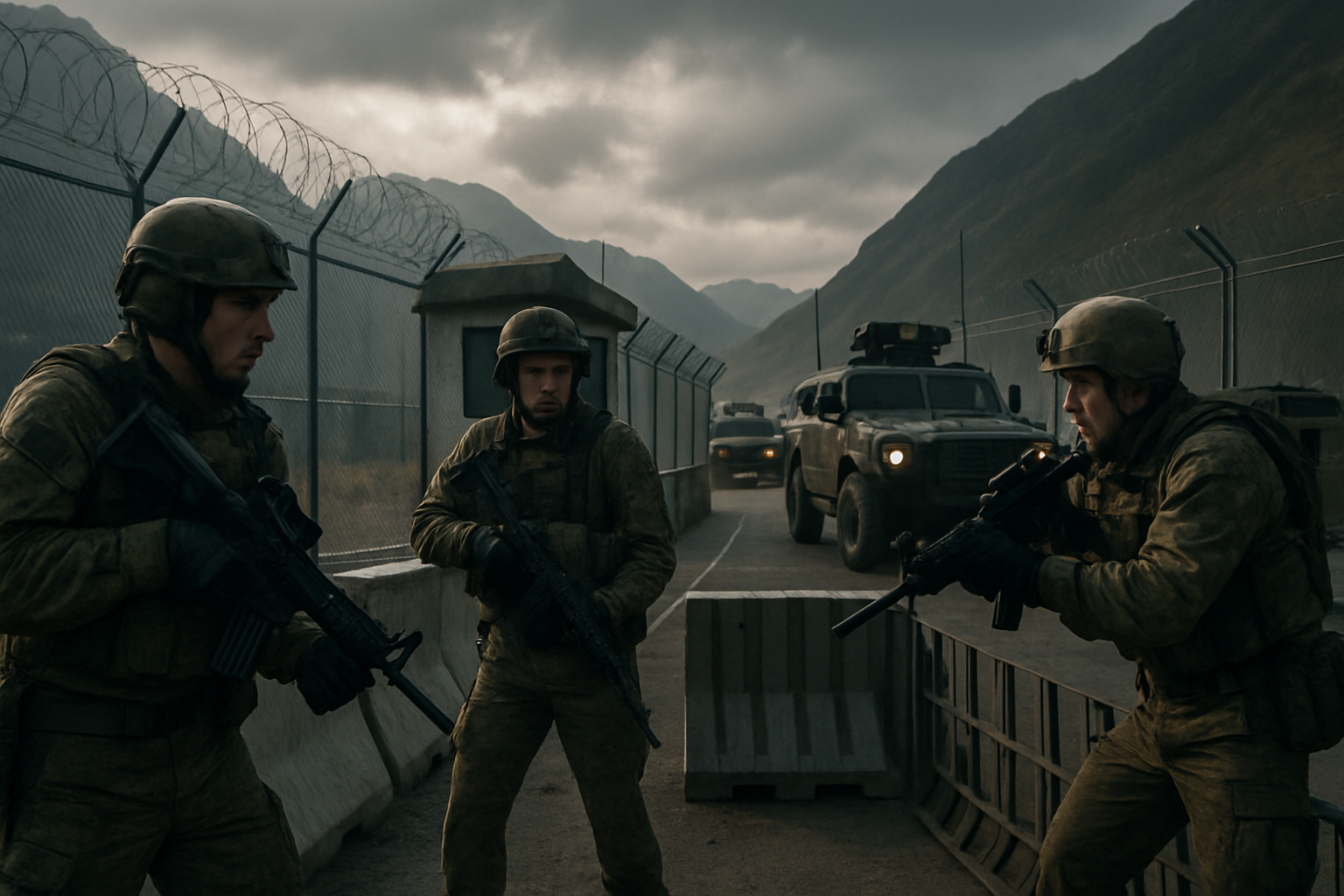
Afghanistan and Pakistan are locked in their most serious military confrontation since the Taliban's return to power in 2021, with escalating drone strikes, artillery exchanges, and cross-border raids claiming both military and civilian lives along the disputed Durand Line.
The Taliban government in Kabul claimed responsibility for a drone strike on a Pakistani military camp in South Waziristan's Wana area, describing it as retaliation for Pakistani airstrikes in Afghanistan. The Afghan Ministry of Defense said the attack targeted Pakistani forces in response to overnight raids in Kandahar province, marking a dangerous escalation in cross-border violence that has plagued the region for months.
Cycle of Retaliation Intensifies
The latest exchange of fire represents the continuation of a deadly cycle that began on February 16, 2026, when a Tehrik-e-Taliban Pakistan (TTP) attack in Bajaur district killed 11 Pakistani soldiers using a vehicle-borne improvised explosive device. Pakistan responded with coordinated airstrikes on February 22, targeting what it described as seven terrorist camps in Afghanistan's Nangarhar and Paktika provinces.
Those Pakistani strikes, while claiming to have killed over 80 militants, also resulted in civilian casualties, including eight schoolchildren in Behsud district. The tragedy prompted Afghanistan to threaten a "measured and appropriate response," describing the protection of sovereignty and population as "religious obligations and national duties."
"These strikes were carried out in response to Pakistani air raids that violated our airspace and sovereignty."
— Taliban Ministry of Defense Statement
The situation reached a critical juncture on February 27 when Pakistani Defense Minister Khawaja Asif declared "open war" against Afghanistan's Taliban government – the first formal declaration of its kind between the neighboring countries since the Taliban's return to power.
Humanitarian Crisis Deepens
The escalating violence has taken a devastating toll on civilian populations. Pakistani media reported that at least five members of a family were killed when a rocket fired from Afghanistan struck their home in the village of Salarzai in Bajaur district. The victims were civilians caught in the crossfire of the military confrontation.
According to the UN Office for the Coordination of Humanitarian Affairs (OCHA), over 16,000 families have been newly displaced across 10 Afghan provinces, while the UN Assistance Mission in Afghanistan (UNAMA) has documented 185 civilian casualties – 56 killed and 129 wounded – between February 26 and March 5 alone.
The humanitarian crisis is compounded by Afghanistan's existing challenges. The World Health Organization is providing emergency medical oxygen to only 23 hospitals, while hundreds of health centers have closed due to funding cuts and security concerns. An estimated 88% of female-headed households in Afghanistan are unable to meet minimum living requirements.
Economic Devastation and Trade Collapse
The border violence has severely impacted bilateral trade, which has collapsed by 59% over seven months. Pakistani exports to Afghanistan dropped from $550 million to $228 million, affecting border communities that depend on cross-border commerce. Traditional trade routes through Chaman-Spin Boldak and Torkham crossings face repeated closures, further strangling the economic lifeline between the two countries.
This economic disruption comes at a particularly challenging time for both nations. Pakistan is undergoing an IMF-monitored economic recovery program, while Afghanistan faces international sanctions and limited access to global financial systems.
The Durand Line Dispute
At the heart of the current crisis lies the long-standing dispute over the Durand Line, the 2,640-kilometer colonial-era border established by the British in 1893. Afghanistan has never formally recognized this boundary, viewing it as an artificial division of Pashtun tribal lands. The porous, mountainous terrain along this border provides sanctuary for militant groups and complicates security operations for both countries.
Pakistan maintains that TTP and other militant organizations operate "with impunity from Afghan soil," using the difficult terrain to launch attacks before retreating to safe havens. The Taliban government categorically denies providing sanctuary to any group that conducts attacks against neighboring countries, but acknowledges the challenges of controlling the remote border regions.
International Mediation Efforts Fall Short
Despite multiple diplomatic interventions, international mediation efforts have failed to prevent the escalation. Saudi Arabia facilitated a prisoner exchange in February 2026, securing the release of three Pakistani soldiers captured during October 2025 border clashes. Iran, Turkey, Russia, and China have all offered mediation services, reflecting regional and global concerns about the conflict's potential to destabilize South Asia.
The crisis has exposed Pakistan's acknowledgment of its diminished influence in Afghanistan compared to wealthier regional powers including Turkey, the UAE, Qatar, Saudi Arabia, and China. This has pushed Pakistan toward increasingly relying on military solutions rather than diplomatic engagement.
Nuclear Dimension and Regional Security
The involvement of nuclear-armed Pakistan adds a particularly dangerous dimension to the crisis, requiring careful international monitoring to ensure the conflict doesn't escalate beyond conventional operations. The confrontation represents the most serious test of the post-2021 South Asian security architecture since the Taliban's return to power.
Chinese warnings at the UN Security Council about the presence of ISIS-K, al-Qaeda, and the East Turkestan Islamic Movement (ETIM) in Afghanistan contradict Taliban claims of having defeated terrorism. These concerns reflect broader international anxieties about Afghanistan becoming a launching pad for regional and global terrorist activities.
Pattern of Cross-Border Terrorism
The current crisis must be understood within the broader context of cross-border terrorism that has plagued the region. The February 6 ISIS-K bombing of an Islamabad mosque during Friday prayers, which killed 31 people and wounded 169 others, demonstrated the persistent threat posed by Afghanistan-based terrorist groups.
Pakistan has conducted intensive counter-terrorism operations, eliminating over 400 militants in Balochistan alone during February 2026. However, the sophisticated tactics employed by groups like TTP – including coordinated assaults and vehicle-borne explosive devices – demonstrate their retained operational capabilities despite sustained military pressure.
International Law Concerns
The targeting of civilian areas, including residential homes, educational institutions, and religious sites, has raised serious international humanitarian law concerns. UN human rights officials have called for immediate adherence to the principles of distinction, proportionality, and precaution in any military operations.
The timing of some strikes during the holy month of Ramadan has added particular sensitivity to the crisis, with Islamic scholars issuing fatwas calling for immediate ceasefires between Muslim nations. However, these religious appeals have thus far failed to halt military operations.
Looking Ahead: Diplomatic vs. Military Solutions
The Afghanistan-Pakistan border crisis represents a critical test of whether 21st-century diplomatic frameworks can effectively manage the intersection of territorial sovereignty disputes and transnational terrorism concerns. The Taliban maintains that "the path of talks remains open" and seeks resolution through "mutual understanding and respect," while Pakistani officials indicate there is "no rush" to end their military campaign until concrete anti-militant measures are implemented.
The success or failure of diplomatic containment efforts will influence how similar regional challenges are addressed globally. The crisis serves as a template for managing complex security situations where counter-terrorism concerns intersect with governance limitations, historical disputes, and humanitarian obligations.
As the violence continues to escalate, the international community faces mounting pressure to develop effective conflict prevention mechanisms before the confrontation spreads beyond the immediate border region. The stakes extend far beyond bilateral relations, affecting regional stability mechanisms, international conflict resolution approaches, and the broader architecture of post-2021 South Asian security.
Without innovative diplomatic intervention, the current trajectory threatens to establish a dangerous precedent for how territorial sovereignty disputes and cross-border terrorism challenges are managed in an interconnected world where the consequences of regional conflicts increasingly have global implications.