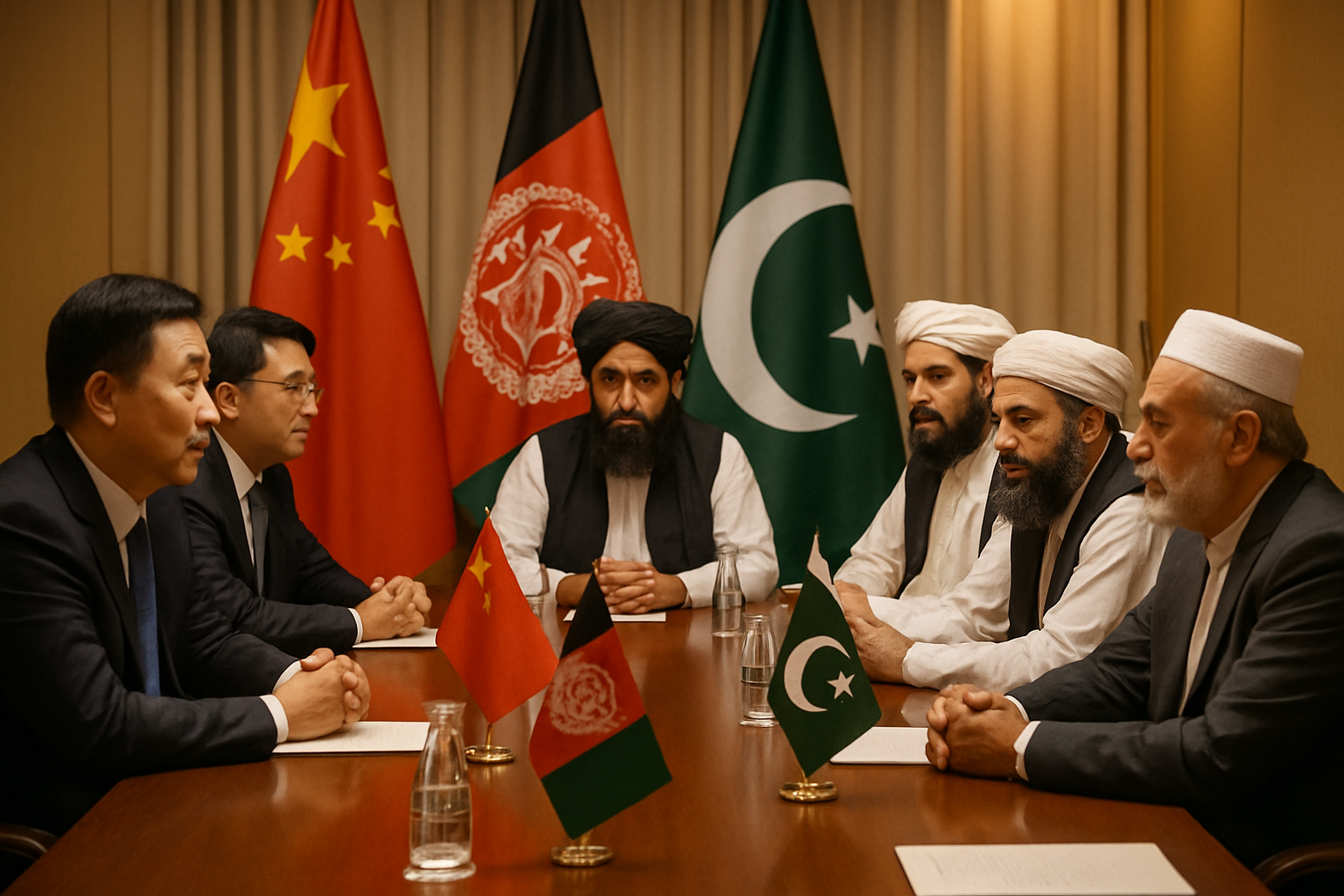
Afghan Taliban and Pakistani officials have begun historic diplomatic talks in the Chinese city of Urumqi, marking the first high-level engagement between the two nations after months of devastating military confrontation that has claimed hundreds of civilian lives and brought the nuclear-armed neighbors to the brink of war.
The talks, facilitated by China at its own initiative, represent a crucial diplomatic breakthrough in what has been the most serious Afghanistan-Pakistan crisis since the Taliban's return to power in August 2021. According to Abdul Qahar Balkhi, spokesperson for Afghanistan's Ministry of Foreign Affairs, the Islamic Emirate delegation arrived in China to hold official discussions with Pakistani representatives "in line with its principled position."
China's Mediation Role
Beijing's intervention comes as the regional power seeks to stabilize its volatile neighborhood and protect its significant economic interests, including the China-Pakistan Economic Corridor (CPEC) investments. Chinese Foreign Minister Wang Yi has been actively shuttling between Kabul and Islamabad, with Beijing positioning itself as a neutral mediator capable of bridging the deep divide between the two Muslim neighbors.
"These talks are set to begin in the city of Urumqi with the mediation of the Chinese government," Balkhi confirmed in his statement. The process is being carried forward "at China's request and on the basis of mutual respect and constructive engagement."
Afghanistan's Minister of Economy, Din Mohammad Hanif, expressed cautious optimism about the negotiations, stating he hopes the discussions will "help bring an end to ongoing tensions and conflict between the two neighboring countries."
Crisis Background and Escalation
The current diplomatic effort comes after nearly two months of unprecedented military confrontation that began with a February 16, 2026 attack by the Tehreek-e-Taliban Pakistan (TTP) in Bajaur district, killing 11 Pakistani soldiers. The incident triggered a devastating escalation cycle that saw Pakistani Defense Minister Khawaja Asif declare "open war" against the Taliban government on February 27.
The conflict has exacted a terrible human toll. According to the UN Assistance Mission in Afghanistan (UNAMA), at least 289 civilian casualties have been documented, including 76 deaths and 213 injuries, with the majority being women and children. The UN Office for the Coordination of Humanitarian Affairs (OCHA) reports that over 16,370 families have been newly displaced across 10 Afghan provinces.
"The Islamic Emirate is participating in these meetings based on a balanced and principled approach, and intends to hold comprehensive and responsible discussions with the other side on good neighborly relations, strengthening trade ties, and the effective management of security issues."
— Abdul Qahar Balkhi, Afghan Foreign Ministry Spokesperson
Pakistan's Foreign Ministry spokesperson, Tahir Andarabi, emphasized that the talks involve senior officials, rejecting claims that they are merely low-level engagements and calling such reports a "false narrative." Islamabad has dispatched a delegation to Urumqi while reiterating its longstanding position that Afghanistan must address Pakistan's security concerns, particularly regarding militant groups.
Humanitarian and Economic Catastrophe
The prolonged crisis has devastated the already fragile region. Bilateral trade between the two countries has collapsed by 59%, with Pakistani exports to Afghanistan plummeting from $550 million to just $228 million over seven months. Traditional trade routes at Chaman-Spin Boldak and Torkham have faced repeated closures, severely affecting border communities that depend on cross-border commerce for survival.
The humanitarian impact extends far beyond trade disruptions. The World Health Organization (WHO) has been forced to deliver emergency medical oxygen to only 23 hospitals, while hundreds of health centers have closed due to security concerns and funding shortages. In Afghanistan, 88% of female-headed households are unable to meet minimum living requirements, according to UN data.
The Durand Line Dispute
At the heart of the conflict lies the 2,640-kilometer Durand Line, the colonial-era border demarcated by the British in 1893 that has never been recognized by any Afghan government. This artificial boundary, which cuts through Pashtun tribal areas, remains a source of perpetual tension between the two nations.
Pakistan maintains that the TTP operates "with impunity from Afghan soil," using mountainous sanctuary regions to launch attacks against Pakistani forces and civilians. The Taliban categorically denies providing militant sanctuary or allowing its territory to be used for cross-border attacks, instead arguing that Pakistan's demands are so unreasonable that even Pakistani officials are "embarrassed to articulate them."
International Stakes and Nuclear Dimensions
The crisis carries significance far beyond the bilateral relationship, representing the most serious confrontation involving nuclear-armed Pakistan since the Taliban's return to power. Chinese Foreign Ministry spokesperson Mao Ning emphasized Beijing's position, stating that "both Afghanistan and Pakistan are neighbors of China" and that Beijing supports resolving differences through diplomatic channels.
Previous international mediation efforts have met with mixed results. While Saudi Arabia successfully facilitated a prisoner exchange in February 2026 and religious leaders from Turkey, Qatar, and Saudi Arabia achieved a temporary Eid al-Fitr ceasefire in March, these confidence-building measures proved insufficient to address the underlying structural issues driving the conflict.
A Test for Regional Diplomacy
The Urumqi talks represent a critical test for 21st-century conflict resolution mechanisms, particularly in managing the complex intersection of territorial sovereignty claims and transnational terrorism concerns. Pakistan has acknowledged its diminished influence in Afghanistan compared to wealthier regional powers like Turkey, the UAE, Qatar, Saudi Arabia, and China, forcing it to increasingly rely on military solutions.
For China, successful mediation would demonstrate Beijing's growing role as a regional stabilizer while protecting its massive investments in both countries. The talks also come amid Chinese warnings at the UN Security Council about the presence of ISIS-K, al-Qaeda, and the East Turkestan Islamic Movement (ETIM) in Afghanistan, contradicting Taliban claims of having defeated terrorism.
Path Forward
Both sides have indicated willingness to engage in dialogue while maintaining their core positions. The Taliban maintains that "the path of talks remains open" and seeks resolution through "mutual understanding and respect." Pakistan, meanwhile, states it is in "no rush" to end its military campaign until concrete anti-militant measures are implemented by the Afghan government.
The success or failure of these Chinese-mediated talks will likely influence the template for managing similar territorial sovereignty versus transnational terrorism challenges globally. With stakes extending beyond bilateral relations to affect regional stability and international security architecture, the coming days in Urumqi will be closely watched by the international community.
As the talks proceed, the fundamental question remains whether innovative diplomatic frameworks can bridge the deep mistrust between these neighbors and address the root causes of conflict that have plagued the region for decades. The outcome may well determine whether this crisis becomes a catalyst for sustainable peace or a harbinger of prolonged regional instability with global implications.