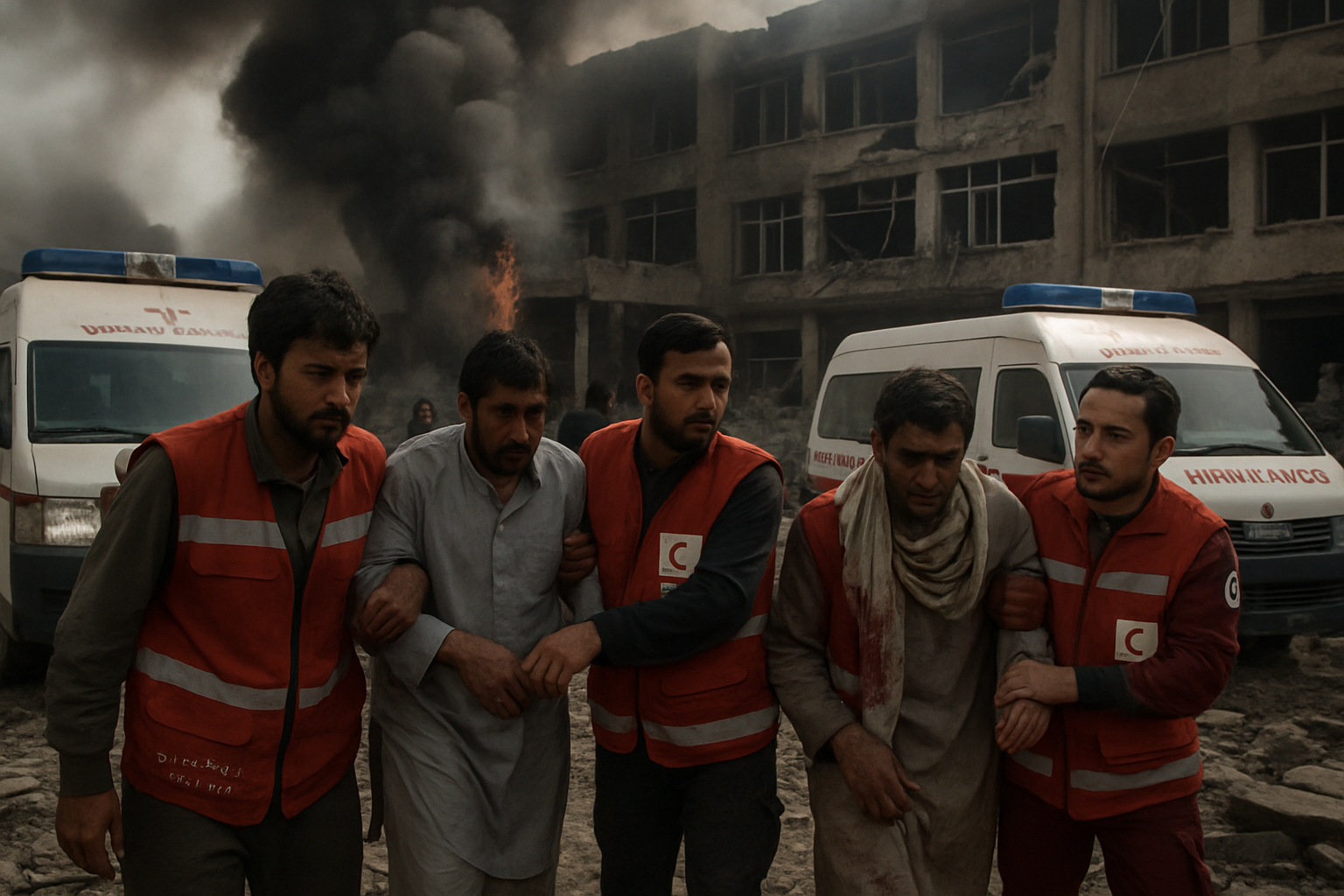
Pakistani airstrikes allegedly targeted a major drug rehabilitation hospital in Kabul on Monday night, with Taliban officials claiming over 400 people were killed in what would be the deadliest single incident of the ongoing Afghanistan-Pakistan border war that has now entered its fourth devastating week.
The Omid Addiction Treatment Hospital, a 2,000-bed facility in Kabul's Pul-e-Charkhi area, was struck late Monday evening according to Afghan Interior Ministry spokesperson Abdul Matin Qane, who warned that Afghanistan would deliver a "teeth-breaking response" to Pakistan. Taliban deputy spokesman Hamdullah Fitrat reported that 400 people were killed and 250 wounded in the attack, with recovery efforts still ongoing as emergency teams searched for bodies beneath the rubble.
Pakistan's Information Ministry has categorically rejected the claims as "false and misleading," maintaining that its Operation Ghazab lil-Haq strikes "precisely targeted military installations and terrorist infrastructure." Pakistani officials insist the target was Camp Phoenix, located several kilometers from the hospital, and that secondary explosions indicated the presence of ammunition depots.
International Condemnation Mounts
The alleged hospital attack has drawn sharp international condemnation, with India's Ministry of External Affairs describing it as a "cowardly and unconscionable act" that violated international humanitarian law. New Delhi emphasized that targeting a medical facility during the holy month of Ramadan made the incident "even more reprehensible."
"Such a site cannot be justified as a military target under any circumstances. This is a blatant assault on Afghanistan's sovereignty and a serious threat to regional peace and stability."
— India's Ministry of External Affairs Statement
China's Foreign Ministry has also intervened diplomatically, with officials expressing hope that the Taliban and Pakistan would engage in face-to-face talks "as soon as possible to de-escalate ongoing tensions." The Chinese mediation effort reflects growing international concern that the conflict could destabilize the entire South Asian region.
A Month of Unprecedented Military Escalation
The alleged hospital bombing represents the latest and most severe escalation in what began as a border dispute but has now evolved into the most serious military confrontation between Pakistan and Afghanistan since the Taliban's return to power in August 2021.
The crisis timeline began on February 16, 2026, when a Tehreek-e-Taliban Pakistan (TTP) attack in Bajaur district killed 11 Pakistani soldiers using a vehicle-borne improvised explosive device. Pakistan responded on February 22 with coordinated airstrikes targeting seven alleged terrorist camps in Afghanistan's Nangarhar and Paktika provinces, claiming to have eliminated 80+ militants but causing civilian casualties including eight schoolchildren in Behsud district.
The situation dramatically escalated on February 27 when Pakistani Defense Minister Khawaja Asif formally declared "open war" against Afghanistan's Taliban government—the first such declaration between the neighboring countries since Afghanistan's establishment. This marked the beginning of Operation Ghazab lil-Haq, Pakistan's sustained military campaign targeting Taliban positions across multiple Afghan provinces.
Humanitarian Crisis Deepens
The ongoing conflict has created a severe humanitarian catastrophe, with the UN Office for the Coordination of Humanitarian Affairs (OCHA) reporting that 16,370 families have been newly displaced across 10 Afghan provinces since the fighting began. The breakdown includes 7,000 families in Paktia province alone, 3,500 in Kunar, and 2,500 each in Khost and Nangarhar.
The United Nations Assistance Mission in Afghanistan (UNAMA) has documented 185 civilian casualties between February 26 and March 5, with 56 killed and 129 wounded. The majority of victims have been women and children, according to UN officials who have called for all parties to protect civilians and uphold international humanitarian law.
The World Health Organization has been forced to deliver emergency medical oxygen to only 23 hospitals across Afghanistan, with hundreds of health centers closed due to funding cuts and security concerns. The healthcare system, already struggling under Taliban rule and international sanctions, is now completely overwhelmed by the influx of wounded civilians.
Economic Warfare and Trade Collapse
Beyond the human toll, the conflict has devastated economic relations between the two countries. Bilateral trade has collapsed by 59% over seven months, with Pakistan's exports to Afghanistan dropping from $550 million to just $228 million. This dramatic decline affects border communities dependent on cross-border commerce and compounds Afghanistan's existing humanitarian crisis, where 88% of female-headed households are unable to meet minimum living requirements.
The traditional trade routes through Chaman-Spin Boldak and Torkham have faced repeated closures, further isolating Afghanistan's already sanctions-hit economy. The economic warfare component adds another layer of pressure on Afghanistan's civilian population, which was already facing one of the world's worst humanitarian crises.
The Durand Line Dispute at the Heart of Conflict
At the core of this escalating conflict lies the century-old dispute over the Durand Line, the 2,640-kilometer border established by British colonial authorities in 1893. This boundary has never been formally recognized by any Afghan government, which views it as an artificial division of the Pashtun people.
Pakistan maintains that the TTP operates "with impunity from Afghan soil," using the porous mountainous terrain as a sanctuary for launching attacks against Pakistani territory. The Taliban government categorically denies providing sanctuary to militant groups or allowing Afghan territory to be used against neighboring countries.
This fundamental disagreement over territorial sovereignty versus cross-border terrorism has proven impossible to resolve through diplomatic means, with Pakistan acknowledging that it has lost traditional influence over Afghanistan to wealthier regional powers including Turkey, the UAE, Qatar, Saudi Arabia, and China.
International Mediation Efforts Fail
Despite intensive international mediation efforts, the conflict continues to escalate. Multiple diplomatic tracks have proven unsuccessful, including a Saudi-mediated prisoner exchange in February 2026 that saw three Pakistani soldiers released from Taliban custody, Iranian mediation offers, Turkish Foreign Minister Hakan Fidan's shuttle diplomacy, and Russian Special Envoy Zamir Kabulov's intervention.
Even religious appeals have failed to halt the violence. Prominent Islamic scholar Ali al-Qaradaghi, president of the International Union of Muslim Scholars, issued a fatwa calling for an immediate ceasefire during Ramadan, stating that fighting between Muslim nations contradicts Islamic teachings. However, military operations have continued despite these religious appeals.
Nuclear Implications and Regional Security
The most serious aspect of this crisis is Pakistan's nuclear capability, which adds a dangerous dimension requiring careful international monitoring. This represents the most serious confrontation involving a nuclear-armed state in South Asia since the Taliban's return to power, testing the post-2021 regional security architecture.
Chinese officials have warned the UN Security Council about the presence of ISIS-K, al-Qaeda, and the East Turkestan Islamic Movement (ETIM) in Afghanistan, contradicting Taliban claims of having "defeated terrorism." These warnings highlight the complex security challenges that extend far beyond bilateral relations.
Military Operations Expand to Strategic Targets
The conflict has evolved far beyond border skirmishes to include strikes on strategic installations and capital cities. Pakistani forces have targeted Bagram Airfield, Kabul's military installations, and fuel depots serving UN aircraft at Kandahar airport. Taliban forces have responded with drone strikes on Pakistani military facilities in cities including Islamabad, Nowshera, Jamrud, and Abbottabad.
This expansion of military operations to include civilian infrastructure and strategic installations represents a dangerous escalation that violates international humanitarian law principles. The targeting of medical facilities, if confirmed, would constitute a particularly grave violation of the Geneva Conventions.
Diplomatic Path Remains Uncertain
Despite the military escalation, Taliban officials maintain that the "path of talks remains open," with spokesman seeking "mutual understanding and respect" for a diplomatic resolution. However, Pakistan has indicated there is "no rush" to end the military campaign until concrete anti-militant measures are implemented by the Taliban government.
The success or failure of current diplomatic containment efforts will influence global approaches to managing the intersection of territorial sovereignty and transnational terrorism in the 21st century. This crisis serves as a template for similar regional challenges requiring innovative diplomatic frameworks that balance legitimate security concerns with respect for territorial integrity, civilian protection, and international law compliance.
Regional and Global Implications
The Afghanistan-Pakistan conflict has implications that extend far beyond bilateral relations, potentially destabilizing the broader South Asian region and affecting global security architecture. The crisis tests whether international mediation mechanisms can prevent broader regional confrontation between nuclear-armed neighbors or whether sustained military escalation will become the new norm.
As the conflict enters its fourth week with no resolution in sight, the international community faces mounting pressure to develop effective conflict prevention mechanisms before this crisis triggers wider regional destabilization. The stakes could not be higher—the success or failure of diplomatic intervention in this case may determine how similar territorial sovereignty versus transnational terrorism challenges are managed globally in the coming decades.
With civilian casualties mounting, humanitarian conditions deteriorating, and military operations expanding, the urgent need for innovative diplomatic solutions has never been more critical. The alleged hospital attack in Kabul, regardless of its ultimate verification, underscores the devastating human cost of this escalating conflict and the imperative for immediate international intervention to prevent further tragedy.