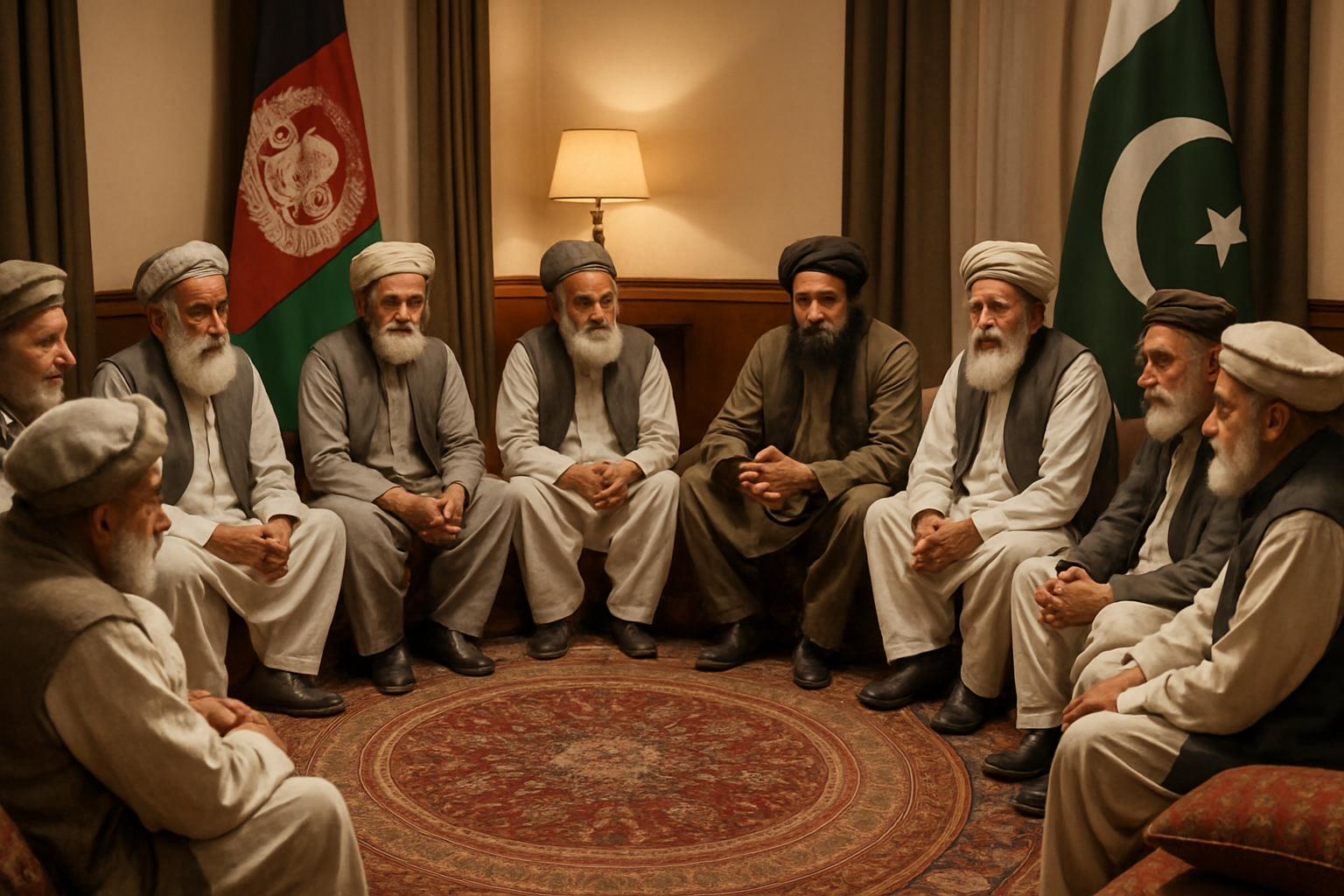
A pivotal peace jirga bringing together Afghan and Pakistani elders, political leaders, and civil society representatives is scheduled for Tuesday, March 31, in Peshawar, offering a glimmer of hope amid one of the most serious military confrontations between the neighboring countries since the Taliban's return to power in 2021.
The peace assembly, announced by former KP chief secretary and Aspire-Khyber Pakhtunkhwa head Arbab Shezad Khan alongside Qaumi Islahi Tehreek head Haji Sohrab Ali Khan, comes at a critical juncture. The initiative aims to establish a comprehensive framework for promoting peace, stability, and sustained dialogue between the two nations, which have been locked in escalating military confrontations since February.
Context of Crisis
The peace talks are being organized against the backdrop of Pakistan's ongoing military campaign, Operation Ghazab lil-Haq, launched following a February 16 attack by the Tehreek-e-Taliban Pakistan (TTP) that killed 11 Pakistani soldiers in Bajaur district. What began as targeted airstrikes has escalated into the most serious Pakistan-Afghanistan confrontation in decades, with both sides conducting cross-border operations that have devastated civilian populations.
The crisis reached its peak when Pakistani Defense Minister Khawaja Asif declared "open war" against Afghanistan's Taliban government on February 27, marking an unprecedented diplomatic escalation. Since then, military operations have expanded beyond border regions to include strikes on capitals and strategic installations, transforming what began as counter-terrorism operations into a broader territorial conflict.
"A significant Pakistan-Afghanistan peace jirga is set to take place in Peshawar on Tuesday, March 31, aiming to establish a joint framework for promoting peace, stability, and dialogue between the neighbouring countries."
— Arbab Shezad Khan, Former KP Chief Secretary
Humanitarian Catastrophe
The human cost of the ongoing confrontation has been severe. According to the UN Office for the Coordination of Humanitarian Affairs (OCHA), 16,370 families have been newly displaced across 10 Afghan provinces, with the UN Assistance Mission in Afghanistan (UNAMA) documenting 289 civilian casualties, including 76 deaths and 213 injuries since late February.
The World Health Organization reports that emergency medical oxygen is available at only 23 hospitals, while hundreds of health centers have been forced to close due to security concerns. The economic impact has been equally devastating, with bilateral trade collapsing by 59% as Pakistan's exports to Afghanistan dropped from $550 million to $228 million over seven months.
Traditional trade routes including Chaman-Spin Boldak and Torkham have faced repeated closures, affecting border communities and exacerbating Afghanistan's humanitarian crisis, where 88% of female-headed households are unable to meet minimum living requirements according to UN data.
Broad Participation Expected
According to Khan, the Peshawar jirga will bring together a diverse cross-section of society from both countries, including political leaders, tribal elders, religious scholars, civil society representatives, members of the business community, and media professionals. Prominent figures with a proven history of working toward Pakistan-Afghanistan reconciliation have also been invited to participate.
The inclusive nature of the gathering reflects traditional methods of conflict resolution in the region, where jirgas (assemblies of elders) have historically played crucial roles in mediating disputes and establishing peace agreements between communities and nations.
Historical Precedent and Innovation
The peace initiative comes after previous mediation efforts, including religious diplomacy that achieved a temporary ceasefire during Eid al-Fitr (March 18-23) through coordination between Saudi Arabia, Qatar, and Turkey. However, that ceasefire was immediately violated, demonstrating the fragility of temporary measures without addressing underlying issues.
The current crisis has its roots in the disputed Durand Line, a 2,640-kilometer colonial-era border established in 1893 that has never been recognized by Afghan governments. Pakistan maintains that TTP militants operate "with impunity from Afghan soil," while the Taliban categorically denies providing militant sanctuaries.
International Mediation Efforts
The peace talks in Peshawar represent one of several international mediation efforts currently underway. Chinese Foreign Minister Wang Yi has been actively shuttling between capitals promoting dialogue, while Iran has offered mediation services warning of regional destabilization risks. Turkey, through Foreign Minister Hakan Fidan, has launched comprehensive mediation initiatives involving Qatar and Saudi Arabia.
Religious scholars, including prominent clerics from both countries, have jointly called for extending ceasefires and establishing sustainable peace frameworks. Islamic scholar Ali al-Qaradaghi has issued fatwas calling for peace between the Muslim nations, demonstrating the role of faith-based diplomacy in conflict resolution.
Nuclear Implications
The crisis carries particular urgency given Pakistan's nuclear capabilities, making this the most serious confrontation involving a nuclear-armed nation since the Taliban's return to power. The situation requires careful international monitoring to prevent escalation beyond conventional operations.
This conflict is testing the post-2021 South Asian security architecture and serving as a template for addressing 21st-century challenges where territorial sovereignty intersects with transnational terrorism concerns.
Economic and Strategic Dimensions
Pakistan has acknowledged its diminished influence in Afghanistan compared to wealthier regional powers including Turkey, the UAE, Qatar, Saudi Arabia, and China, which have increased their engagement with the Taliban government. This shift has forced Pakistan to rely more heavily on military solutions rather than diplomatic leverage.
The economic warfare dimension affects millions of civilians dependent on cross-border commerce, with traditional supply routes for Afghanistan's remote mountainous communities, particularly in provinces like Nuristan, facing severe disruptions that threaten essential goods and medical supplies.
Path Forward
The Taliban maintains that "the path of talks remains open" and seeks "mutual understanding and respect," while Pakistan indicates there is "no rush" to end its military campaign without concrete anti-militant measures. The success or failure of the Peshawar peace jirga could provide a template for innovative diplomatic frameworks that balance security concerns with territorial integrity and civilian protection.
The peace initiative faces the challenge of addressing fundamental disagreements over border recognition, militant sanctuaries, and cross-border terrorism while establishing mechanisms for sustained cooperation and dialogue.
Regional and Global Implications
The outcome of the Peshawar peace talks will have implications extending far beyond bilateral Pakistan-Afghanistan relations. Success could provide a model for managing similar territorial sovereignty versus transnational terrorism challenges globally, while failure risks prolonged confrontation with broader regional stability implications.
The international community faces pressure to develop effective conflict prevention mechanisms before the confrontation escalates further. The crisis represents a critical test of whether innovative diplomatic frameworks can prevent broader regional warfare between nuclear-armed neighbors.
As the March 31 date approaches, the peace jirga in Peshawar stands as perhaps the most significant opportunity for diplomatic breakthrough in what has become one of the most serious security crises in post-2021 South Asian regional architecture. The success of this traditional yet innovative approach to peacemaking could determine whether the region moves toward sustainable peace or continues on a path toward prolonged military confrontation.