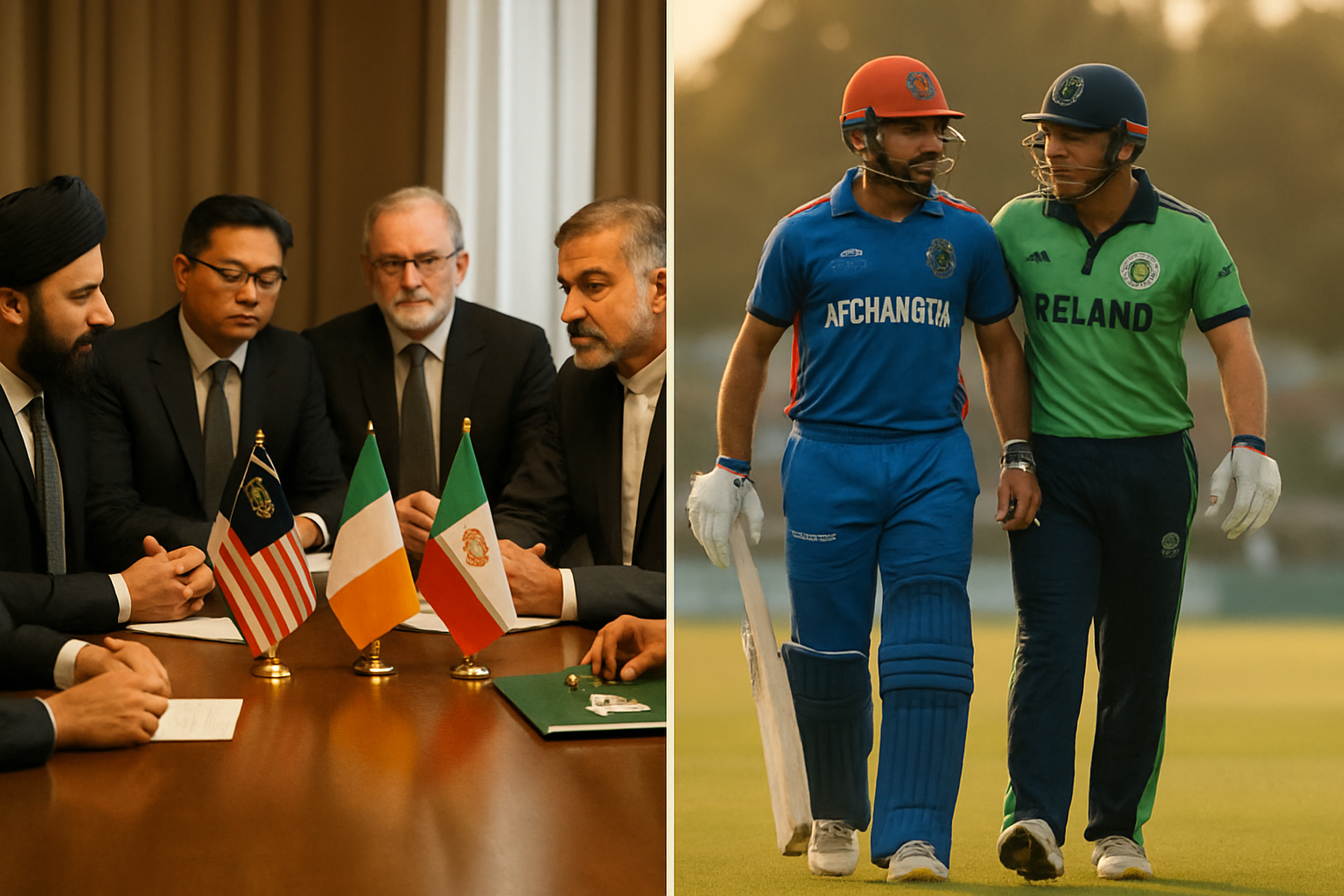
Malaysian Prime Minister Anwar Ibrahim has welcomed a temporary ceasefire between Pakistan and Afghanistan announced for Eid-ul-Fitr celebrations, while Ireland's cricket officials have confirmed they will host Afghanistan for a five-match ODI series in August, highlighting the complex interplay between diplomacy and sports in South Asian affairs.
The developments come as the region seeks to de-escalate tensions following weeks of cross-border military confrontations that have tested the limits of traditional diplomatic mechanisms and international mediation efforts.
Malaysian Diplomatic Intervention
Prime Minister Anwar Ibrahim's intervention marks a significant moment in regional diplomacy, as he called for sustained efforts to reduce tensions and achieve lasting peace between the neighboring nations. Speaking during a telephone conversation with Pakistani Prime Minister Shehbaz Sharif, Anwar emphasized the critical importance of dialogue and de-escalation in the current volatile situation.
The Malaysian leader also expressed broader concerns about rising tensions in the Middle East, particularly involving Iran, urging all parties to prioritize peaceful solutions over military confrontation. This diplomatic outreach demonstrates Malaysia's growing role as a regional mediator and its commitment to stability in South Asia.
"The temporary ceasefire represents a crucial opportunity for both nations to step back from the brink and pursue meaningful dialogue."
— Anwar Ibrahim, Malaysian Prime Minister
Pakistan announced it had temporarily suspended military operations in Afghanistan at the request of Saudi Arabia, Qatar, and Turkey, while Afghan authorities likewise announced a halt to operations during Eid, citing goodwill and similar requests from regional partners. This coordinated international effort reflects the serious concern among regional powers about the escalating situation.
Historical Context of Regional Tensions
The current ceasefire follows weeks of heightened tensions between Afghanistan and Pakistan, including disputes over the Durand Line and cross-border security issues. The 2,640-kilometer colonial-era border, established in 1893, has never been recognized by Afghan governments and remains a fundamental source of disagreement between the two nations.
Recent escalations began with a February 16 attack in Bajaur that killed 11 Pakistani soldiers, attributed to the Tehreek-e-Taliban Pakistan (TTP). This incident triggered a cycle of retaliatory strikes and counter-operations that culminated in Pakistani Defense Minister Khawaja Asif's declaration of "open war" on February 27, marking the most serious military confrontation since the Taliban's return to power in 2021.
The humanitarian impact has been severe, with UNAMA documenting 185 civilian casualties (56 killed, 129 wounded) and OCHA reporting 16,370 families displaced across 10 Afghan provinces. The economic consequences have been equally devastating, with bilateral trade collapsing by 59% as Pakistan's exports to Afghanistan fell from $550 million to $228 million over seven months.
International Mediation Efforts
The temporary ceasefire represents the culmination of extensive diplomatic efforts by multiple regional and international actors. Saudi Arabia, Qatar, and Turkey have played particularly active roles in facilitating dialogue between the parties. Iran's new Supreme Leader, Mojtaba Khamenei, also made a direct appeal for improved relations between Afghanistan and Pakistan in his Persian New Year message, describing them as "two brotherly countries."
Khamenei emphasized the importance of cooperation "for the sake of divine pleasure and to avoid division among Muslims," underscoring his personal readiness to "take the necessary steps" to help facilitate stronger ties between the two countries. This intervention by Iran's highest religious authority adds significant weight to the regional mediation efforts.
Previous diplomatic initiatives, including a Saudi-mediated prisoner exchange in February 2026 and various confidence-building measures, had proven insufficient to address the underlying security challenges. The current ceasefire, timed to coincide with Eid-ul-Fitr, represents the first successful de-escalation in the crisis.
Ireland's Cricket Diplomacy Initiative
Against this backdrop of regional tensions, Ireland's decision to host Afghanistan for a cricket series represents a powerful example of sports diplomacy. Cricket Ireland chief executive Sarah Keane announced that the five-match ODI series will take place from August 5-14 in Belfast, making Ireland one of the few nations willing to maintain sporting ties with Afghanistan under the current Islamic Emirate.
"Cricket Ireland has made a decision to play Afghanistan in Belfast this year. This has been a decision by Cricket Ireland in what it believes is the best interest of the organisation as a whole."
— Sarah Keane, Cricket Ireland CEO
The decision is particularly significant given that other major cricket nations, including Australia and England, have either cancelled or avoided scheduling bilateral series against Afghanistan since the Islamic Emirate regained power in 2021. Ireland's commitment to maintaining cricketing relations demonstrates the sport's potential as a bridge between nations despite political differences.
This cricket diplomacy echoes previous successful sporting interventions in South Asian politics. In February 2026, Pakistan's reversal of its boycott of a T20 World Cup match against India in Colombo demonstrated cricket's unique capacity to transcend political tensions. The match proceeded with heightened security measures and generated massive tourism benefits for Sri Lanka, proving that sporting events can provide neutral ground for engagement.
Regional Security Architecture Under Pressure
The Afghanistan-Pakistan crisis has exposed the limitations of traditional diplomatic mechanisms and highlighted the need for innovative conflict resolution approaches. The involvement of multiple regional powers – including Russia, Turkey, Iran, China, and the Gulf states – reflects the broader implications of the conflict for South Asian security architecture.
Chinese Foreign Minister Wang Yi has been actively involved in mediation efforts, emphasizing that disputes must be "resolved through consultation and negotiation." Russia's Special Envoy Zamir Kabulov has similarly stressed the importance of diplomatic solutions, while Turkish President Erdogan has offered Turkey's support for ceasefire restoration.
The nuclear dimension adds particular urgency to the situation, as this represents the most serious confrontation involving nuclear-armed Pakistan since the Taliban's return to power. International monitoring and diplomatic engagement are crucial to preventing escalation beyond conventional operations.
Economic and Humanitarian Dimensions
The economic impact of the crisis extends far beyond bilateral trade figures. Afghanistan's humanitarian situation, already precarious due to international sanctions and aid cuts, has been further complicated by the border closure and military operations. The World Food Programme has warned that 88% of female-headed households in Afghanistan are unable to meet minimum living requirements.
Traditional trade routes including Chaman-Spin Boldak and Torkham have faced repeated closures, affecting border communities that depend on cross-border commerce for their livelihoods. The crisis has also disrupted humanitarian aid operations, with the WHO reporting that emergency medical oxygen is available to only 23 hospitals, while hundreds of health centers have been forced to close.
Looking Forward: Challenges and Opportunities
The temporary ceasefire provides a crucial window for intensive diplomatic engagement, but underlying issues remain unresolved. The disputed Durand Line, competing claims over territorial sovereignty, and concerns about cross-border terrorism require sustained attention and innovative diplomatic frameworks.
Iran's offer to help facilitate stronger ties between Afghanistan and Pakistan, combined with ongoing mediation efforts by Saudi Arabia, Qatar, and Turkey, suggests a regional consensus in favor of peaceful resolution. The involvement of multiple faith-based mediators also demonstrates the potential for religious and cultural considerations to provide leverage in conflict resolution.
Ireland's cricket diplomacy initiative, meanwhile, offers a different model for engagement – one that maintains human connections and cultural exchange even when official diplomatic channels are strained. Sports have historically played an important role in South Asian diplomacy, and cricket's particular significance in the region makes it a powerful tool for bridge-building.
Global Implications
The Afghanistan-Pakistan crisis has broader implications for international conflict resolution mechanisms and the management of territorial sovereignty disputes in the 21st century. The intersection of counter-terrorism concerns, disputed borders, and nuclear capabilities creates a complex challenge that traditional diplomatic frameworks struggle to address.
The success or failure of current mediation efforts will influence how similar challenges are approached globally, particularly in regions where colonial-era borders remain contested and transnational terrorism complicates bilateral relations. The template being established through faith-based diplomacy and regional coordination may prove valuable for other conflicts involving neighboring nations with shared religious and cultural ties.
As the temporary ceasefire holds during Eid celebrations, the international community watches closely to see whether this respite can be transformed into a sustainable peace framework. The combination of high-level diplomatic intervention, economic incentives for cooperation, and sporting connections offers multiple pathways for engagement – but success will require sustained commitment from all parties involved.
The ultimate test will be whether the lessons learned from this crisis can contribute to more effective mechanisms for preventing and resolving conflicts in an increasingly complex international environment, where traditional state-to-state diplomacy must be supplemented by innovative approaches that engage religious leaders, civil society, and sporting communities in the pursuit of peace.