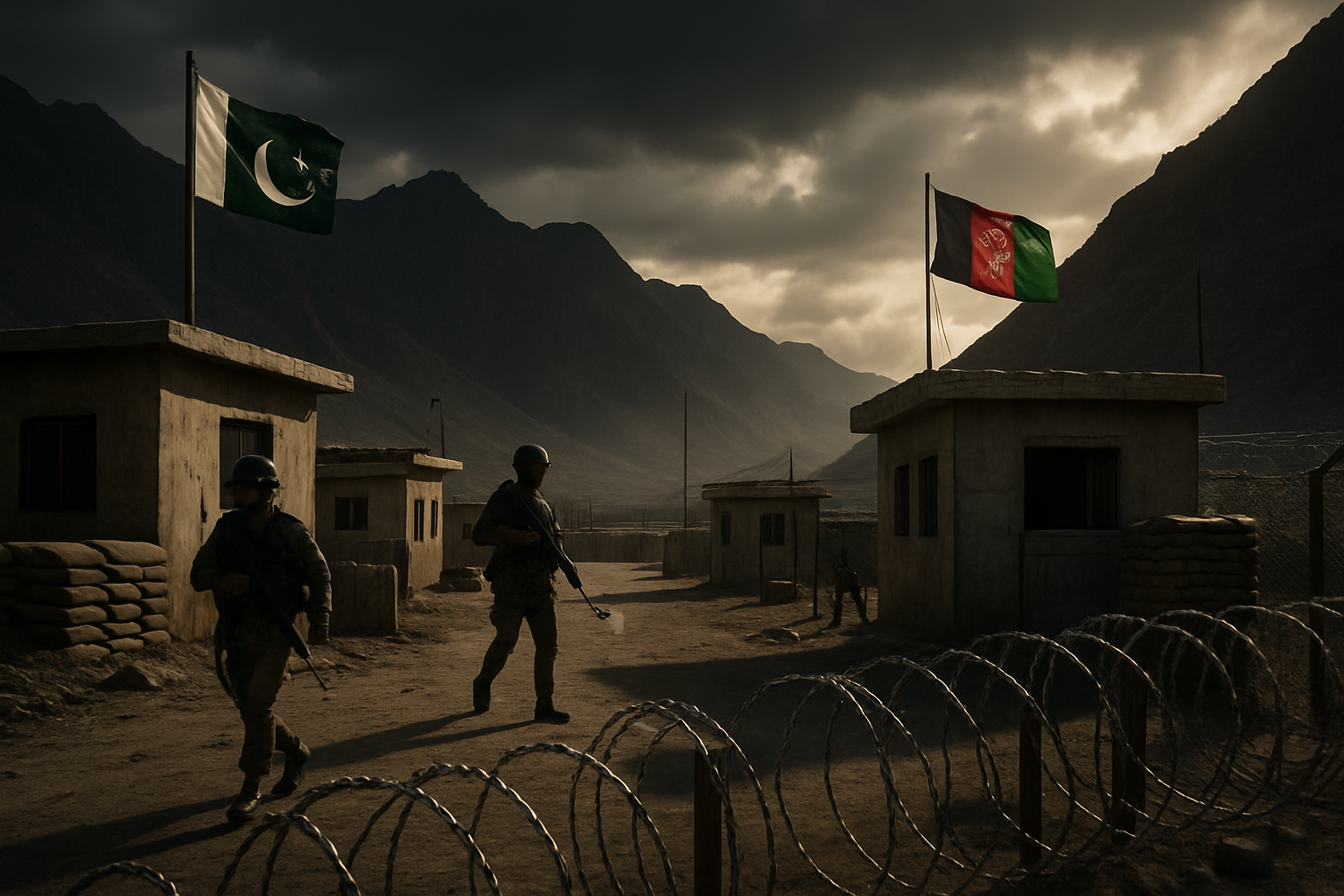
Security threats from Afghanistan continue to destabilize regional relations and international evacuation efforts, as more than 1,100 Afghan evacuees remain stranded in Qatar camps while the Collective Security Treaty Organization warns of persistent security risks emanating from Afghan territory.
The complex humanitarian and security crisis unfolding across the Afghanistan region has reached critical proportions, with multiple interconnected challenges testing international diplomatic frameworks and regional stability mechanisms. From stranded evacuees in Middle Eastern camps to escalating cross-border violence, the situation represents one of the most serious threats to South Asian security since the Taliban's return to power in 2021.
Stranded Evacuees in Qatar Present Diplomatic Challenge
The United States is currently negotiating with several countries to relocate more than 1,100 Afghan evacuees who have been stranded in Qatar after plans to bring them to America stalled under tightened U.S. immigration restrictions. According to the Wall Street Journal, Washington has opened talks with at least three nations—two in sub-Saharan Africa and one in Southeast Asia—as the administration seeks third-country solutions for the displaced Afghans.
These evacuees represent a fraction of the hundreds of thousands of Afghans who fled their homeland following the Taliban's rapid takeover in August 2021. Many had worked with U.S. forces or international organizations and now find themselves in legal limbo, unable to return to Afghanistan and facing uncertain futures in temporary accommodations.
The situation has created significant diplomatic pressure on Qatar, which has served as a crucial intermediary in regional affairs. The Gulf nation's role as a transit point for Afghan evacuees has strained its resources while highlighting the broader international failure to develop comprehensive resettlement programs for Afghan refugees.
CSTO Raises Alarm Over Regional Security Threats
The Collective Security Treaty Organization (CSTO) has issued stark warnings about the persistent security threats emanating from Afghan territory, following a meeting of officials and regional representatives in Moscow to review the deteriorating situation. The warning came at the 43rd meeting of the Afghanistan working group under the CSTO Council of Foreign Ministers, held at the organization's secretariat.
CSTO officials expressed grave concern about the continued presence of various militant groups operating from Afghan soil, including ISIS-K, al-Qaeda, and the East Turkestan Islamic Movement (ETIM). These warnings directly contradict Taliban claims that terrorism has been defeated within Afghanistan's borders, highlighting the fundamental disconnect between Taliban assertions and international intelligence assessments.
"Potential threats and security risks emanating from Afghanistan territory remain high."
— CSTO Official Statement
The organization's assessment comes amid mounting evidence of cross-border terrorist activities that have destabilized neighboring regions. Chinese officials have also warned the UN Security Council about severe terrorist threats from Afghanistan, citing the continued operational capability of multiple extremist organizations.
Pakistan-Taliban Diplomatic Tensions Escalate
Adding to regional instability, diplomatic relations between Pakistan and the Taliban government have deteriorated following the collapse of China-hosted talks between the two sides. Mohammad Naeem Wardak, a senior Taliban foreign ministry official, revealed that Pakistan's insistence on raising its internal security concerns caused the negotiations to end without any breakthrough.
The failed diplomatic engagement represents a significant setback for Chinese mediation efforts, which had been seen as the most promising avenue for resolving the persistent border tensions between the two neighbors. China's involvement reflected Beijing's concerns about regional stability and the security of its investments in the China-Pakistan Economic Corridor (CPEC).
Wardak criticized Pakistan's approach, suggesting that Islamabad was attempting to shift responsibility for its domestic security failures onto Afghanistan. This hardening of the Taliban's public tone came after months of sustained diplomatic efforts aimed at reducing tensions along the disputed 2,640-kilometer Durand Line.
Historical Context of Regional Instability
The current crisis builds upon months of escalating tensions that began in February 2026 with a devastating attack in Pakistan's Bajaur district that killed 11 Pakistani soldiers. The incident, attributed to the banned Tehreek-i-Taliban Pakistan (TTP), triggered a cycle of retaliation and counter-retaliation that culminated in Pakistan's Defense Minister Khawaja Asif declaring "open war" against the Taliban government.
The resulting military confrontation became the most serious Pakistan-Afghanistan crisis since the Taliban's return to power, with hundreds of civilian casualties and the displacement of thousands of families along the border regions. Despite multiple international mediation efforts led by Saudi Arabia, Turkey, Iran, and China, the underlying security challenges remain unresolved.
The humanitarian toll has been devastating, with the United Nations documenting hundreds of civilian casualties and the displacement of over 16,000 families across ten Afghan provinces. The World Health Organization has been forced to deliver emergency medical oxygen to only 23 hospitals, while hundreds of health centers have been closed due to security and funding concerns.
Economic Warfare and Trade Disruption
The security crisis has had severe economic consequences, with bilateral trade between Pakistan and Afghanistan collapsing by 59% over seven months. Pakistani exports to Afghanistan fell from $550 million to just $228 million, affecting border communities dependent on cross-border commerce.
Traditional trade routes through Chaman-Spin Boldak and Torkham have faced repeated closures, compounding Afghanistan's humanitarian crisis where 88% of female-headed households are unable to meet minimum living requirements. The economic dimension of the conflict has created additional pressure on already vulnerable populations.
Remote communities in provinces like Nuristan have appealed to Taliban officials for intervention to reopen roads blocked by Pakistan, as they face critical supply shortages affecting access to essential goods, medical supplies, and humanitarian aid.
International Response and Mediation Efforts
The international community has struggled to develop effective responses to the multifaceted crisis. Religious diplomacy achieved temporary success with a brief Eid ceasefire in March 2026, negotiated through Saudi Arabia, Qatar, and Turkey using faith-based frameworks. However, the truce was immediately violated, highlighting the fragility of diplomatic solutions.
European Union officials have called for urgent de-escalation and dialogue, emphasizing that Afghan soil must not be allowed to threaten other countries and that the Taliban must take action against militant groups. The EU has also raised concerns about the return of over 4 million Afghans from Iran and Pakistan in the past two years, straining regional resources.
China's mediation efforts represent the most sustained international intervention, with Foreign Minister Wang Yi deploying special envoys and facilitating trilateral talks in Urumqi. Beijing's involvement reflects its concerns about regional stability and the potential impact on Chinese investments in the region.
Nuclear Implications and Regional Architecture
The crisis carries particular gravity due to Pakistan's nuclear capabilities, making it the most serious confrontation involving a nuclear-armed state since the Taliban's return to power. This dimension requires careful international monitoring to prevent escalation beyond conventional military operations.
The situation represents a critical test of the post-2021 South Asian security architecture, with implications extending far beyond bilateral relations. Success or failure in managing this crisis could provide a template for addressing similar challenges where territorial sovereignty intersects with transnational terrorism concerns.
Regional powers have acknowledged Pakistan's diminished influence in Afghanistan compared to wealthier nations like Turkey, the UAE, Qatar, Saudi Arabia, and China, which has contributed to Islamabad's increased reliance on military solutions rather than diplomatic engagement.
Humanitarian Emergency Deepens
The ongoing crisis has created one of the worst humanitarian emergencies in recent memory, with international aid organizations struggling to provide assistance to affected populations. The Norwegian Refugee Council has called for urgent aid for thousands of families displaced by the Pakistan-Taliban fighting in eastern Afghanistan.
Taliban police spokesman Sayed Tayeb Hamad has reported a devastating situation in Nangarhar province from cross-border military operations, with civilian infrastructure severely damaged and basic services disrupted. The pattern of civilian targeting has raised serious concerns about compliance with international humanitarian law.
Medical facilities have been overwhelmed treating wounded civilians, while rescue operations continue for those trapped under debris from bombardments. The targeting of civilian areas during religious periods has added additional complexity to an already grave humanitarian situation.
Looking Forward: Prospects for Resolution
Despite the deteriorating situation, Taliban officials maintain that "the path of talks remains open," seeking what they describe as "mutual understanding and respect." However, Pakistan indicates it has "no rush" to end military operations without concrete anti-militant measures being implemented by the Taliban government.
The success or failure of current diplomatic containment efforts will influence global approaches to managing territorial sovereignty versus transnational terrorism challenges in the 21st century. The stakes extend well beyond the immediate bilateral relationship, affecting international conflict resolution mechanisms and regional stability frameworks worldwide.
As the crisis enters its seventh week, the international community faces mounting pressure to develop innovative diplomatic frameworks that can balance legitimate security concerns with territorial integrity, civilian protection, and international law compliance. The resolution of this crisis may well determine the template for future conflict management in regions where cross-border terrorism intersects with disputed sovereignty claims.
The Afghanistan security situation remains a defining challenge for regional stability, international humanitarian response, and global security architecture adaptation to contemporary threats. Without sustained diplomatic engagement addressing root causes, the crisis threatens to become a prolonged confrontation with devastating consequences for millions of civilians caught in the crossfire.