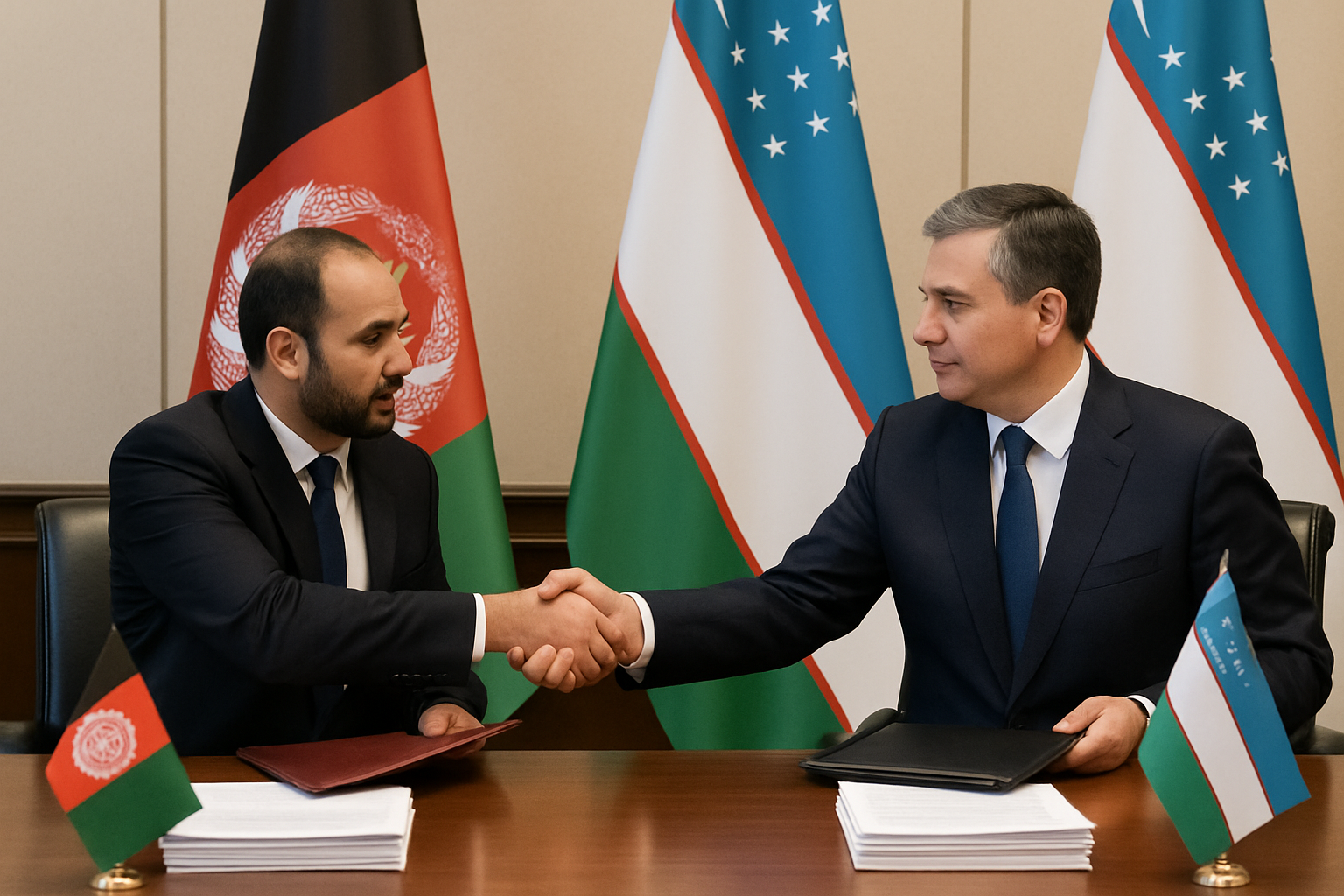
Afghanistan and Uzbekistan have signed cooperation agreements worth $514.8 million during a high-level connectivity conference, marking one of the most significant bilateral trade initiatives between the neighboring Central Asian nations in recent years.
The agreements were finalized during a series of business meetings that brought together senior officials, private sector representatives, and investors from both countries. Among the key participants were Afghanistan's Minister of Industry and Commerce Nooruddin Azizi and Shavkat Abdurazaqov, chairman of the Afghanistan Chamber of Commerce and Investment, alongside an Uzbek delegation comprising government and business leaders.
Building on Previous Success
This latest agreement builds upon a strong foundation of cooperation established in February 2026, when the two nations signed 25 comprehensive trade agreements worth $300 million. The earlier framework covered preferential trade arrangements for eight Afghan export items and six Uzbek products, demonstrating the sustained political and economic momentum driving bilateral cooperation expansion.
During the connectivity conference, Minister Azizi described Afghanistan as a dependable partner for regional trade and investment, praising Uzbekistan's ongoing cooperation and commitment to brotherhood that has spanned four years since the Islamic Emirate's establishment.
"Afghanistan represents significant untapped potential for regional trade and investment partnerships, and Uzbekistan has been a steadfast partner in this journey."
— Nooruddin Azizi, Minister of Industry and Commerce
Comprehensive Sector Cooperation
The agreements encompass cooperation across multiple key sectors, building on the framework established during previous high-level bilateral meetings. These include partnerships in industrial production, manufacturing capabilities, agricultural development, and infrastructure projects that will benefit both nations' economies.
Shukhrat Abdullazov, Governor of Namangan Province, who participated in earlier negotiations, had emphasized the region's industrial and production capacities, describing the Afghan people as "friends and brothers" and highlighting the long-standing historical and economic links between the two nations.
The success of these agreements demonstrates the growing role of Afghan traders in the Syrdarya region and other areas of Uzbekistan, where active commercial relationships have been developing over recent years. This economic partnership represents a major milestone in Afghanistan's regional economic integration efforts while positioning Uzbekistan as a crucial Central Asian trade hub.
Strategic Regional Context
These developments occur within the broader context of Central Asia's evolution from a peripheral region to a strategic economic hub attracting major international investment. The Afghanistan-Uzbekistan partnership is part of a larger infrastructure renaissance that includes projects like the Uzbekistan-Afghanistan-Pakistan railway project, renewable energy initiatives, and technology transfer programs.
The agreements provide a foundation for regular consultations and review mechanisms, ensuring sustained cooperation beyond short-term transactional arrangements. Governor Erkinjon Turdimov of Syrdarya region has previously noted the historical economic links and the active role of Afghan traders in regional commerce, emphasizing the natural partnership between the neighboring countries.
Economic Integration Framework
The $514.8 million agreement framework emphasizes practical economic cooperation that addresses immediate bilateral needs while building strategic partnerships for long-term stability. Unlike simple commodity exchanges, these modern partnerships emphasize technology transfer, institutional capability building, and supply chain coordination essential for sustainable economic development.
The success of these bilateral arrangements demonstrates neighboring countries' capacity for mutually beneficial agreements despite broader geopolitical challenges. This approach provides a template for other nations in the region seeking to develop strategic economic partnerships that balance sovereignty with practical cooperation benefits.
Implementation and Future Prospects
The implementation of these agreements requires transparent governance frameworks, sustained political commitment across electoral cycles, and comprehensive technical capacity building. Both countries have committed to establishing dedicated coordination bodies and regular consultation mechanisms to ensure the successful execution of the 37 agreements covering various sectors.
Success factors identified by regional analysts include community engagement, business-to-business connections, and systematic cooperation frameworks that go beyond government-level agreements to include private sector participation and civil society involvement.
Regional Stability and Development
These economic partnerships serve as a foundation for broader regional stability and development. The Central Asian region's strategic positioning between Europe and Asia, combined with abundant natural resources and growing technical capabilities, positions these nations as crucial players in global supply chain diversification efforts.
The Afghanistan-Uzbekistan agreements occur alongside other regional developments, including Kazakhstan's $1.1 billion mining investment projects and various Central Asian infrastructure initiatives that collectively represent a coordinated approach toward institutional modernization and economic integration.
The framework provides foundation for trade volume expansion beyond current levels, with regular consultation mechanisms and monitoring systems ensuring sustained partnership development. This template demonstrates how regional cooperation can address contemporary challenges while maintaining strategic autonomy and promoting mutual prosperity.
Looking Forward
The success of these agreements will be measured not just by immediate trade increases but by their contribution to regional stability and long-term economic development. The emphasis on technology transfer, institutional capability building, and sustainable resource development reflects a mature understanding of 21st-century economic partnerships.
As both nations work to implement these comprehensive agreements, the international community will be watching closely to see how this model of bilateral cooperation can serve as a template for other regional partnerships facing similar challenges and opportunities in an increasingly interconnected global economy.