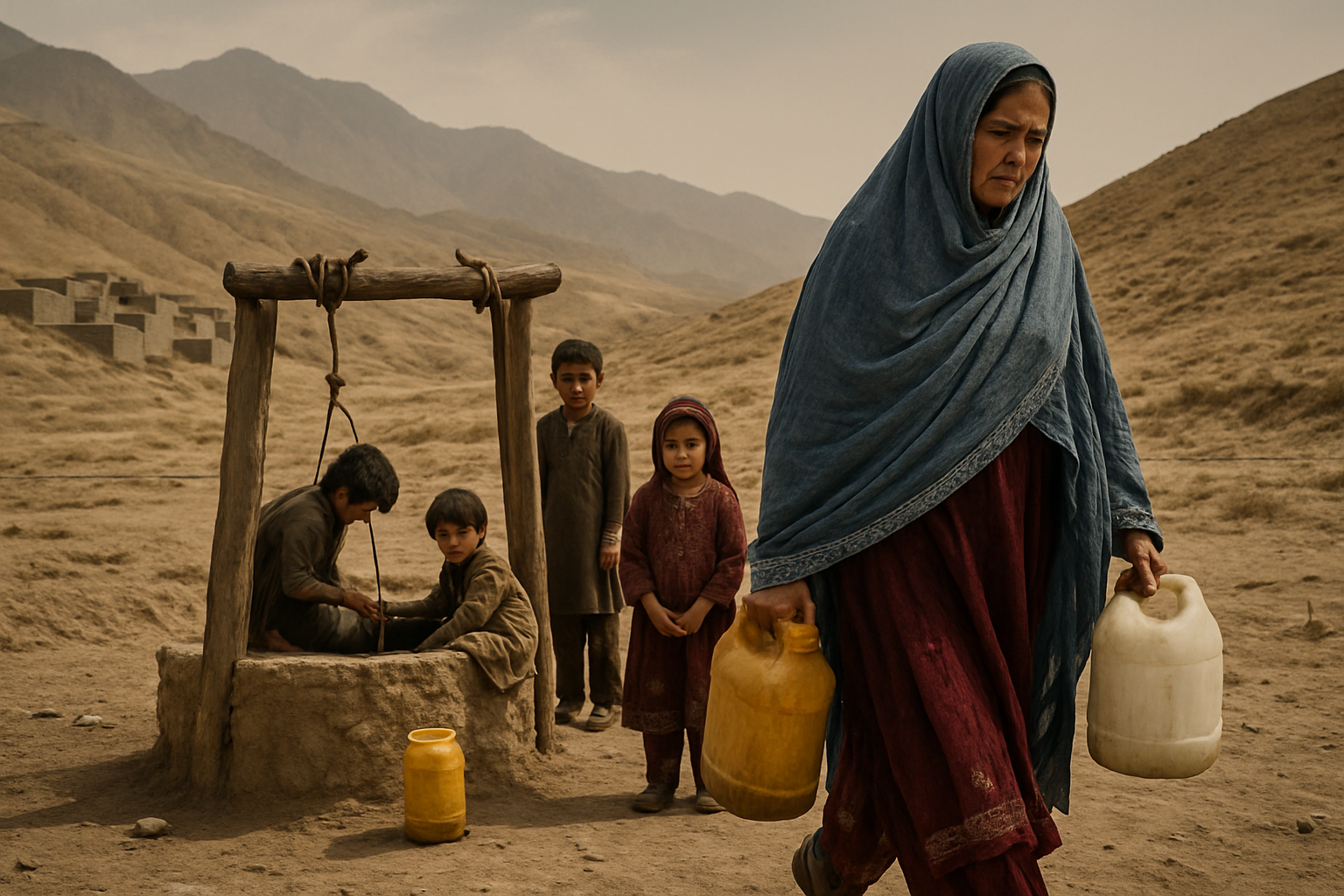
As the world marked World Water Day, Afghanistan faces a worsening water crisis that threatens millions of lives, with families forced to travel hours daily for basic water access while traditional sources like wells and ancient karezes face unprecedented strain from years of drought and rapid population growth.
The crisis represents a convergence of environmental and humanitarian challenges that has pushed Afghanistan's water infrastructure to the breaking point. Traditional water sources that have sustained communities for generations—including wells and karezes, the ancient underground channels that channel mountain water across vast distances—are experiencing severe depletion as the country struggles with declining rainfall and the return of families from neighboring countries.
Traditional Infrastructure Under Unprecedented Strain
The deterioration of Afghanistan's water systems extends far beyond simple scarcity. The country's traditional water management infrastructure, perfected over centuries, is collapsing under pressure from multiple converging factors. Karezes, which have provided reliable water to communities for over a millennium, are drying up as water tables drop to historically low levels.
In rural areas, families are increasingly forced to rely on unsafe surface water or travel unprecedented distances to meet their daily water needs. Women and children bear the heaviest burden of this crisis, often spending entire days collecting water instead of attending school or pursuing economic opportunities. The impact on education is particularly severe, as children—especially girls—are withdrawn from school to help with water collection duties.
Urban Centers Face Critical Shortages
The water crisis is not limited to rural areas. Major urban centers including Kabul, Mazar-e-Sharif, and Kandahar are experiencing significant shortages that threaten basic municipal services. Rapid population growth, exacerbated by internal displacement and refugee returns, has overwhelmed urban water systems designed for much smaller populations.
Unregulated groundwater extraction has led to dramatic depletion of aquifers, creating a vicious cycle where deeper wells must be drilled at increasingly prohibitive costs. Many urban households have become dependent on private wells or expensive water delivery services, creating stark inequalities in access to this most basic necessity.
"The situation has reached a critical point where traditional water sources that sustained our communities for centuries are failing. Families are making impossible choices between water, food, and other basic needs."
— Water sector specialist (name withheld for security)
Healthcare Crisis Compounds Water Emergency
The water crisis intersects dangerously with Afghanistan's broader humanitarian emergency. According to recent assessments, 88% of female-headed households are unable to meet minimum living requirements, while the country faces what the UN describes as the worst humanitarian crisis in 25 years.
Healthcare facilities are particularly vulnerable, with the World Health Organization delivering emergency medical oxygen to only 23 hospitals across the country while hundreds of health centers remain closed due to funding cuts. The lack of clean water in healthcare settings creates additional risks for patients and medical staff, potentially exacerbating already dire health outcomes.
The systematic exclusion of women from many sectors of the economy has created additional challenges for water management, as traditional roles in household water management are disrupted while alternative employment opportunities remain severely limited.
Regional Context and Border Tensions
Afghanistan's water crisis occurs against a backdrop of regional tensions that complicate international assistance efforts. The ongoing border crisis with Pakistan, which has seen trade collapse by 59% over seven months, has disrupted traditional supply chains and reduced access to water infrastructure equipment and technical expertise.
Traditional trade routes through Chaman-Spin Boldak and Torkham have faced repeated closures, affecting the flow of essential goods including water pumping equipment and purification systems. This economic isolation compounds the water crisis by limiting access to both technical solutions and emergency supplies.
Climate Change Amplifies Traditional Challenges
The current crisis represents more than a temporary drought. Climate data indicates that January 2026 marked the 18th consecutive month of temperatures exceeding 1.5°C above pre-industrial levels, fundamentally altering traditional water cycles and agricultural patterns that Afghan communities have relied upon for generations.
This sustained warming trend affects every aspect of Afghanistan's water systems: traditional growing seasons no longer align with historical water availability, mountain snowpack that feeds rivers and aquifers is declining, and extreme weather events are becoming more frequent and severe.

International Response and Aid Challenges
Despite the severity of the crisis, international assistance faces significant constraints. The International Federation of Red Cross and Red Crescent Societies provided health services to over 2 million people in 2025, supporting 128 healthcare centers, but funding shortfalls continue to limit the scope of possible interventions.
Recent aid deliveries have demonstrated ongoing international commitment despite political complexities. India delivered 2.5 tons of emergency medical supplies in March 2026, while Japan contributed $6.08 million in humanitarian aid through both the World Food Programme and the World Bank's Afghanistan Reconstruction Trust Fund. However, these contributions represent a fraction of the estimated need.
Humanitarian organizations report that water infrastructure projects face particular challenges due to the technical complexity of rehabilitation work, the need for sustained maintenance, and the current restrictions on international personnel and equipment movement.
Women and Children Bear Heaviest Burden
The water crisis disproportionately affects Afghanistan's most vulnerable populations. With systematic restrictions on women's participation in many sectors of the economy, families have lost critical income sources that might otherwise allow them to purchase water or invest in private water solutions.
Children, particularly girls, are being withdrawn from school at increasing rates to assist with water collection duties. This creates a devastating cycle where immediate survival needs undermine long-term development prospects, potentially affecting an entire generation's educational and economic opportunities.
Healthcare access for women and children is particularly compromised, as cultural norms requiring female medical providers intersect with water shortages affecting medical facilities. The result is a healthcare system under multiple pressures, unable to adequately serve the populations most affected by the water crisis.
Technology Meets Traditional Knowledge
Efforts to address the crisis must balance technological innovation with respect for traditional water management practices that have sustained communities for centuries. Solar-powered water pumping systems show promise in areas with adequate groundwater, while water conservation techniques adapted from traditional practices could extend the life of remaining sources.
However, implementing these solutions requires sustained political commitment, adequate technical training, and ongoing maintenance support—all challenging in the current environment. The most successful interventions have been those that combine modern technology with traditional knowledge while ensuring community ownership of projects.
Economic Implications Beyond Water
The water crisis creates ripple effects throughout Afghanistan's economy. Agricultural productivity has declined dramatically, affecting food security and rural livelihoods. Small businesses dependent on water—from bakeries to small-scale manufacturing—are struggling to maintain operations.
The time and resources families devote to water collection represent a massive opportunity cost, removing human capital from productive economic activities. Women who might otherwise contribute to household income or community development are instead spending hours daily on water collection, while children miss educational opportunities that could improve long-term economic prospects.
Looking Forward: Sustainable Solutions Required
Addressing Afghanistan's water crisis requires approaches that recognize both immediate humanitarian needs and long-term sustainability challenges. Emergency water supplies can provide temporary relief, but lasting solutions must address infrastructure rehabilitation, water resource management, and the broader economic and environmental factors contributing to the crisis.
Successful interventions will likely require innovative financing mechanisms that can operate within current political constraints while ensuring accountability and effectiveness. Community-based management approaches, combined with technical assistance and sustained funding, offer the best prospects for rebuilding Afghanistan's water security.
The international community faces a crucial test in responding to this crisis. The scale of need far exceeds current assistance levels, while political constraints limit traditional aid delivery mechanisms. Finding ways to prioritize humanitarian needs while building toward sustainable solutions will require unprecedented cooperation and creative approaches to international assistance.
"This is not just about water—it's about the basic dignity and survival of millions of people. The international community cannot allow an entire population to suffer from lack of access to humanity's most fundamental need."
— Senior humanitarian official (speaking anonymously)
Regional Stability Implications
Afghanistan's water crisis has implications that extend far beyond its borders. Water scarcity can drive internal displacement, create competition between communities, and undermine social stability in ways that affect regional security.
The crisis also tests regional cooperation mechanisms, as Afghanistan's water resources are connected to broader river systems shared with neighboring countries. Addressing the crisis effectively will require not just national action but regional coordination on water resource management and cross-border assistance.
As Afghanistan enters what experts describe as a critical phase of its water crisis, the choices made in coming months by both Afghan authorities and the international community will determine whether the country can avoid a complete collapse of its water systems. The stakes could not be higher: access to clean water is not just a humanitarian concern but a fundamental requirement for human dignity and societal stability.
The world's response to Afghanistan's water crisis will serve as a test case for how the international community addresses humanitarian emergencies in complex political environments. Success will require innovation, sustained commitment, and recognition that water access is both a immediate humanitarian imperative and a foundation for any sustainable future for the Afghan people.