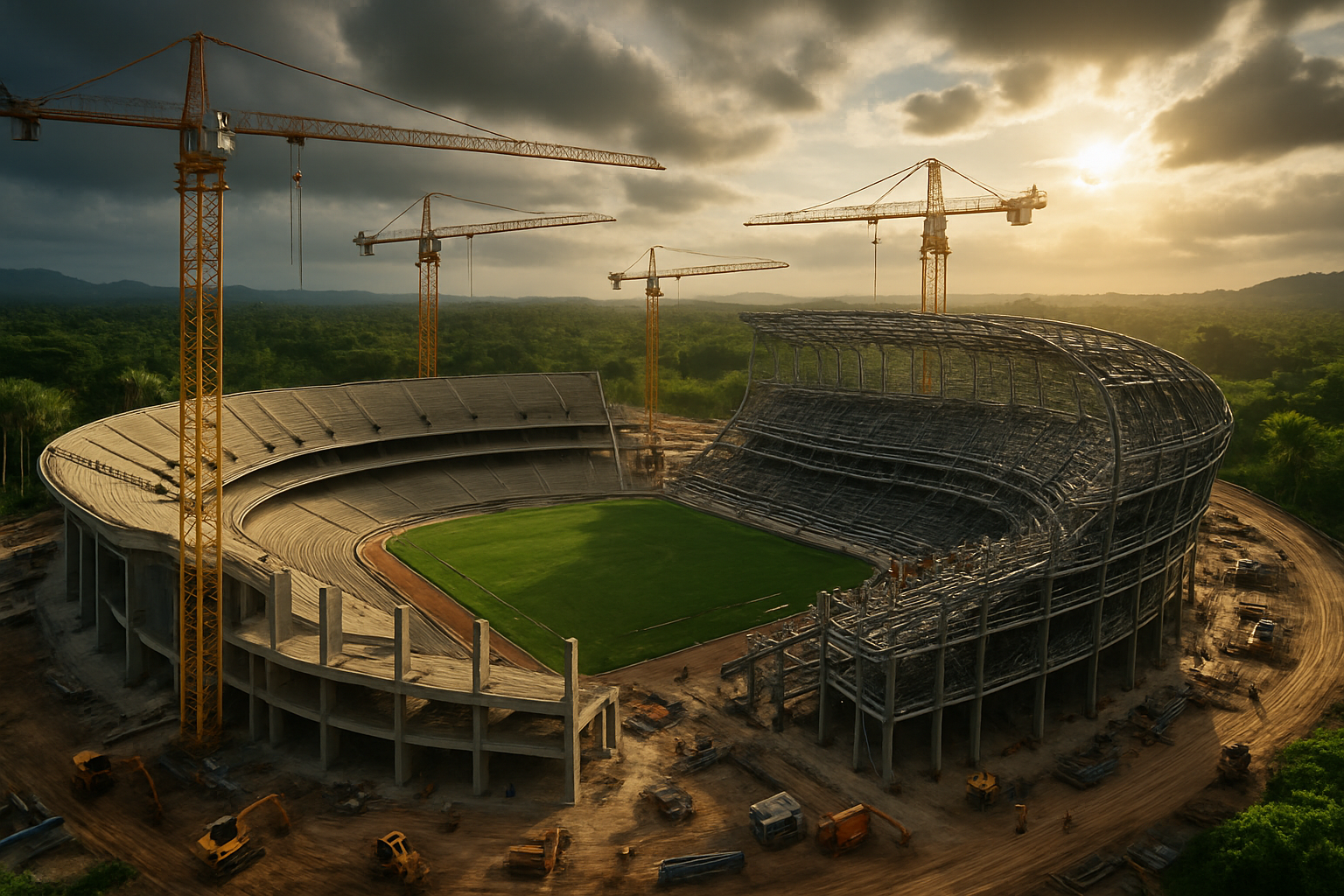
A coordinated surge in sports infrastructure investment is transforming the landscape across Africa and the Pacific, as nations from Ghana to Papua New Guinea leverage athletic facilities as drivers of economic growth, tourism, and international recognition.
The wave of development spans continents, with each country taking distinct approaches to maximize the economic and social returns from sports investments. The initiatives represent a fundamental shift in how developing nations view sports infrastructure – not as luxury amenities, but as essential economic catalysts.
Ghana's Strategic Sports Collaboration Framework
The Sports Writers Association of Ghana (SWAG) has forged a groundbreaking partnership with the Ministry of Sports and Recreation, marking unprecedented institutional collaboration in Ghanaian sports development. SWAG President Kwabena Yeboah praised Minister Kofi Adams' open-door policy, noting the minister's unprecedented visit to their offices before formal appointment.
"We have been extremely impressed with your relationship with sports journalists in this country. Even before you were formally appointed, you came to our office, which is unprecedented, and we are most humbled."
— Kwabena Yeboah, SWAG President
The partnership extends beyond symbolic gestures to concrete policy support. SWAG has endorsed the government's sports fund policy, recognizing its potential to transform Ghana's athletic infrastructure and international competitiveness. This collaboration model demonstrates how media partnerships can amplify sports development initiatives.
Papua New Guinea's NRL Infrastructure Blitz
Papua New Guinea's Governor Parkop has unveiled an ambitious infrastructure program designed to support the nation's 2028 National Rugby League (NRL) entry. The comprehensive development plan addresses the massive infrastructure requirements for hosting professional rugby league matches at international standards.
The initiative comes at a critical time, as historical memory from the Milano-Cortina 2026 Olympics demonstrates the importance of proper infrastructure preparation. The Perth Bears' successful recruitment drive for their 2027 NRL debut season shows the competitive landscape PNG will enter, making infrastructure development essential for success.
PNG's approach reflects lessons learned from Australia's current sports challenges, where injury epidemics and venue pressures have tested existing infrastructure. The proactive infrastructure investment positions PNG to avoid similar challenges when entering the world's most competitive rugby league competition.
Zimbabwe's Sports Tourism Integration Strategy
Zimbabwe's National Development Strategy 2 (NDS-2) represents the most sophisticated approach to sports infrastructure development, positioning athletic facilities as tourism playmakers rather than standalone amenities. The strategy integrates sports development with broader economic growth objectives.
This holistic approach addresses multiple economic sectors simultaneously – sports, tourism, and economic development – creating synergistic effects that maximize return on infrastructure investment. Zimbabwe's model provides a template for other developing nations seeking to optimize sports facility investments.
The timing aligns with global trends observed during the Milano-Cortina 2026 Olympics, where sustainable infrastructure approaches and multi-purpose venues proved most successful. Zimbabwe's strategy anticipates these international best practices.
Global Context and Historical Precedents
The current infrastructure surge builds on successful models observed throughout 2026. Kenya's HSBC Rugby Sevens tournament at Nyayo Stadium demonstrated how proper venue management can create sold-out international events, while recent Winter Olympics experiences show both the benefits and challenges of major sports infrastructure projects.
The Milano-Cortina 2026 Olympics revealed important lessons about infrastructure preparation. Despite some challenges with incomplete cable cars and venue construction, the Games proved that innovative approaches – such as dual-city hosting across 400+ kilometers – can work when properly planned and executed.
Economic Multiplier Effects
Each nation's approach reflects understanding of sports infrastructure as economic multipliers. Ghana's media partnership model leverages existing institutional relationships to maximize policy impact. Papua New Guinea's NRL preparation recognizes the revenue potential of professional sports hosting. Zimbabwe's tourism integration acknowledges the broader economic ecosystem that sports can activate.
Research from recent international events shows that well-planned sports infrastructure can generate significant economic returns through:
- Direct employment during construction and operation phases
- Tourism revenue from hosting international competitions
- Media exposure and national branding benefits
- Youth development and social cohesion programs
- Legacy benefits from improved recreational facilities
Technology and Innovation Integration
The current infrastructure wave incorporates technological advances observed in recent international competitions. The Milano-Cortina 2026 Olympics showcased AI integration with Alibaba Qwen systems and OMEGA analysis tools, setting new standards for modern sports venues.
These technological capabilities are increasingly accessible to developing nations, allowing them to build world-class facilities that incorporate broadcasting technology, performance analysis systems, and spectator experience enhancements previously limited to wealthy nations.
Challenges and Risk Management
The infrastructure developments face common challenges observed in recent international projects. Weather-related delays, construction complications, and funding coordination require careful management. However, the current projects benefit from lessons learned during recent major events.
The Milano-Cortina experience showed that infrastructure challenges can be overcome through adaptive management and international cooperation. Power outages, incomplete transportation systems, and venue construction delays were successfully managed, allowing competition to proceed at the highest levels.
International Cooperation and Knowledge Transfer
The cross-continental nature of current developments creates opportunities for knowledge sharing and best practice transfer. Ghana's institutional partnership model could inform similar approaches in other nations. Papua New Guinea's NRL preparation strategies may benefit other countries entering professional leagues.
Zimbabwe's tourism integration approach offers insights for nations seeking to maximize economic returns from sports investments. The diversity of approaches creates a rich knowledge base for future infrastructure development.
Future Outlook and Sustainability
The current infrastructure surge represents more than temporary construction activity – it signals a fundamental shift in how developing nations approach sports development. The emphasis on economic integration, tourism potential, and international competitiveness reflects sophisticated understanding of modern sports economics.
Success will depend on sustained political commitment, effective project management, and continued international cooperation. The diversity of approaches across Ghana, Papua New Guinea, and Zimbabwe provides multiple models for other nations considering similar investments.
As these projects reach completion, they will establish new benchmarks for sports infrastructure development in emerging economies, potentially influencing international standards and best practices for years to come.