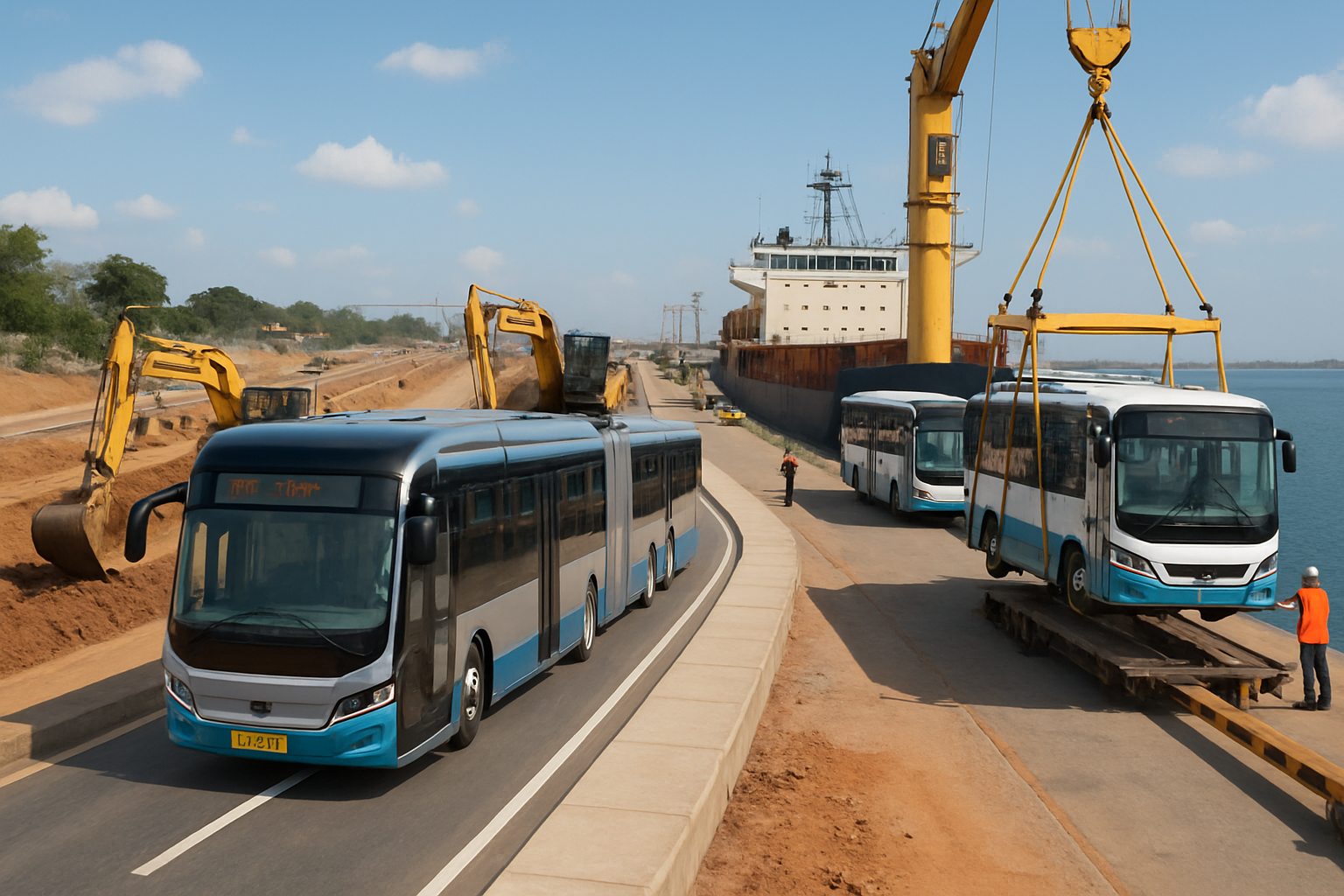
A wave of major transportation infrastructure developments across North and Central Africa is reshaping regional connectivity, with Algeria welcoming its first shipment of 176 advanced public transit buses while Cameroon accelerates critical highway reconstruction and launches groundbreaking Bus Rapid Transit procurement processes.
These developments represent a significant milestone in Africa's ongoing transportation infrastructure renaissance, occurring within the context of an unprecedented $570+ billion global infrastructure investment surge that has seen transformative projects from Vietnam's $120 billion expressway commitment to Kenya's accelerated highway completions.
Algeria's Public Transport Modernization
Algeria's state transport company ETUSA announced the arrival of the first batch of 176 TS9 buses at Jijel port, marking a crucial step in the nation's public transportation modernization program. These buses, each with a 70-passenger capacity, meet international quality, safety, and comfort standards while incorporating modern technical equipment designed to meet contemporary public transport requirements.
The vessels carrying these buses represent part of a comprehensive program to strengthen Algeria's national transport fleet. A second ship carrying 262 buses of different types was scheduled to arrive the same evening, demonstrating the scale and urgency of Algeria's transport infrastructure upgrade.
"This delivery ensures better service for citizens and more efficient utilization of our transport network,"
— ETUSA Official Statement
The TS9 buses feature advanced technical specifications aligned with modern public transportation demands, including enhanced safety systems, passenger comfort features, and operational efficiency improvements. This modernization comes as Algeria faces mounting pressure to upgrade its aging public transport infrastructure amid growing urban populations and environmental concerns.
Cameroon's Infrastructure Surge
Cameroon is simultaneously advancing multiple critical transportation projects that promise to transform the nation's connectivity. The Ministry of Public Works, under Minister Emmanuel Nganou Doumessi, announced urgent interventions on strategic road axes including the heavily traveled Yaoundé-Douala corridor, Douala-Bafoussam route, Edéa-Kribi connection, and the Ngaoundéré-Garoua highway.
These routes, which carry the majority of Cameroon's commercial and passenger traffic, have reached critical degradation levels requiring immediate attention. The ministry emphasized that interventions will include both immediate improvements to enhance road usability and comprehensive reconstruction projects undertaken with technical and financial partners.
Critical Highway Network
The condition of Cameroon's road network has become a pressing national concern, with over 92% of freight transportation dependent on road infrastructure. The Yaoundé-Douala axis alone carries thousands of vehicles daily, serving as the economic lifeline connecting the political capital with the nation's primary port city.
Minister Nganou Doumessi indicated that while the long-awaited second phase of the Yaoundé-Douala highway remains in planning stages, immediate interventions cannot be delayed due to the deteriorating condition of existing infrastructure.
Revolutionary BRT Project Advances
Perhaps most significantly, Cameroon's Douala Urban Community (CUD) has launched the first procurement processes for its ambitious Bus Rapid Transit (BRT) system, marking a transformative moment for urban mobility in Central Africa.
The initial tender, launched in October 2025, attracted significant international interest with 14 companies submitting bids for the feeder road construction after 21 firms initially acquired tender documents. These preliminary works cover 12.5 kilometers of access roads valued at 4.7 billion CFA francs (approximately $7.8 million).
The feeder road project encompasses critical infrastructure across Douala's 1st, 2nd, 3rd, and 5th districts, including roadways, drainage systems, lighting installations, traffic management equipment, and the relocation of water and electrical networks. Results are expected by the end of February 2026.
"These preliminary works lay the foundation for Douala's transformation into a modern urban center with world-class public transportation,"
— Douala Urban Community Officials
BRT System Implications
The Douala BRT represents more than a transportation project—it embodies Cameroon's commitment to sustainable urban development and positions the city as a pioneer in Central African urban planning. The system is designed to reduce traffic congestion, lower carbon emissions, and provide affordable, reliable transportation for Douala's growing population.
The project forms a crucial component of the broader Douala Urban Mobility Project, which aims to create an integrated transportation network serving one of Central Africa's most important economic centers. Success here could establish a template for similar projects across the region.
Regional and Global Context
These developments occur within the broader context of Africa's infrastructure renaissance, which has seen unprecedented investment and international cooperation. Recent memory indicates similar transformative projects including Angola's Lobito Corridor railway revival, Algeria's Gara Djebilet mining railway development, and Tanzania's 1,000-kilometer railway feasibility studies.
The projects also align with African Continental Free Trade Area (AfCFTA) objectives, emphasizing improved regional connectivity and reduced transportation costs. Enhanced infrastructure directly supports trade facilitation, economic integration, and competitiveness within global markets.
Technology Integration
Modern African infrastructure projects increasingly incorporate smart technology features, including digital monitoring systems, real-time passenger information, electronic payment integration, and environmental impact optimization. Algeria's new buses feature advanced technical equipment meeting contemporary standards, while Cameroon's BRT planning includes sophisticated traffic management systems.
This technological integration reflects a broader shift toward infrastructure that serves immediate needs while establishing foundations for future innovation and expansion. Climate adaptation considerations are also becoming standard requirements, given the increasing frequency of extreme weather events affecting transportation networks globally.
Economic Multiplier Effects
Transportation infrastructure investments create significant economic multiplier effects extending far beyond immediate construction activities. Improved connectivity reduces logistics costs, enhances market access for rural producers, and creates employment opportunities throughout project lifecycles.
For Algeria, modern public transportation supports urban development strategies while reducing environmental impact from private vehicle usage. For Cameroon, highway improvements directly affect agricultural export capabilities, while the BRT system positions Douala for sustainable urban growth.
The projects also demonstrate sophisticated financing approaches, combining domestic resources with international partnerships and technical expertise. This model has proven successful across Africa's infrastructure renaissance, enabling large-scale development while maintaining national ownership and control.
Implementation Challenges and Success Factors
Contemporary African infrastructure development faces complex challenges including coordination across multiple government levels, environmental compliance requirements, community engagement, and technical integration demands. Success depends on adaptive management approaches, transparent procurement processes, and sustained political commitment.
The timeline for Cameroon's BRT feeder roads—with results expected by February's end—demonstrates the compressed schedules required to meet growing urban transportation demands. Similarly, Algeria's rapid bus deployment reflects urgency in addressing public transportation gaps.
International cooperation remains crucial, with projects benefiting from partnerships spanning technical expertise, financing mechanisms, and knowledge sharing. The success of these initiatives will likely influence similar projects across the continent and establish precedents for future transportation development.
Future Implications
The February 2026 transportation developments in Algeria and Cameroon represent more than individual national projects—they embody Africa's emergence as a significant player in global infrastructure development. These initiatives demonstrate the continent's capacity for large-scale project management, international cooperation, and technological integration.
Success will create models for other African nations facing similar transportation challenges, while establishing competitive advantages through enhanced connectivity and reduced logistics costs. The projects also position both nations as regional leaders in sustainable transportation planning and urban development.
As these developments unfold over coming months, they will provide crucial lessons for balancing immediate infrastructure needs with long-term sustainability goals, community engagement with technical requirements, and national development priorities with regional integration objectives.
The convergence of Algeria's public transport modernization and Cameroon's comprehensive infrastructure advancement marks a pivotal moment in African transportation development, establishing foundations that will influence continental connectivity and economic integration for decades ahead.