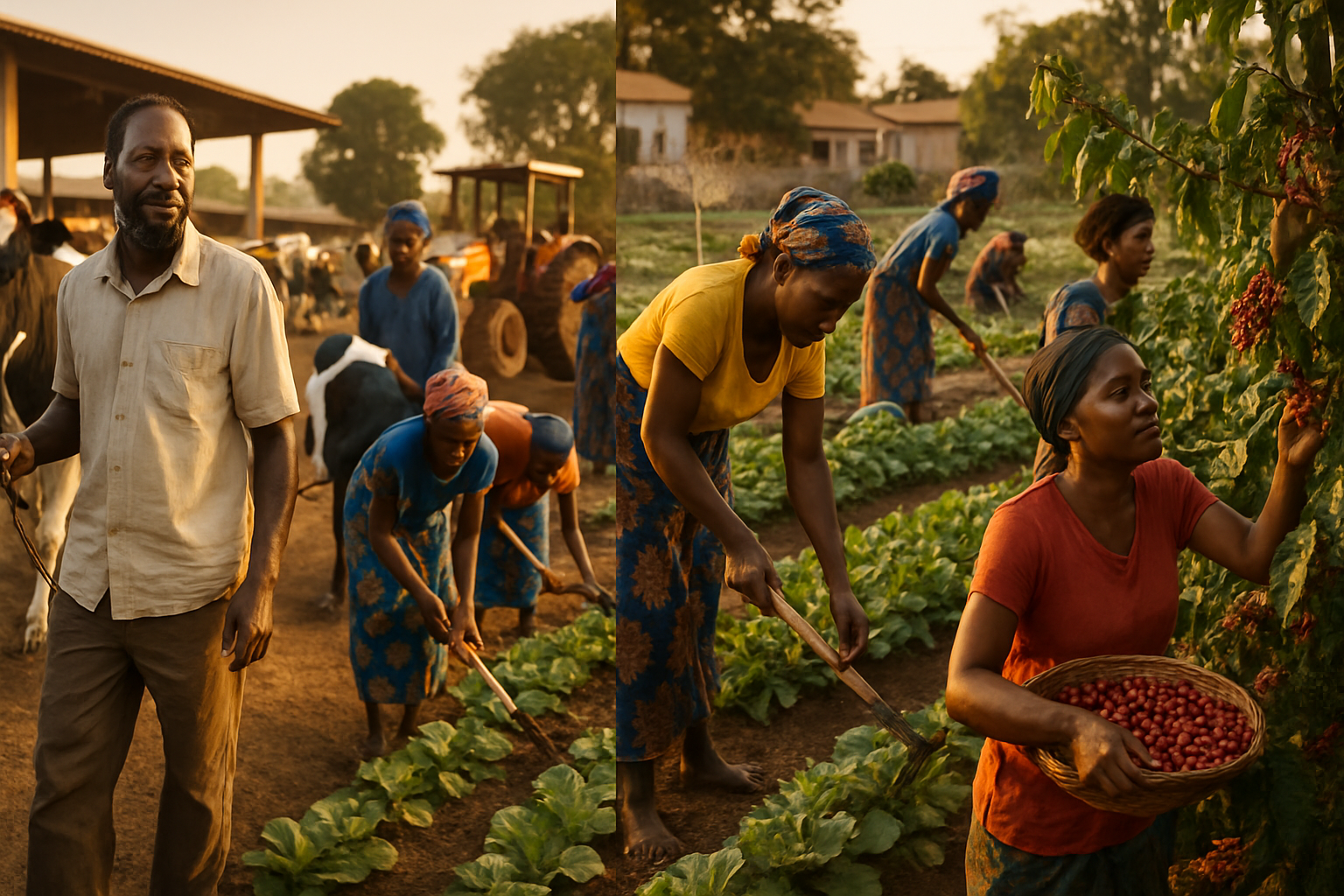
A remarkable agricultural transformation is sweeping across Africa, with Burkina Faso, Chad, and Mozambique emerging as leaders in innovative food security initiatives that could reshape the continent's agricultural landscape for decades to come.
On March 11, 2026, these three nations demonstrated the diversity and sophistication of Africa's agricultural renaissance through coordinated developments spanning livestock imports, urban farming innovations, and coffee plantation expansions. The initiatives represent a paradigm shift from traditional aid-dependent models to South-South cooperation and technology-driven solutions.
Burkina Faso's Dairy Revolution
In a groundbreaking ceremony at the Loumbila livestock station near Ouagadougou, Minister of Agriculture Ismaël Sombié officially received and distributed 710 high-performance pregnant cows imported from Brazil. This landmark initiative aims to dramatically reduce Burkina Faso's milk import dependency while strengthening domestic dairy production capacity.
The Brazilian cattle, selected for their superior milk production capabilities, represent more than a simple livestock import. They embody Burkina Faso's strategic approach to agricultural modernization that balances international partnerships with local expertise. The ceremony, attended by government officials and local producers, signaled the country's commitment to transforming its agricultural sector through strategic international collaboration.
"This investment represents our commitment to building a self-sufficient dairy sector that serves our people while reducing our dependence on imports,"
— Minister Ismaël Sombié, Burkina Faso Ministry of Agriculture
The initiative builds on Burkina Faso's broader agricultural transformation strategy, which has seen the country achieve record gold production revenue of over $6 billion while simultaneously investing in agricultural diversification. This dual approach reflects the government's understanding that sustainable development requires both mineral wealth exploitation and agricultural sector strengthening.
Chad's Urban Agricultural Innovation
In N'Djamena, Minister of Agricultural Production and Industrialization Keda Ballah launched an ambitious urban farming project that could serve as a template for African cities facing rapid urbanization and food security challenges. The "Smart City Market Gardening Development Project" received $250,000 funding from the Food and Agriculture Organization (FAO), representing approximately 138 million CFA francs.
The 24-month program focuses on strengthening food security while creating economic opportunities specifically targeted at young people and women—demographics that have historically faced limited access to agricultural investment and training. The initiative addresses both immediate urban food needs and long-term economic empowerment through skills development and market access.
Chad's approach demonstrates how African nations are adapting agricultural strategies to address urbanization pressures. Rather than viewing urban growth as a threat to agricultural development, the project treats cities as agricultural innovation centers where technology, education, and community organizing can create new food production models.
Mozambique's Coffee Renaissance
The southern African nation is experiencing a coffee renaissance through a strategic partnership between the Ministry of Agriculture, Environment and Fisheries (MAAP), the United Nations Food and Agriculture Organization (FAO), and the United Nations Industrial Development Organization (UNIDO). The initiative aims to establish approximately 200 hectares of new coffee plantations across communities in Manica province.
This coffee expansion represents more than agricultural diversification; it exemplifies Mozambique's strategy of revitalizing traditional export crops through modern agricultural techniques and international partnerships. The project combines traditional knowledge of coffee cultivation with contemporary agricultural science, creating a hybrid approach that respects local expertise while embracing beneficial innovations.
The Manica province initiative builds on Mozambique's broader agricultural transformation, which includes innovative biodiversity financing through the BCI Biodiversity Conservation Fund (BIOFUND) and strategic water infrastructure development serving rural communities. These interconnected projects demonstrate how successful agricultural development requires comprehensive approaches addressing production, financing, and infrastructure simultaneously.
Climate Adaptation and Technology Integration
These developments occur during unprecedented environmental challenges, with March 2026 marking the 19th consecutive month of global temperatures exceeding 1.5°C above pre-industrial levels. The sustained warming is fundamentally altering traditional farming cycles, water availability, and pest management patterns across Africa, requiring rapid adaptation strategies.
The three nations demonstrate sophisticated responses to climate challenges through technology-tradition synthesis. Burkina Faso's Brazilian cattle import includes climate-adaptive breeds suitable for Sahelian conditions. Chad's urban farming employs water-efficient techniques essential for semiarid regions. Mozambique's coffee expansion focuses on climate-resilient varieties capable of withstanding increased temperature variability.
South-South Cooperation Model
Perhaps most significantly, these initiatives represent the emergence of South-South cooperation as a dominant agricultural development model across Africa. Rather than relying exclusively on traditional North-South aid relationships, African nations are increasingly forming partnerships with other developing countries that share similar challenges and cultural contexts.
Burkina Faso's Brazilian partnership exemplifies this trend, combining Latin American livestock expertise with West African agricultural knowledge. The model proves more culturally appropriate and economically sustainable than conventional development assistance, as both partners understand the challenges of tropical agriculture, climate adaptation, and rural development.
This shift aligns with broader continental trends observed through the African Continental Free Trade Agreement (AfCFTA), which enables cross-border agricultural ventures, regional value chains, and shared infrastructure development. Countries across Africa are leveraging continental integration to address food security challenges that individual nations cannot solve independently.
Economic Development Beyond Agriculture
The agricultural initiatives function as comprehensive economic development engines extending far beyond farm-level improvements. Burkina Faso's dairy program creates employment in transportation, processing, and veterinary services while reducing foreign currency expenditure on milk imports. Chad's urban farming generates sustainable employment for youth while providing affordable food access for city residents.
Mozambique's coffee expansion establishes export revenue streams while developing rural infrastructure and agricultural expertise transferable to other crops. These multiplier effects illustrate why agricultural development increasingly serves as the foundation for broader economic transformation across the continent.
Gender Integration and Community Ownership
A common thread across all three initiatives is the emphasis on gender integration and community ownership. Chad's urban farming specifically targets women and young adults, recognizing their crucial roles in African food systems while addressing historical exclusion from agricultural investment. Mozambique's coffee program engages local communities as stakeholders rather than beneficiaries, ensuring long-term sustainability through local ownership.
This approach reflects lessons learned from earlier agricultural development projects where top-down technology transfer failed without consideration for local knowledge systems and community structures. Successful agricultural transformation requires approaches that respect traditional wisdom while incorporating beneficial innovations through community-driven processes.
International Cooperation Framework
The initiatives demonstrate how effective international cooperation can support African agricultural development while respecting sovereignty and local priorities. FAO's support for Chad combines financial resources with technical expertise tailored to local conditions. UNIDO's involvement in Mozambique brings industrial development knowledge essential for agricultural value chain development.
These partnerships contrast with traditional aid models by emphasizing mutual benefit, technology sharing, and capacity building rather than dependency relationships. The approach enables African nations to access international expertise while maintaining control over development priorities and implementation strategies.
Implementation Challenges and Success Factors
Despite promising starts, these initiatives face significant implementation challenges common to agricultural development across the continent. Funding sustainability remains a critical concern for developing nations where immediate economic pressures often override long-term investments. Technical capacity building requires sustained investment in education, training, and institutional development.
Climate change disrupts project timelines, requiring adaptive management capable of responding to rapidly changing environmental conditions. Success factors identified across all three initiatives include community ownership, transparent governance, sustained political commitment, and international cooperation that respects local autonomy while providing necessary technical and financial support.
Strategic Continental Significance
The agricultural transformations in Burkina Faso, Chad, and Mozambique provide templates that could be adapted and scaled across similar contexts throughout Africa. Their diversity offers multiple pathways for agricultural development: livestock improvement through international partnerships, urban agriculture addressing urbanization challenges, and traditional crop revitalization through modern techniques.
This diversity provides resilience against single-solution dependencies while offering multiple adaptation pathways for different national circumstances. The approaches contribute to continental food security objectives while building economic resilience during accelerating environmental change.
Future Implications
The success of these March 2026 agricultural initiatives may determine whether African agricultural innovation keeps pace with accelerating climate change while serving growing populations during this critical climate action decade. The window for building resilient, equitable food systems is narrowing rapidly, making coordinated responses crucial for ensuring continental food security.
The tools, knowledge, and cooperation frameworks exist for comprehensive responses to agricultural challenges, as demonstrated by these three nations. Success depends on sustained international cooperation, enhanced multi-sector coordination, and increased financial commitments recognizing food security as essential infrastructure for human prosperity and planetary sustainability.
As these initiatives mature and expand, they offer hope that African agricultural innovation, combined with international cooperation and community engagement, can create food systems capable of serving the continent's 1.4 billion people while protecting environmental resources during humanity's most environmentally challenging period.