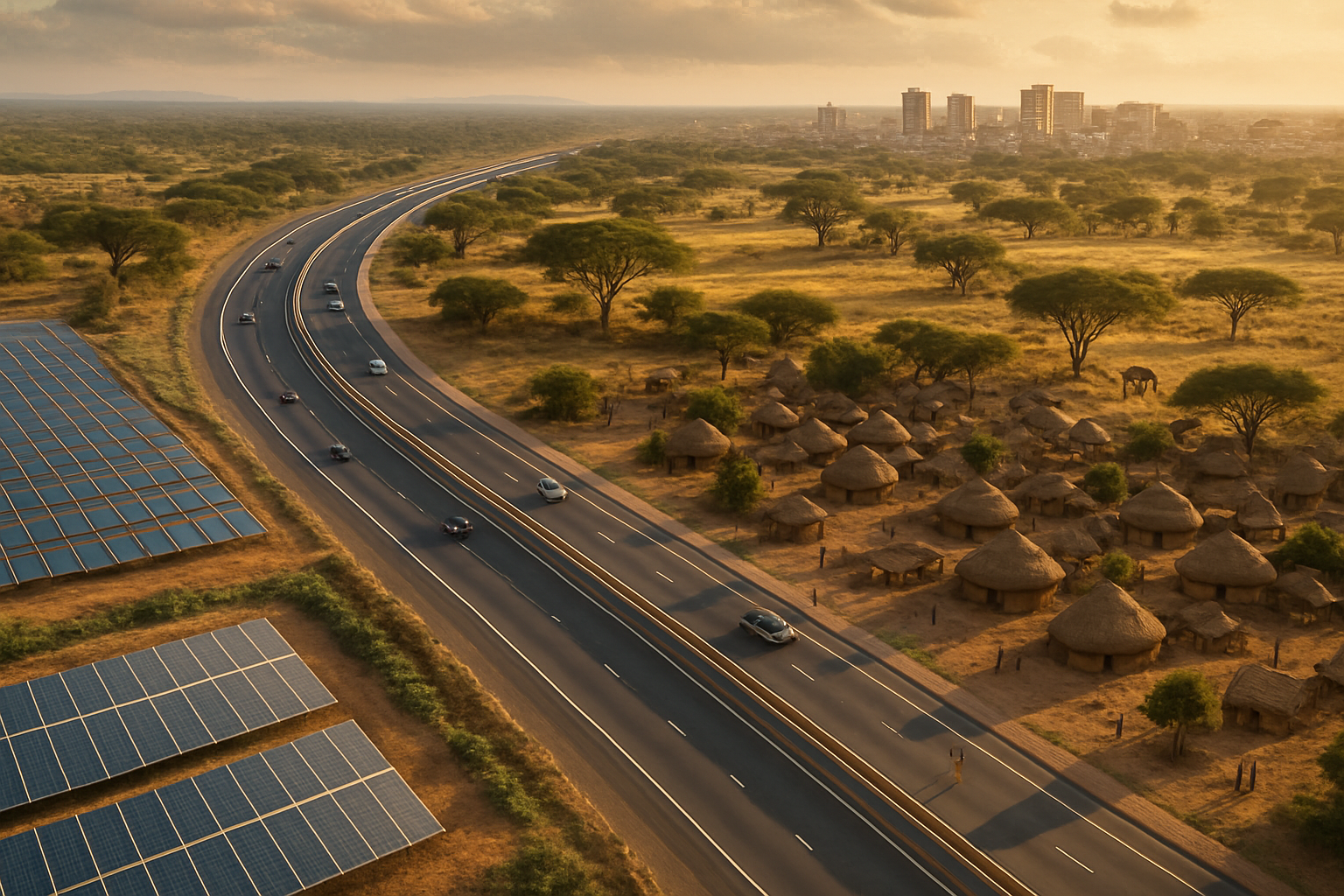
Across the African continent, a remarkable transformation is unfolding as women break traditional barriers, conservationists battle wildlife threats, and governments grapple with agricultural crises—painting a complex picture of development that encompasses both unprecedented opportunities and persistent challenges.
Breaking Barriers: Women's Economic Empowerment in Northern Nigeria
In Nigeria's conservative Muslim city of Kano, Umma Hani Yusuf Khalid represents a quiet revolution. Sporting a pink knee-length veil, she has found financial stability as a rickshaw taxi driver—a profession that would have been inconceivable for women just two years ago. Her story exemplifies the broader transformation occurring across West Africa, where traditional gender roles are evolving to meet economic necessities and changing social dynamics.
This shift reflects the strategic recognition by institutions like Afriland First Bank, where Director General Célestin Guela Simo emphasizes women's economic empowerment as a "genuine strategy for sustainable development." In Central Africa, women represent 52% of the population and serve as the backbone of the informal economy, yet less than 25% of women in the CEMAC zone hold formal bank accounts, and women entrepreneurs receive only a fraction of available business financing.
"Technology is the gold and oil of the current times"
— Charles Peter Mayiga, Katikiro of Buganda Kingdom
The continent's digital revolution is enabling new forms of economic participation. Uganda's Buganda Kingdom recently launched the Kibuga e-commerce platform, designed specifically for local consumers with mobile money integration and traditional bargaining mechanisms digitized. Nigeria leads Africa's fintech revolution with 43% of fuel sales now conducted through digital payments, providing same-day settlements that solve critical liquidity issues for small businesses.
Conservation Under Siege: Wildlife Protection in Kenya's Maasai Mara
Kenya's iconic Maasai Mara Game Reserve faces mounting pressure as tour guides, drivers, and conservation organizations protest the killing of lions in this globally renowned ecosystem. The Narok County Government faces intense scrutiny for its failure to protect the reserve's lion population, highlighting the complex relationship between tourism, local communities, and wildlife conservation.
This crisis reflects broader continental conservation challenges. Recent memory shows that environmental protection increasingly functions as an economic development engine rather than a regulatory burden. Countries implementing comprehensive environmental protection demonstrate greater economic resilience and attract sustainable investment. Cameroon's National Waste Exchange, launched in February 2025, treats waste as a valuable resource through innovative market-based approaches, creating employment in waste processing and environmental services.
The Maasai Mara situation illustrates the delicate balance African nations must strike between immediate economic needs and long-term environmental sustainability. Success in conservation requires sophisticated integration of traditional knowledge with modern conservation science, community ownership, and transparent governance frameworks that respect both wildlife and human needs.
Agricultural Innovation and Crisis Management
South Africa's launch of a mass cattle vaccination campaign against foot-and-mouth disease demonstrates the continent's capacity for coordinated agricultural crisis response. The outbreak threatens meat, dairy, and livestock supplies and exports, requiring swift government intervention to protect both domestic food security and international trade relationships.
This agricultural challenge occurs within a broader context of continental food security initiatives. Ghana has mandated that 50% of cocoa beans be processed locally starting in the 2026/2027 season, reviving the Produce Buying Company and Cocoa Processing Company. Such value-addition strategies represent a shift from raw material exports toward comprehensive industrial development.

The continent's agricultural renaissance includes innovative approaches to climate adaptation. Algeria has pioneered date waste-to-livestock feed conversion, representing circular economy solutions. Kenya's Nguruman irrigation scheme rehabilitation has benefited over 10,000 farmers, while Uganda's Teso cattle farming revival demonstrates successful integration of modern veterinary practices with traditional animal husbandry.
Infrastructure Renaissance and Regional Integration
Africa's infrastructure development has reached unprecedented scales, with projects worth hundreds of billions of dollars transforming continental connectivity. The African Finance Corporation reports that Africa holds $29.5 trillion in mineral reserves—20% of the global total—yet $8.6 trillion remains untapped despite growing international demand for critical materials.
Major infrastructure initiatives include Algeria's Gara Djebilet railway accessing the world's third-largest iron ore reserves, Angola's Lobito Corridor revival connecting the Atlantic coast to DRC mineral regions, and Tanzania's completion of the 1,000-kilometer Mtwara-Mbamba Bay railway feasibility study. These projects incorporate digital monitoring, renewable energy integration, and climate adaptation as standard features rather than premium additions.
The African Continental Free Trade Agreement (AfCFTA) serves as the framework enabling cross-border mining ventures, regional value chains, and shared infrastructure development. This integration creates opportunities for coordinated development strategies that maximize investment impact across multiple countries rather than limiting benefits to individual nations.
Technology and Traditional Knowledge Integration
Perhaps most significantly, successful African development initiatives demonstrate sophisticated synthesis of cutting-edge technology with traditional knowledge systems. Ghana's KNUST Responsible AI Lab has developed a national AI strategy, while maintaining respect for traditional governance structures and community decision-making processes.
Sierra Leone's Ministry of Communication, Technology, and Innovation has launched nationwide school tours preparing young innovators for the Robotics for Good Youth Challenge 2026, positioning the post-conflict nation as a potential leader in African educational technology. Students aged 10-18 are designing robots to address real-world challenges including disaster response and food security.
This technology-tradition integration extends to financial services. Zimbabwe's Ndarama platform represents the world's first programmable collateral-to-fiat system with a $1 minimum investment, bridging tokenized real-world assets to traditional currency without cryptocurrency complexity. Such innovations demonstrate Africa's emergence as a global leader in practical financial technology implementation.
Geopolitical Positioning and Strategic Autonomy
Seven African countries—Angola, DRC, Guinea, Kenya, Morocco, Sierra Leone, and Zambia—now participate in the US-EU-Japan Critical Minerals Partnership, challenging China's 60% production and 90% refining dominance in critical materials. Simultaneously, China announced zero-tariff access for 53 African countries starting May 1, 2026, representing the most comprehensive China-Africa trade expansion in history.
This dual engagement demonstrates African strategic autonomy in managing international partnerships. Rather than choosing sides in great power competition, African nations are leveraging their resource wealth and strategic importance to secure better terms from multiple partners while maintaining sovereignty over their development priorities.
Climate Adaptation and Environmental Leadership
African development occurs against the backdrop of accelerating climate change, with January 2026 marking the 18th consecutive month of global temperatures exceeding 1.5°C above pre-industrial levels. This sustained warming fundamentally alters agricultural systems, requiring rapid adaptation in crop selection, irrigation methods, and harvest timing.
Countries are responding with innovative climate adaptation strategies. Eritrea's livestock expert Mehari Woldebruk advocates urgent adoption of hydroponic and aquaponic systems for sustainable animal fodder production, emphasizing energy and water conservation. Such controlled environment agriculture provides protection from extreme weather while maintaining food security as climate patterns become increasingly unpredictable.
"Despite our challenges, Africa stands on the threshold of true integration. Our success hinges on our collective will to align national reforms with continental goals."
— Emmanuel Armah-Kofi Buah, Ghana Minister of Lands and Natural Resources
Challenges and Implementation Hurdles
Despite remarkable progress, significant challenges persist. Nigeria faces expanding terrorism with Lakurawa (Islamic State-affiliated) attacks spreading from traditional northeastern strongholds to middle belt regions. Sudan experiences what the UN describes as the world's worst humanitarian crisis, with drone strikes killing civilians and systematic targeting of infrastructure.
Implementation challenges include funding sustainability, technical capacity building, climate disruption affecting project timelines, and the need for coordinated multi-country execution. Global supply chain constraints, including sixfold increases in semiconductor prices affecting technology-dependent programs until 2027, create additional hurdles for digital transformation initiatives.
Governance challenges remain significant across the continent. The African Union faces criticism over institutional effectiveness amid "genocide, insurgencies, coups" across various regions. Recent Peace and Security Council elections brought Somalia, DRC, and Morocco as new members, facing immediate pressure to address continental security challenges.
Success Factors and Future Trajectory
Analysis of successful African development initiatives reveals common success factors: sustained political commitment surviving electoral cycles, community ownership and engagement, transparent governance frameworks, international cooperation that respects sovereignty, and adaptive management responding to changing conditions.
The integration of traditional knowledge with modern technology emerges as particularly crucial. Countries that successfully blend indigenous wisdom with contemporary innovations—whether in agriculture, governance, or environmental management—demonstrate superior outcomes compared to wholesale technology transfers that ignore local contexts.
Economic development increasingly functions as the foundation for addressing other challenges. Ghana's former Chief Justice Sophia Akuffo advocates comprehensive economic transformation through local gold market development, arguing "It's never too late" for Ghana to stop exporting raw gold and build vibrant domestic processing capabilities.
Continental Integration and Trade Facilitation
The Africa Prosperity Network's adoption of a 12-point Action Compact, demanding urgent visa-free travel across all AU member states, reflects growing momentum toward continental integration. With 6,530 delegates from 51 countries meeting in Accra, the initiative aims to enable a 1.5 billion person single market.
Trade facilitation projects commissioned by TradeMark Africa, including Mozambique's Trade Facilitation Programme and the Assessment and Review of EAC Vision 2050, demonstrate practical implementation of continental integration moving beyond symbolic commitments to tangible infrastructure for African economic unity.
Looking Forward: Strategic Implications
March 2026 represents a potential inflection point for African development, establishing patterns that could influence continental competitiveness for decades ahead. The convergence of technological advancement, environmental urgency, geopolitical realignment, and domestic transformation creates unprecedented opportunities alongside significant risks.
Success requires recognizing that African development is not simply about catching up to developed economies but about pioneering new models that integrate environmental sustainability, social equity, and economic growth. The continent's youth demographics, natural resources, and growing technological sophistication position it to leapfrog traditional development constraints.
The stories of Umma Hani Yusuf Khalid driving her rickshaw in Kano, conservationists protecting lions in the Maasai Mara, and farmers adapting to climate change across the continent illustrate that African development is ultimately about human agency, resilience, and the capacity to create opportunity from challenge. As the continent stands at this critical juncture, its choices will determine whether it becomes an essential global partner in addressing 21st-century challenges or remains constrained by historical limitations.
The evidence suggests that Africa is choosing the path of transformation, but success will require sustained commitment, innovative solutions, and recognition that development is not a destination but an ongoing process of adaptation and growth in an rapidly changing world.