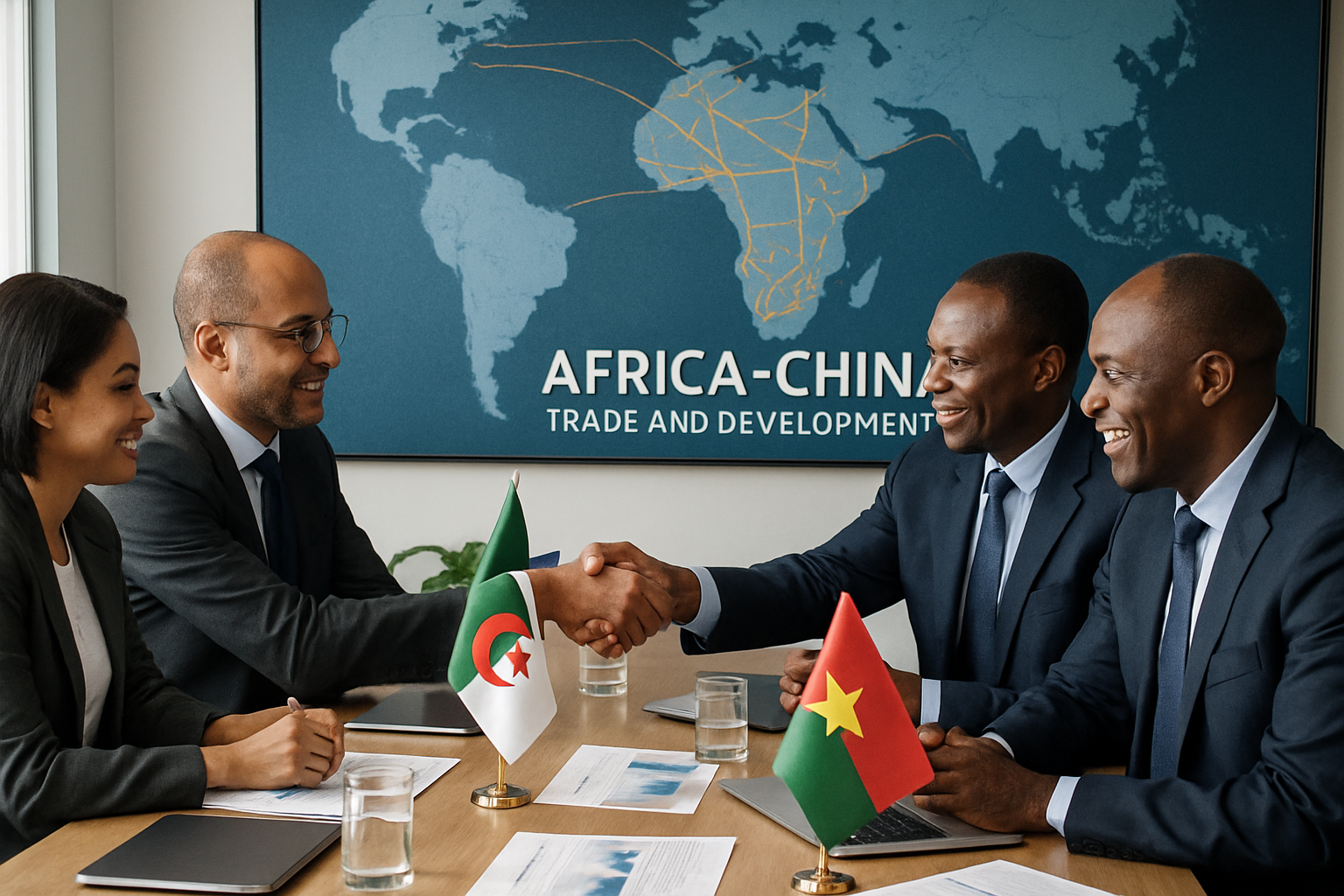
Africa is experiencing an unprecedented transformation as continental nations position themselves as strategic global partners rather than aid recipients, with major international cooperation initiatives and environmental programs marking March 2026 as a potential inflection point for decades of development patterns ahead.
Two significant developments across Algeria and Burkina Faso this week exemplify the continent's evolving approach to international partnerships. Algeria's "Invest Expo" facilitated strategic memorandums of understanding with Mauritanian, Senegalese, and Tunisian partners, while Chinese Ambassador Zhao Deyong outlined comprehensive environmental cooperation frameworks in Burkina Faso, emphasizing shared planetary stewardship over traditional donor-recipient relationships.
Strategic Investment Networks Emerge
Algeria's eighth International Investment Salon (Algeria Invest Expo) in Oran witnessed the signing of three crucial memorandums of understanding by Placo corporation with African partners from Mauritania, Senegal, and Tunisia. The agreements, overseen by more than 150 exhibitors from domestic and international markets under the Ministry of Industry's patronage, represent a fundamental shift toward South-South cooperation models.
These partnerships strengthen Placo's presence across African markets, which have become a strategic priority for the organization's next phase of expansion. The company's General Manager emphasized that this initiative aligns with broader continental integration objectives, leveraging the African Continental Free Trade Agreement (AfCFTA) framework to create cross-border value chains and coordinated development strategies.
The timing coincides with China's historic announcement of zero-tariff access for 53 African countries beginning May 1, 2026 – the most comprehensive expansion of China-Africa trade relations in modern history. This policy eliminates tariffs on all imports from eligible African nations, including agricultural products, minerals, manufactured goods, and textiles, creating unprecedented market access opportunities.
Environmental Cooperation as Development Strategy
Chinese Ambassador Zhao Deyong's environmental framework presentation in Burkina Faso represents a sophisticated evolution in international cooperation, moving beyond traditional infrastructure investment toward comprehensive ecological partnership. The ambassador's emphasis on "protecting our common planet" and "jointly promoting the construction of ecological civilization" reflects China's recognition that sustainable development requires environmental protection as foundational infrastructure.
This approach builds upon China's broader commitment to African development, which includes massive infrastructure investments such as Angola's Lobito Corridor railway revival connecting Atlantic coast to DRC mineral regions, Algeria's Gara Djebilet railway accessing the world's third-largest iron ore reserves, and Tanzania's Mtwara-Mbamba Bay railway feasibility completion spanning 1,000 kilometers.
The environmental cooperation framework acknowledges that economic growth and resource consumption must be balanced with ecological sustainability, particularly as January 2026 marked the 18th consecutive month of global temperatures exceeding 1.5°C above pre-industrial levels. This sustained warming creates an urgent context for climate adaptation strategies integrated into all development planning.
Continental Integration Momentum
These developments occur within broader African integration momentum driven by the AfCFTA framework, which enables cross-border infrastructure projects, regional value chains, and coordinated development strategies. The African Finance Corporation reports that the continent holds $29.5 trillion in mineral reserves – representing 20% of global totals – with $8.6 trillion remaining untapped, highlighting enormous potential requiring political stability and effective governance.
Recent infrastructure developments demonstrate this potential in action. Major projects include Algeria's strategic railway development, Angola's corridor connecting Atlantic ports to Central African mineral regions, and Tanzania's comprehensive transport network completion. These initiatives create physical foundations for trillion-dollar trade flows while enabling regional processing facilities and shared infrastructure that maximizes investment impact across multiple countries.
Seven African countries – Angola, Democratic Republic of Congo, Guinea, Kenya, Morocco, Sierra Leone, and Zambia – are participating in the US-EU-Japan Critical Minerals Partnership, challenging China's 60% production and 90% refining dominance in lithium, cobalt, and rare earth elements. This demonstrates Africa's sophisticated approach to managing international partnerships while maintaining strategic autonomy.
Technology Integration and Innovation
Modern African development projects incorporate advanced technologies as standard requirements rather than premium additions. Digital monitoring, renewable energy integration, smart logistics, and environmental compliance have become prerequisites for international investment. Nigeria demonstrates this technological advancement through fintech leadership, with 43% of fuel sales now processed through digital payments using same-day settlement systems.
The technology-first approach enables African nations to leapfrog traditional development constraints. Projects combine cutting-edge innovation with traditional knowledge systems, creating comprehensive frameworks that respect cultural contexts while embracing beneficial innovations. This synthesis proves more effective than purely technological solutions that ignore local expertise and community ownership requirements.
Congo's suspension of Congo Dongfang Mining for environmental violations demonstrates the evolution of governance frameworks, showing that African governments are asserting regulatory oversight while maintaining investment attractiveness through transparent and consistent enforcement standards.
Economic Transformation Beyond Resources
Africa's development model is evolving beyond traditional resource extraction toward comprehensive economic transformation. Ghana's advocacy for local gold processing, demonstrated by former Chief Justice Sophia Akuffo's call for domestic value-addition strategies, exemplifies this shift from raw material exports to industrial development that creates ripple effects throughout the economy.
The African Development Bank's launch of a $10 billion artificial intelligence mobilization initiative by 2035, targeting 40 million job creation, represents the most ambitious technology-focused development initiative in African history. This partnership with UNDP and private sector actors positions the continent as an active AI revolution participant rather than a passive technology recipient.
Economic diversification extends across multiple sectors simultaneously. Gabon positions Libreville as a regional energy hub targeting 300 million African electricity connections by 2030. Kenya's $2.9 billion investment conference deals created over 63,000 jobs while demonstrating direct investment success. These initiatives create specialized employment, export revenues, and economic development opportunities that strengthen entire ecosystems of supporting industries.
Strategic Partnerships and Global Positioning
Africa's emergence as a strategic global partner reflects sophisticated international relationship management. The continent balances Chinese investment and market access with Western partnerships and technological cooperation while maintaining resource sovereignty and development control. This multipolar approach enables beneficial relationships with multiple partners without becoming dependent on any single relationship.
The success of direct nation-to-nation agreements demonstrates pragmatic alternatives to complex multilateral institutional constraints. China's comprehensive tariff elimination, bilateral European partnerships, and strategic US cooperation in critical minerals create diverse options for African nations to pursue development objectives while maintaining strategic autonomy.
Regional organizations serve as building blocks for continental integration. The African Union's evolution from aspirational to implementation-focused demonstrates institutional maturation, while organizations like the Economic Community of West African States (ECOWAS) provide frameworks for coordinated responses to transnational challenges.
Climate Adaptation and Resilience
Environmental sustainability has become central to all development planning, reflecting recognition that climate change impacts threaten long-term prosperity. The 20th consecutive month of temperatures exceeding critical thresholds creates agricultural system stress, infrastructure challenges, and resource management complications requiring adaptive strategies integrated into all economic planning.
African nations demonstrate leadership in renewable energy development. Algeria's partnerships with Italy strengthen Mediterranean energy corridors combining traditional gas exports with renewable energy development. Namibian President Netumbo Nandi-Ndaitwah positions the nation as a "global player in delivering climate solutions," leveraging world-class solar irradiation and extensive Atlantic wind resources.
Climate adaptation strategies combine modern technology with traditional ecological knowledge. Community-based conservation programs in Liberia transform local populations from passive recipients to active environmental stewards. Morocco's participation in international renewable energy initiatives demonstrates how environmental protection functions as economic development strategy rather than regulatory burden.
Implementation Challenges and Success Factors
Despite unprecedented opportunities, significant implementation challenges remain. Funding sustainability concerns affect developing nations with immediate economic pressures that can override long-term investment priorities. Technical capacity building requires sustained educational investment, institutional development, and knowledge transfer beyond initial capital deployment.
Climate change continues disrupting project timelines, requiring adaptive management that responds to rapidly changing conditions. The global semiconductor shortage, which drove memory chip prices sixfold higher and affects smart technology deployment until 2027, illustrates supply chain vulnerabilities that complicate development planning.
Success factors include sustained political commitment transcending electoral cycles, transparent governance preventing corruption, community engagement ensuring local ownership, and international cooperation that respects sovereignty while providing technical expertise and market access. The diversity of approaches provides resilience against single-solution dependencies while offering multiple adaptation pathways for complex challenges.
Future Trajectory and Global Implications
March 2026 represents a potential watershed moment for African development, demonstrating the continent's sophisticated policy implementation capacity, international cooperation management, and strategic partner emergence versus traditional aid recipient positioning. The convergence of technological advancement, environmental awareness, and international cooperation creates development models that prioritize sustainability alongside economic growth.
The evolution establishes precedents for economic partnerships that prioritize mutual benefit over conditional assistance, permanent preferential treatment over aid-based arrangements, and comprehensive development combining domestic social policy with international economic expansion. These templates potentially influence international development and trade policies globally, reshaping trade patterns through strategic partnerships that transcend traditional geopolitical alignments.
Success could catalyze a positive cycle of enhanced investment, strengthened international cooperation, and expanded African capabilities contributing to global prosperity, supply chain security, and climate adaptation. The stakes extend far beyond the continent – Africa's emergence as a strategic partner capable of sophisticated investment management while maintaining development control positions it as an essential contributor to addressing 21st-century global challenges.
The window for building resilient, equitable development systems that balance immediate economic needs with long-term environmental sustainability is narrowing rapidly. However, the tools, knowledge, and cooperation frameworks demonstrated across Algeria, Burkina Faso, and throughout the continent provide evidence that coordinated responses can address these challenges effectively. The human dimension remains central – millions of farmers, workers, entrepreneurs, and communities depend on stable, fair systems that provide opportunities while supporting sustainable development goals that serve both immediate needs and planetary sustainability requirements.