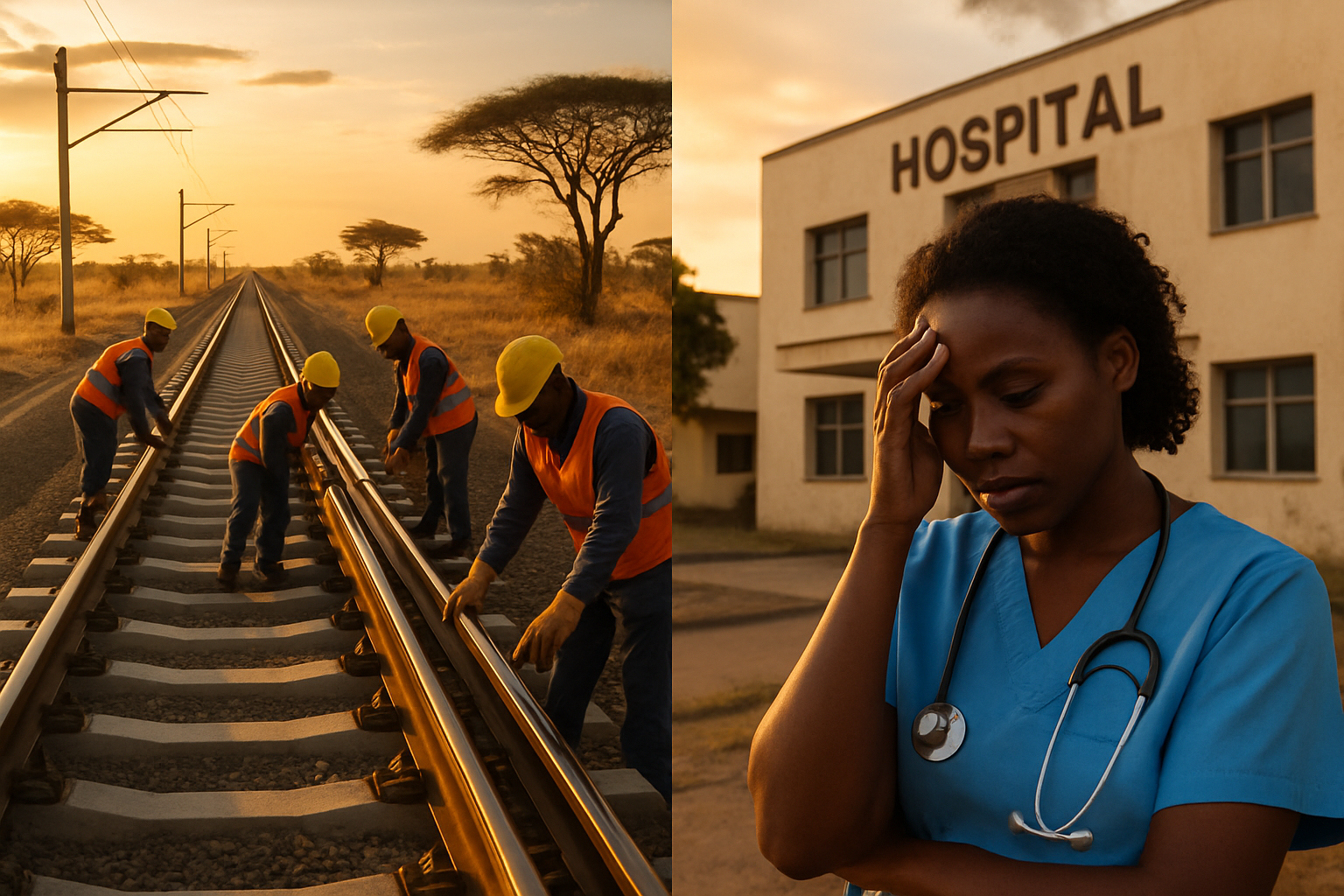
Two East African nations present starkly contrasting narratives of economic development as Tanzania advances major infrastructure projects while South Sudan confronts a deepening healthcare crisis, illustrating the complex challenges and opportunities facing the continent in 2026.
Tanzania's completion of feasibility and preliminary design studies for the ambitious Mtwara-Mbamba Bay Standard Gauge Railway (SGR) project marks a significant milestone in the nation's infrastructure development strategy. The 1,000-kilometer railway network, which includes branches to Liganga and Mchuchuma, represents one of East Africa's most comprehensive transportation infrastructure initiatives, designed to unlock the economic potential of Tanzania's southern regions.
Deputy Transport Minister David Kihenzile announced the project's progress during parliamentary proceedings in Dodoma, responding to questions about the government's strategic infrastructure priorities. The railway is positioned as a critical component of Tanzania's preparation for the implementation of the Liquefied Natural Gas (LNG) project, connecting resource-rich interior regions to coastal export facilities.
Tanzania's Infrastructure Renaissance
The Mtwara-Mbamba Bay SGR project exemplifies Tanzania's broader commitment to infrastructure-led economic development. The railway will connect the port city of Mtwara on the Indian Ocean to Mbamba Bay on Lake Nyasa, with strategic branches extending to the Liganga iron ore deposits and Mchuchuma coal fields. This comprehensive network is designed to transform Tanzania's mineral resource accessibility and export capabilities.
According to government projections, the railway will significantly reduce transportation costs for agricultural products and mineral resources from southern Tanzania, while creating employment opportunities and stimulating economic activity across multiple regions. The project aligns with Tanzania's Vision 2025 development goals and the broader East African Community integration initiatives.
"The Government is currently focusing on mobilizing financial resources for the implementation of this major infrastructure project, which will transform our economic landscape."
— David Kihenzile, Deputy Transport Minister
The timing of Tanzania's infrastructure advancement occurs within a broader context of African development momentum. Recent continental infrastructure initiatives include Algeria's launch of the western mining railway connecting Gara Djebilet-Tindouf-Bechar, Angola's revival of the Lobito Corridor railway, and Ethiopia's climate resilience water infrastructure investments.
South Sudan's Healthcare System Under Siege
In stark contrast to Tanzania's infrastructure progress, South Sudan faces a devastating healthcare crisis as the Ministry of Health announced the scale-down of services in more than 100 health facilities nationwide. The dramatic reduction follows major cuts to donor funding for the Health Sector Transformation Project (HSTP), originally conceived as a flagship $400 million reform initiative.
Health Minister Sarah Cleto Rial announced at a Juba press conference that support will be withdrawn from 101 health facilities, while six hospitals will scale down selected non-core services to focus exclusively on life-saving care. The decision represents one of the most significant healthcare service reductions in South Sudan's post-independence history.
The HSTP, launched in 2024 as a multi-donor investment designed to transform South Sudan's healthcare infrastructure, has seen available resources reduced by nearly half due to the withdrawal of key donors and global funding constraints. The project was originally planned to continue through 2027, but funding shortfalls have forced immediate and dramatic restructuring.
The Funding Crisis Reality
Minister Rial explained that the United States, previously a major supporter of South Sudan's health sector, has significantly reduced its contributions due to budget constraints and shifting aid priorities. Other international donors have similarly scaled back commitments, creating a critical funding gap that threatens basic healthcare delivery across the country.
The impact extends beyond simple service reduction. The affected facilities serve rural and marginalized communities that often have no alternative healthcare options. Many of these areas are already dealing with the ongoing effects of conflict, food insecurity, and limited infrastructure, making healthcare access even more critical for population survival and wellbeing.
"When the HSTP was launched in 2024, it was designed as a multi-donor investment of about $400 million. However, the withdrawal of key donors and global funding constraints has reduced available resources by nearly half, forcing us to realign priorities."
— Sarah Cleto Rial, Health Minister
The healthcare crisis occurs within the context of broader challenges facing South Sudan's development trajectory. The world's youngest nation continues to grapple with post-conflict reconstruction, economic instability, and limited government revenue generation capacity. Unlike Tanzania's diversified economy and relatively stable political environment, South Sudan remains heavily dependent on oil revenues and international assistance.
Continental Development Disparities
The contrasting experiences of Tanzania and South Sudan reflect broader patterns of uneven development across Africa. Countries with stable governance structures, diversified economies, and strategic geographic advantages are advancing major infrastructure projects and economic diversification initiatives. Meanwhile, nations affected by conflict, political instability, and limited institutional capacity struggle to maintain basic service delivery.
Tanzania's infrastructure development strategy aligns with continental initiatives such as the African Continental Free Trade Agreement (AfCFTA) and the African Union's Agenda 2063 vision for integrated continental development. The Mtwara-Mbamba Bay railway will enhance regional connectivity and trade facilitation, potentially benefiting neighboring countries through improved transportation networks.
The railway project also demonstrates Tanzania's capacity to engage with international partners while maintaining ownership of strategic development priorities. The government has indicated ongoing discussions with multiple potential financing partners, including development finance institutions, bilateral partners, and private sector investors.
Regional Economic Integration Implications
The Mtwara-Mbamba Bay SGR project extends beyond national boundaries, with potential connections to regional transportation networks linking Tanzania to Malawi, Mozambique, and other Southern African Development Community (SADC) member states. This regional integration approach reflects broader trends in African infrastructure development, where countries are increasingly pursuing cross-border projects to maximize economic benefits and efficiency.
The railway's connection to mineral-rich regions positions Tanzania to become a major player in global supply chains for critical minerals needed for renewable energy technologies and industrial applications. The Liganga iron ore deposits and Mchuchuma coal fields represent significant economic assets that could generate substantial export revenues and support domestic industrial development.
However, the success of such ambitious projects depends on sustained political commitment, effective project management, and adequate financing mechanisms. Tanzania's track record of completing major infrastructure projects, including the Standard Gauge Railway central corridor and port modernization initiatives, provides confidence in the government's implementation capabilities.
Healthcare as Economic Foundation
South Sudan's healthcare crisis illustrates how inadequate health systems can undermine broader economic development efforts. Population health outcomes directly affect productivity, human capital development, and long-term economic growth potential. The reduction of healthcare services in over 100 facilities represents a significant setback for South Sudan's development trajectory.
The crisis also highlights the vulnerability of developing countries to donor funding fluctuations and changing international aid priorities. South Sudan's heavy dependence on external support for basic service delivery creates substantial risks during periods of global economic uncertainty or shifting donor priorities.
Regional health organizations and African Union health initiatives may need to develop more robust mechanisms for supporting countries facing healthcare crises. The development of continental health security frameworks and mutual support systems could help prevent situations where basic healthcare services collapse due to funding shortfalls.
Looking Forward: Lessons and Opportunities
The contrasting experiences of Tanzania and South Sudan provide important lessons for African development strategies. Countries pursuing infrastructure-led growth must ensure that basic service delivery systems remain functional and accessible to all populations. Similarly, nations focusing on immediate humanitarian needs must develop longer-term strategic visions for sustainable economic development.
Tanzania's infrastructure development success demonstrates the potential for African countries to lead their own development processes while engaging strategically with international partners. The government's approach to project planning, financing mobilization, and implementation provides a model for other developing countries pursuing ambitious infrastructure projects.
For South Sudan, the healthcare crisis requires both immediate humanitarian response and longer-term systemic reforms. Building sustainable healthcare financing mechanisms, improving governance structures, and developing domestic revenue generation capacity will be essential for reducing dependence on volatile donor funding.
The broader implications extend to continental development strategies and international development cooperation frameworks. African countries are increasingly asserting ownership over their development priorities while seeking partnerships that support sustainable, locally-driven growth. The success of projects like Tanzania's railway and the resolution of crises like South Sudan's healthcare challenges will significantly influence the continent's overall development trajectory through the remainder of the decade.