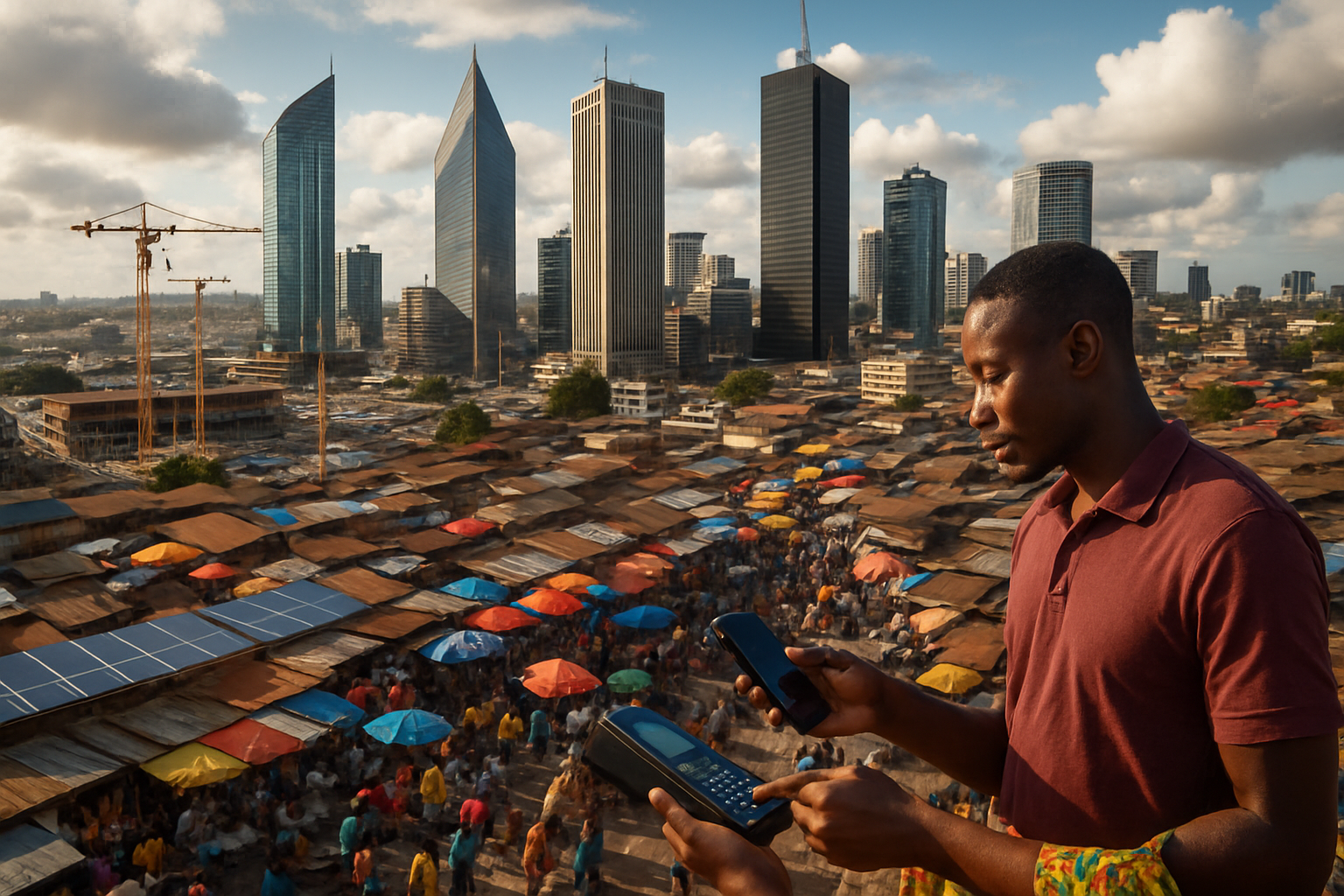
Africa has undergone a remarkable economic and digital transformation over the past decade, driven by unprecedented urbanization, technological leapfrogging, and strategic international partnerships that have repositioned the continent as a global economic force rather than merely an aid recipient.
The acceleration has been nothing short of extraordinary. Strong population growth and rapid urbanization, combined with an increasingly connected youth demographic, have catalyzed innovations that bypass traditional development constraints. This transformation represents far more than incremental progress—it signals a fundamental shift in how Africa engages with the global economy.
The Digital Payment Revolution Leading Global Innovation
Nigeria exemplifies Africa's digital finance leadership, with an unprecedented 43% of fuel sales now conducted through digital payments, solving critical liquidity issues through same-day settlements. This revolutionary shift has eliminated the cash flow challenges that traditionally plagued businesses, creating a template that other continents are studying and replicating.
The success extends far beyond convenience. Mobile money integration has democratized financial services for millions previously excluded from traditional banking. Countries like Kenya pioneered this transformation with M-Pesa, creating a global template that has influenced digital payment systems worldwide.
"Africa has demonstrated that practical fintech solutions focusing on real economic needs consistently outperform speculative alternatives," according to financial technology analysts tracking continental developments.
— Continental Fintech Analysis, 2026
This stability contrasts sharply with volatile cryptocurrency markets, which lost over $2 trillion since late 2025. Government-backed digital payment systems across Africa—from Nigeria's mobile money success to Zimbabwe's Ndarama platform—have proven superior in reliability and user adoption.
Infrastructure Renaissance Reshaping Continental Connectivity
The African Finance Corporation reports that the continent possesses $29.5 trillion in mineral reserves—representing 20% of the global total—with $8.6 trillion remaining untapped. This wealth is now being leveraged through sophisticated infrastructure projects that create the physical foundations for enhanced regional cooperation and global competitiveness.
Major developments include Algeria's Gara Djebilet railway project, which will access the world's third-largest iron ore reserves. Angola's Lobito Corridor revival connects Atlantic ports to Democratic Republic of Congo's mineral regions. Tanzania has completed feasibility studies for a 1,000-kilometer railway system that will transform East African commerce.
These projects incorporate cutting-edge technology from the design phase: digital monitoring systems, renewable energy integration, smart logistics, and environmental optimization have become standard requirements rather than premium additions. Climate adaptation measures—including enhanced drainage, weather-resistant materials, and backup power systems—address future conditions rather than historical patterns.
Strategic Partnership Evolution Beyond Traditional Aid Models
Perhaps most significantly, Africa has demonstrated sophisticated strategic autonomy in managing competing international relationships while maintaining development control. Seven African countries—Angola, Democratic Republic of Congo, Guinea, Kenya, Morocco, Sierra Leone, and Zambia—participate in the US-EU-Japan Critical Minerals Partnership, challenging China's current dominance of 60% production and 90% refining capacity.
Simultaneously, China announced zero-tariff access for 53 African countries starting May 1, 2026—the most comprehensive China-Africa trade expansion in modern history. This dual approach exemplifies African nations' evolution from passive aid recipients to strategic partners capable of sophisticated investment management while maintaining sovereignty over development priorities.
The African Continental Free Trade Area (AfCFTA) framework enables cross-border ventures, regional value chains, and coordinated development strategies that transform individual national projects into continental economic drivers. This approach maximizes the impact of individual investments while building collective capacity for global market engagement.
Economic Multiplier Effects Creating Sustainable Growth
Modern African infrastructure projects generate substantial economic multiplier effects through reduced logistics costs, enhanced market access, and improved business productivity. Uganda's historic €641.1 million infrastructure financing with Standard Chartered Bank creates thousands of direct construction jobs and tens of thousands of indirect opportunities while supporting the country's Ten-Fold Growth Strategy to reach a USD 500 billion economy by 2040.
The transformation extends beyond construction. Value-addition strategies are reshaping traditional resource extraction models. Ghana is implementing a mandate requiring 50% of cocoa beans to be processed locally starting in the 2026/2027 season. This approach creates domestic industrial capacity while capturing more value from natural resource exports.
Technology Integration Enabling Leapfrog Development
African countries have turned global constraints into competitive advantages. The worldwide semiconductor shortage, which drove memory chip prices up sixfold until 2027, has paradoxically accelerated efficient, resource-conscious solutions across the continent. This constraint-driven innovation has led to algorithms and systems that maximize performance while minimizing resource requirements.
Uganda's Buganda Kingdom launched the Kibuga e-commerce platform, demonstrating how traditional governance structures can successfully integrate with modern digital commerce. The platform addresses local market needs through mobile money integration, local language support, and digitized traditional bargaining mechanisms.
Sierra Leone has implemented robotics education programs preparing youth for disaster response and food security applications. These initiatives represent technology serving community needs rather than replacing traditional knowledge systems.
Political Maturation Supporting Economic Development
The political landscape has evolved to support economic transformation. Countries demonstrate sophisticated institutional capacity for large-scale international partnerships while maintaining democratic governance and sovereignty over development priorities.
Gabon's Ministry of Digital Economy has successfully integrated digital payment systems within transportation networks, while Nigeria has established a National Cybersecurity Coordination Council to protect the digital infrastructure driving the country's fintech revolution. These initiatives reflect comprehensive planning that addresses both development opportunities and potential vulnerabilities.
Climate Adaptation as Development Driver
Rather than viewing climate change as merely a constraint, African nations are incorporating climate adaptation as a fundamental driver of innovation. With temperatures exceeding 1.5°C pre-industrial levels for 18 consecutive months through January 2026, all major infrastructure projects now include climate resilience from the design phase.
Algeria has developed circular economy innovations converting date waste into livestock feed. Kenya's Nguruman irrigation project serves over 10,000 farmers with climate-adaptive agriculture. These initiatives demonstrate how environmental challenges can catalyze innovative solutions rather than simply requiring defensive responses.
Success Factors and Implementation Models
Analysis of successful African economic development reveals consistent patterns: sustained political commitment beyond electoral cycles, comprehensive community engagement and ownership, transparent governance frameworks, adaptive management capabilities, and international cooperation that respects autonomy while providing technical and financial support.
The diversity of approaches provides resilience against single-solution dependencies. Regional cooperation through frameworks like AfCFTA enables knowledge sharing and coordinated responses that individual nations could not achieve independently.
Global Implications and Future Trajectory
Africa's transformation has global implications extending far beyond the continent. The evolution from aid recipient to strategic partner capable of sophisticated investment management while maintaining development sovereignty provides templates for other regions facing similar challenges.
The continent now positions itself as an essential contributor to global prosperity, supply chain security, and climate adaptation rather than merely a beneficiary of international assistance. This shift represents a fundamental paradigm change in international development cooperation.
Success stories from across the continent—from Nigeria's fintech leadership to Uganda's infrastructure financing to Ghana's value-addition strategies—demonstrate that sustainable development is achievable when it combines local ownership with international cooperation, traditional wisdom with modern innovation, and economic growth with environmental sustainability.
As political tensions have remained manageable across the continent while economic transformation accelerates, April 2026 represents a potential inflection point that could establish African development patterns influencing global competitiveness for decades ahead. The window for effective coordinated action appears to be expanding rather than contracting, offering unprecedented opportunities for sustainable, inclusive growth that serves both African communities and global prosperity.
The decade ahead will likely determine whether these innovations can be scaled and sustained, potentially establishing Africa as a primary driver of 21st-century economic development and global stability.