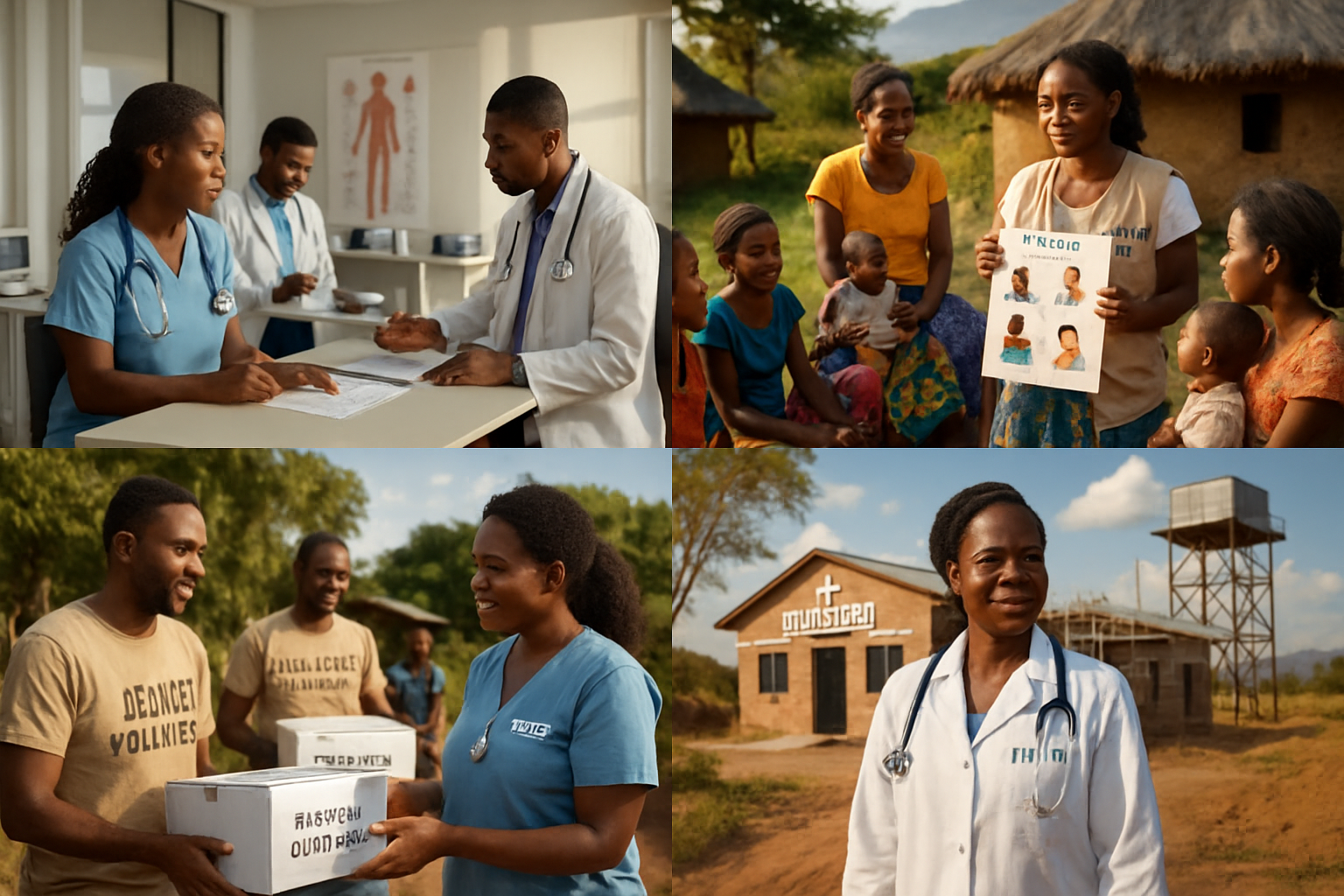
African nations are spearheading a remarkable healthcare transformation that is reshaping the global medical landscape, with Nigeria, Uganda, and Zimbabwe implementing groundbreaking community health worker programs and infrastructure developments that position the continent at the forefront of the "Therapeutic Revolution of 2026."
The latest developments across these three nations demonstrate a coordinated shift from traditional aid-dependent healthcare models to innovative, community-centered approaches that leverage both modern medical technology and indigenous knowledge systems. This transformation represents more than policy changes—it signals Africa's emergence as a global healthcare innovator rather than merely a recipient of international medical assistance.
Nigeria: Revolutionary Maternal Healthcare in Kano
In Nigeria's Kano State, the Sarkin Kura community exemplifies this transformation through its revamped Primary Healthcare Centre, which has fundamentally changed the experience of childbirth for local women. For years, expectant mothers faced dangerous journeys to healthcare facilities, with nighttime labor often meaning delivery without skilled medical support.
"Today, that story is gradually changing," according to Nigeria Health Watch, as the renovated facility now provides comprehensive maternal healthcare services that have dramatically reduced risks for both mothers and newborns. This transformation aligns with Nigeria's broader healthcare initiatives, including the country's emergence as a pioneer in advanced HIV prevention technology through lenacapavir twice-yearly injectable treatments launched across ten states in March 2026.
"The journey to the Primary Healthcare Centre was often filled with uncertainty, and for many women, labour that began at night meant delivering without skilled medical support. Today, that story is gradually changing."
— Nigeria Health Watch Report
The Sarkin Kura initiative represents a microcosm of Nigeria's systematic approach to healthcare infrastructure modernization, which includes achieving 43% of fuel sales through digital payments—demonstrating the country's leadership in integrating technology with essential services delivery.
Uganda: Scaling Community Health Extension Workers
Uganda has emerged as a continental leader in community health worker deployment, with recent initiatives in Mbarara and Rukungiri districts showcasing the potential of systematic healthcare decentralization. In Mbarara, 138 newly trained Community Health Extension Workers (CHEWs) have been deployed to strengthen rural healthcare systems, bringing medical services directly to households and bridging critical gaps between communities and formal health facilities.
The program's success in Mbarara prompted immediate expansion to Rukungiri District, where the Ministry of Health commissioned 210 additional CHEWs. This rapid scaling demonstrates Uganda's commitment to grassroots healthcare delivery, with these community health workers specifically trained to strengthen disease prevention at the grassroots level while connecting communities to specialized services when needed.
These initiatives build on Uganda's broader healthcare transformation efforts, including the country's recognition as a regional leader in comprehensive healthcare approaches that integrate traditional healing practices with modern medical interventions. The CHEWs program particularly addresses rural healthcare challenges by providing culturally appropriate care that respects local customs while maintaining evidence-based medical standards.
Zimbabwe: Strategic Business Integration and Healthcare Innovation
Zimbabwe's approach to healthcare development demonstrates sophisticated integration of business development with medical infrastructure expansion. The country is preparing to host the fourth edition of the Business Manoeuvre conference, organized by entrepreneur Kudakwashe Moyo (KD the Event Planner), which will bring together business leaders and miners to explore healthcare investment opportunities alongside other development priorities.
This business-focused approach complements Zimbabwe's pioneering work in HIV prevention through lenacapavir implementation and its innovative healthcare financing mechanisms, including the use of sugar tax revenues to procure hospital machinery and equipment for major medical facilities in Harare. The country has positioned itself as a regional model for sustainable healthcare financing that links public health policy with infrastructure development.
Zimbabwe's healthcare sovereignty approach demonstrates how African nations are transitioning from healthcare recipients to healthcare innovators, developing locally appropriate solutions that can be shared across the continent through South-South cooperation mechanisms.
Continental Context: The Therapeutic Revolution of 2026
These developments occur within what healthcare analysts have termed the "Therapeutic Revolution of 2026," characterized by a fundamental shift from reactive treatment models to prevention-first healthcare strategies. The revolution emphasizes early intervention, community engagement, and international cooperation despite challenges facing traditional multilateral health organizations.
Africa's leadership in this global transformation builds on previous successes documented throughout 2025 and early 2026, including Kenya's deployment of mammography services to 84 hospitals, Ghana's Free Primary Healthcare Programme launch, Tanzania's emergence as an IAEA-recognized cancer treatment hub, and Burkina Faso's pioneering kidney transplant program at CHU de Tengandogo.

Technology Integration and Human-Centered Care
The success of African healthcare initiatives demonstrates sophisticated understanding of technology integration that enhances rather than replaces human-centered care approaches. Uganda's CHEWs program incorporates digital health monitoring tools while maintaining personal relationships with community members. Nigeria's healthcare centers use modern medical equipment alongside traditional birthing support practices that respect cultural preferences.
This balanced approach avoids the "wellness paradox" identified by global health experts, where technological solutions create healthcare inequality rather than improving access for diverse populations. African healthcare innovations consistently prioritize community engagement, cultural sensitivity, and sustainable resource management.
Economic Implications and Prevention-First Benefits
The economic implications of Africa's healthcare transformation extend far beyond immediate medical costs. Prevention-focused strategies implemented across these three nations demonstrate substantial benefits through decreased crisis intervention costs, improved population outcomes, and enhanced community resilience.
Countries investing in comprehensive healthcare infrastructure report multiplier effects including medical tourism potential, reduced international referral dependency, enhanced workforce productivity, and improved quality of life indicators. Nigeria's digital payment integration, Uganda's community health worker deployment, and Zimbabwe's business-healthcare integration create self-reinforcing cycles where economic development supports further healthcare investment.
Economic analyses consistently show prevention-focused approaches deliver superior cost-effectiveness compared to reactive treatment models, with initial prevention investments justified through long-term savings and improved population health metrics. These approaches also contribute to national healthcare sovereignty, reducing dependence on international medical referrals while building regional expertise that benefits neighboring countries.
International Cooperation and South-South Learning
Despite challenges facing traditional multilateral health organizations, including WHO funding pressures from major contributor withdrawals, African nations continue advancing medical innovation through bilateral partnerships and regional collaboration networks. The continent's healthcare transformation represents evolution toward peer-to-peer knowledge sharing and distributed cooperation models that allow flexible, culturally responsive approaches while maintaining evidence-based medical standards.
This South-South cooperation model enables countries like Nigeria, Uganda, and Zimbabwe to share successful strategies with other African nations facing similar healthcare challenges. The community health worker model developed in Uganda is already being studied for potential adaptation in other East African countries, while Nigeria's digital health integration provides templates for similar initiatives across West Africa.
"African nations are transitioning from healthcare recipients to regional medical innovators, developing locally appropriate solutions that can be shared across the continent through South-South cooperation mechanisms."
— Continental Healthcare Assessment, March 2026
Climate Adaptation and Environmental Resilience
The healthcare developments across Nigeria, Uganda, and Zimbabwe also demonstrate sophisticated climate adaptation strategies. With January 2026 marking the 18th consecutive month of global temperatures exceeding 1.5°C above pre-industrial levels, African healthcare systems are being designed to address both immediate medical needs and long-term environmental resilience requirements.
Community health worker programs incorporate climate-responsive training that prepares healthcare providers for changing disease patterns, extreme weather events, and infrastructure challenges. Healthcare facilities are being constructed with renewable energy systems, water conservation technologies, and designs that can withstand increasingly severe weather events while maintaining essential medical services.
Success Factors and Implementation Challenges
The success of African healthcare transformation initiatives depends on several critical factors identified across all three countries: sustained political commitment to healthcare investment, comprehensive professional training programs, authentic community engagement strategies, and continued international cooperation for knowledge sharing and resource optimization.
Implementation challenges include ensuring sustainable financing mechanisms that don't depend solely on external funding, building technical capacity for advanced medical technologies, maintaining quality control across decentralized service delivery networks, and adapting programs to diverse cultural and linguistic contexts within each country.
However, the diversity of approaches demonstrated by Nigeria's facility-based improvements, Uganda's community health worker deployment, and Zimbabwe's business integration provides complementary models that strengthen the overall African healthcare ecosystem through shared learning and adaptation.
Future Implications and Global Significance
March 2026 represents a critical juncture in global healthcare evolution, with African initiatives providing evidence that coordinated action can achieve transformative improvements under resource constraints through scientific excellence balanced with equitable care delivery. The success of these programs influences healthcare policy development across developing nations and offers valuable lessons for developed countries seeking to improve community health outcomes.
The African healthcare transformation demonstrates that effective health systems require thoughtful integration of technological innovation with enduring healthcare principles rather than wholesale replacement of traditional care approaches. This balanced methodology creates sustainable healthcare delivery systems that serve all populations regardless of geographic or economic constraints.
As the global community grapples with increasing healthcare costs, aging populations, and climate-related health challenges, Africa's prevention-first, community-centered approach offers a roadmap for resilient healthcare systems that prioritize human dignity, cultural sensitivity, and sustainable resource management. The continent's leadership in the Therapeutic Revolution of 2026 positions it as an essential partner in addressing 21st-century global health challenges through coordinated international cooperation and innovative healthcare delivery models.
The transformation occurring across Nigeria, Uganda, Zimbabwe, and other African nations represents more than healthcare policy changes—it signals a fundamental shift in how the global community approaches health and wellness, with Africa leading the way toward more equitable, sustainable, and effective healthcare systems that serve as models for the rest of the world.