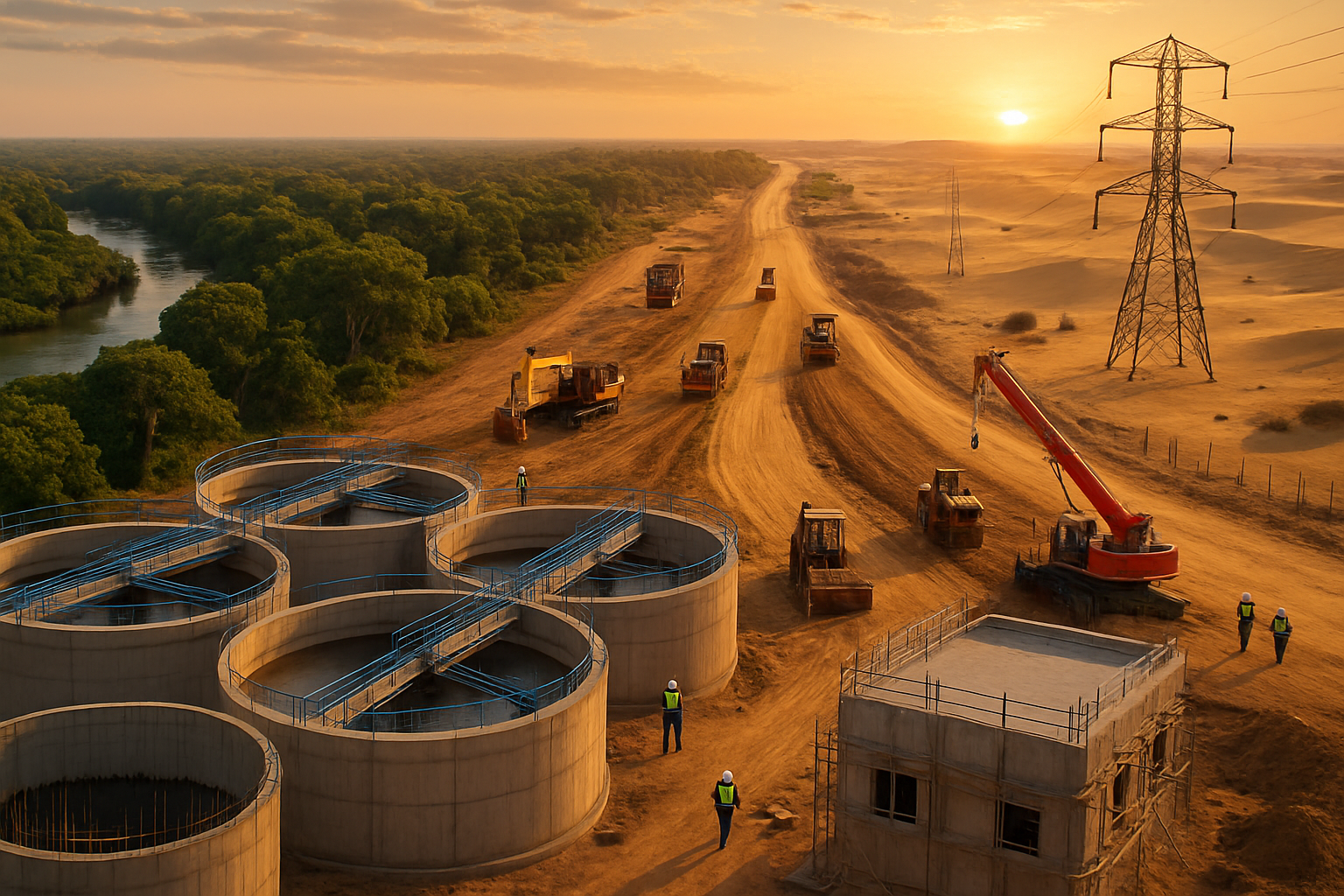
Africa's infrastructure renaissance continues to gather momentum in April 2026, with transformative projects spanning water access, transportation networks, and social services across multiple nations, demonstrating the continent's capacity for sophisticated development coordination while addressing critical needs of its 1.4 billion inhabitants.
The latest wave of developments, concentrated in the Democratic Republic of Congo and Mauritania, exemplifies Africa's evolution from aid recipient to strategic development partner, with projects integrating cutting-edge technology, climate adaptation measures, and international cooperation frameworks that maintain African agency over development priorities.
Water Infrastructure Breakthroughs Transform Rural Communities
A groundbreaking water access initiative in the Democratic Republic of Congo has delivered clean water to 70,000 people in the Kibumba and Buhumba communities of North Kivu's Nyirangongo territory. The project, financed by the Kingdom of the Netherlands, addresses a critical gap in an area bordering Virunga National Park that previously lacked any natural water sources.
The "Water for the Virunga" project represents more than infrastructure development—it's a lifeline for communities in one of Africa's most challenging environments. The initiative demonstrates how strategic international partnerships can deliver tangible results while respecting local sovereignty and environmental constraints.
"This project transforms lives in communities that have struggled with water access for generations. It's about dignity, health, and opportunity."
— Local Community Leader, Nyirangongo Territory
The success builds on broader continental water infrastructure momentum, including recent projects in Mozambique that served 195,305 people across Nampula and Zambézia provinces, and Ethiopia's strategic shift from emergency relief to long-term climate resilience through comprehensive watershed management.
Transportation Infrastructure: Building Continental Connectivity
Major transportation developments are reshaping Africa's connectivity landscape. In the Democratic Republic of Congo, Infrastructure Minister John Banza launched anti-erosion and road modernization projects in Mbuji-Mayi, addressing urgent infrastructure needs while implementing climate-adaptive design principles.
These initiatives target both immediate safety concerns—including protecting the Nyongolo police camp and surrounding neighborhoods from erosion threats—and long-term connectivity goals that support the African Continental Free Trade Area (AfCFTA) objectives. The projects incorporate advanced engineering solutions designed for the challenging Central African climate, including enhanced drainage systems and weather-resistant materials.
Meanwhile, Saudi Arabia's Northern International Highway, stretching over 1,700 kilometers, continues to demonstrate how strategic transportation infrastructure creates regional connectivity that extends far beyond national borders. The route links Gulf Cooperation Council countries with Jordan, Syria, Lebanon, and Turkey, ultimately connecting to European markets—a model for Africa's own continental integration ambitions.
Educational Infrastructure Expansion Addresses Rural Needs
Mauritania's government launched two strategic residential facilities for middle and high school students in Oujeft (Adrar region) and Boutilimit (Eastern Hodh region), each accommodating 150 students. The project represents a sophisticated approach to educational equity, ensuring rural students have access to quality secondary education despite geographic barriers.
The facilities provide comprehensive services including accommodation, meals, and supplementary instruction in mathematics and sciences. This holistic approach addresses not just access to education, but quality learning outcomes that can transform rural economies.
Energy Infrastructure: Powering African Development
A transformative $59.28 million Islamic Development Bank commitment to Mauritania's rural electrification demonstrates the scale of energy infrastructure investment reshaping the continent. The project targets equitable and sustainable electricity access in Adrar, Hodh Ech Chargui, Hodh El Gharbi, and Tagant regions, areas that have historically lacked reliable power infrastructure.
This investment aligns with broader African energy initiatives, including Gabon's positioning as a regional energy hub targeting 300 million electricity connections across Africa by 2030. The convergence of financing, technology, and political commitment creates unprecedented opportunities for energy transformation.
Technology Integration and Climate Adaptation
Modern African infrastructure projects demonstrate sophisticated integration of digital monitoring, renewable energy systems, and climate adaptation measures from the design phase. Projects incorporate real-time monitoring capabilities, predictive maintenance systems, and environmental optimization as standard requirements rather than optional upgrades.
This technological advancement enables African nations to leapfrog traditional development constraints while building infrastructure designed for future climate conditions rather than historical patterns. The approach reflects lessons learned from the continent's experience with climate volatility and the need for resilient systems.
International Cooperation Models
The success of current projects demonstrates sophisticated financing models that combine public investment, international development cooperation, and private sector expertise. The Netherlands' support for Congo's water project, the Islamic Development Bank's commitment to Mauritania's electrification, and various bilateral partnerships show how international cooperation can work while maintaining African ownership of development priorities.
These partnerships occur within a broader context of strategic diversification, as seven African countries participate in the US-EU-Japan Critical Minerals Partnership while maintaining relationships with traditional partners like China, which announced zero-tariff access for 53 African countries starting May 2026.
Economic Multiplier Effects
Infrastructure investments create substantial economic multiplier effects extending far beyond immediate construction jobs. Water access enables agricultural development and reduces healthcare costs from waterborne diseases. Transportation improvements reduce logistics costs and enhance market access. Energy infrastructure attracts additional investment and enables productive economic activities.
The African Finance Corporation reports that the continent holds $29.5 trillion in mineral reserves (20% of the global total), with $8.6 trillion remaining untapped. Strategic infrastructure development is essential for realizing this economic potential while ensuring benefits reach local communities.
Challenges and Success Factors
Implementation challenges include funding sustainability, technical capacity building, environmental compliance, and coordination complexity across multiple stakeholders. Success factors consistently include sustained political commitment, transparent governance frameworks, comprehensive community engagement, and adaptive management strategies that can respond to changing conditions.
The global semiconductor shortage and material cost inflation have created additional challenges, but they have also spurred innovation in resource-efficient solutions and strengthened regional manufacturing capabilities.
Regional Integration and Continental Vision
These infrastructure developments support broader African integration objectives, particularly the implementation of the African Continental Free Trade Area. Enhanced connectivity enables cross-border trade, regional value chains, and shared infrastructure projects that benefit multiple countries simultaneously.
The projects also contribute to Africa's positioning as a strategic global partner capable of sophisticated international cooperation while maintaining control over development priorities. This represents a fundamental shift from traditional aid relationships toward mutually beneficial partnerships.
Looking Forward: Sustainable Development Templates
April 2026's infrastructure developments establish important precedents for balancing immediate development needs with long-term sustainability requirements. The integration of climate adaptation, technology advancement, and community engagement creates templates that can be adapted and scaled across the continent.
The success of these initiatives influences global development cooperation models and demonstrates Africa's capacity for large-scale project management that benefits local populations while engaging productively with international partners. As the continent continues its infrastructure renaissance, these projects provide valuable lessons for achieving transformation that serves both immediate needs and long-term prosperity.
The convergence of technological advancement, environmental awareness, and international cooperation is creating new development models that prioritize comprehensive sustainability alongside economic growth—an approach essential for addressing the complex challenges of the 21st century while building foundation for decades of African prosperity.