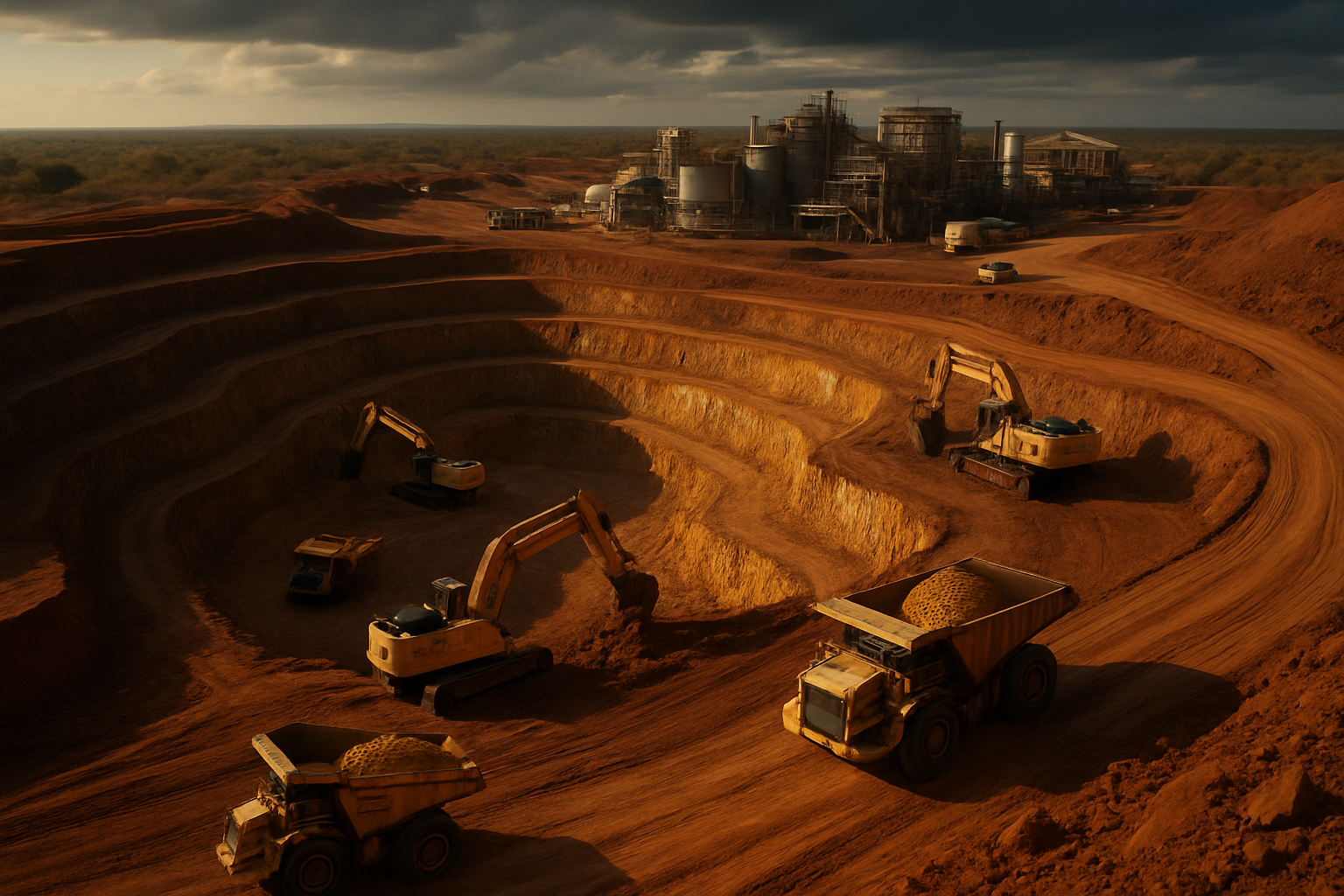
Africa's mining sector is experiencing a historic investment surge as governments across the continent approve billions of dollars in new projects, from Ivory Coast's massive gold developments to South Africa's strategic rare earth initiatives, reflecting the continent's growing importance in global supply chain diversification.
The latest wave of approvals signals a fundamental shift in international mining investment patterns, as traditional energy economies diversify their resource portfolios while emerging global powers seek alternatives to Chinese-dominated supply chains in critical minerals.
Ivory Coast's Golden Opportunity
Ivory Coast's Council of Ministers on February 4 adopted two key decrees granting mining exploitation permits for major gold projects worth 732.7 billion CFA francs (approximately $1.2 billion), marking one of the largest mining investment approvals in West Africa's recent history.
The projects represent a strategic economic diversification initiative for Ivory Coast, traditionally known for cocoa production, as the government seeks to capitalize on the country's substantial but historically underexploited gold reserves. The approval process demonstrates the government's commitment to attracting international mining investment while maintaining regulatory oversight.
"These projects will significantly boost our mining sector's contribution to national GDP and create thousands of jobs across rural communities,"
— Source close to Ivory Coast Ministry of Mines
The timing aligns with broader African mining development trends, building on successes like Burkina Faso's record 94-ton gold production in 2025, which generated over $6 billion in revenue under sovereignty-focused mining reforms. The Ivory Coast projects are expected to position the country among West Africa's leading gold producers within five years.
South Africa's Rare Earth Strategic Play
In a separate but equally significant development, South Africa's state-owned Industrial Development Corporation (IDC) committed R325 million ($18 million) to Frontier Rare Earths's Zandkopsdrift project in the Northern Cape province, marking a major strategic investment in critical minerals.
The Zandkopsdrift project targets rare earth elements essential for renewable energy technologies, electric vehicles, and advanced manufacturing. The IDC backing represents South Africa's strategic response to global supply chain vulnerabilities highlighted by China's dominance in rare earth processing, where China controls 60% of global production and 90% of refining capacity.
This investment occurs against the backdrop of international efforts to diversify critical mineral supply chains. The recent US-EU-Japan alliance announcement, involving 55 countries and led by Vice President J.D. Vance, specifically aims to challenge Chinese dominance in critical minerals through strategic partnerships with resource-rich nations like South Africa.
Botswana's Economic Transformation Vision
Botswana continues positioning itself for substantial economic growth, with analysts describing the country as preparing for an "economic windfall" that extends beyond its traditional diamond-dependent economy. While specific mining details from recent reports remain limited, Botswana's strategic location and stable governance make it an attractive destination for diversified mining investments.
The country's economic diversification efforts align with broader African development patterns, where nations are leveraging their mineral wealth to attract international investment while building local capacity and infrastructure.
Global Context and Strategic Implications
These African mining developments occur within a broader global context of supply chain diversification and energy transition acceleration. The February 4-5, 2026 Critical Minerals Ministerial in Washington D.C. included seven African countries—Angola, Democratic Republic of the Congo, Guinea, Kenya, Morocco, Sierra Leone, and Zambia—highlighting Africa's central role in global mineral security strategies.
The timing is particularly significant as the EU faces what auditors describe as a "critical materials crisis" threatening climate goals, with dangerous dependence on Chinese supply chains for lithium, cobalt, and rare earth elements essential for renewable energy infrastructure.
"Africa represents the most promising alternative to Chinese mineral dominance, offering both resource diversity and the potential for more balanced international partnerships,"
— International mining analyst following Critical Minerals Summit
Investment Drivers and Market Forces
Several factors are driving this African mining investment surge. First, the global energy transition requires massive quantities of critical minerals, creating unprecedented demand for African resources. Second, geopolitical tensions have heightened awareness of supply chain vulnerabilities, prompting diversification efforts away from single-source dependencies.
Third, African governments have learned from previous extractive industry experiences, implementing more sophisticated regulatory frameworks that balance foreign investment attraction with local benefit requirements. Finally, technological advances have made previously uneconomical deposits viable for development.
The investment wave also benefits from improved infrastructure connectivity across the continent, including projects like Algeria's Gara Djebilet mining railway accessing the world's third-largest iron ore reserves, and Angola's Lobito Corridor revival facilitating mineral transport to global markets.
Regional Integration and Economic Impact
African mining investment growth occurs alongside broader continental integration efforts, including the African Continental Free Trade Area (AfCFTA) implementation. This creates opportunities for cross-border mining operations, shared infrastructure development, and regional value chain creation.
The economic implications extend beyond direct mining revenues. Major projects create employment opportunities in rural areas, stimulate local service industries, and generate government revenues for infrastructure and social development. Ivory Coast's gold projects alone are expected to create several thousand direct jobs and many more indirect employment opportunities.
Regional cooperation mechanisms are also evolving, with countries sharing best practices in mining governance, environmental protection, and community engagement. This knowledge transfer accelerates sector development across the continent.
Challenges and Risk Management
Despite promising developments, African mining investment faces significant challenges. Environmental protection requirements demand sophisticated management systems, particularly for large-scale operations. Community relations require careful attention to local benefit distribution and cultural sensitivity.
Infrastructure limitations in remote mining areas necessitate substantial additional investments in roads, power generation, and communications systems. Regulatory complexity across different national jurisdictions can create compliance challenges for international investors.
Market volatility in commodity prices creates revenue uncertainties that affect long-term project viability. Currency fluctuations and political stability concerns also influence investor confidence and project financing availability.
Technology and Innovation Integration
Modern African mining projects increasingly incorporate advanced technologies, from automated extraction equipment to environmental monitoring systems. This technological integration improves operational efficiency while addressing environmental and safety concerns that historically plagued the sector.
Digital technologies enable real-time monitoring of operations, predictive maintenance, and optimized resource extraction. Remote sensing and AI-driven geological analysis help identify new deposits and optimize existing operations.
The integration of renewable energy systems in mining operations also addresses sustainability concerns while reducing operational costs, particularly important as global investors increasingly prioritize environmental, social, and governance (ESG) criteria.
Future Outlook and Strategic Positioning
The current African mining investment surge appears positioned to continue through 2026 and beyond, driven by sustained global demand for critical minerals and ongoing supply chain diversification efforts. The involvement of major international partners, from Asian investors to American and European strategic initiatives, provides multiple financing sources and market outlets.
African countries are increasingly sophisticated in their approach to mining partnerships, negotiating agreements that ensure local value addition, technology transfer, and capacity building. This evolution from simple resource extraction to more comprehensive development partnerships promises greater long-term benefits for African economies.
The success of current projects will likely attract additional investment, creating a positive cycle of development that could transform Africa's position in global mining markets from a supplier of raw materials to a more integrated participant in global value chains.
As global energy transition accelerates and geopolitical considerations reshape supply chain strategies, Africa's mining sector stands poised to play an increasingly central role in the world economy, provided that current investment trends continue and governance frameworks continue evolving to support sustainable, beneficial development for all stakeholders.