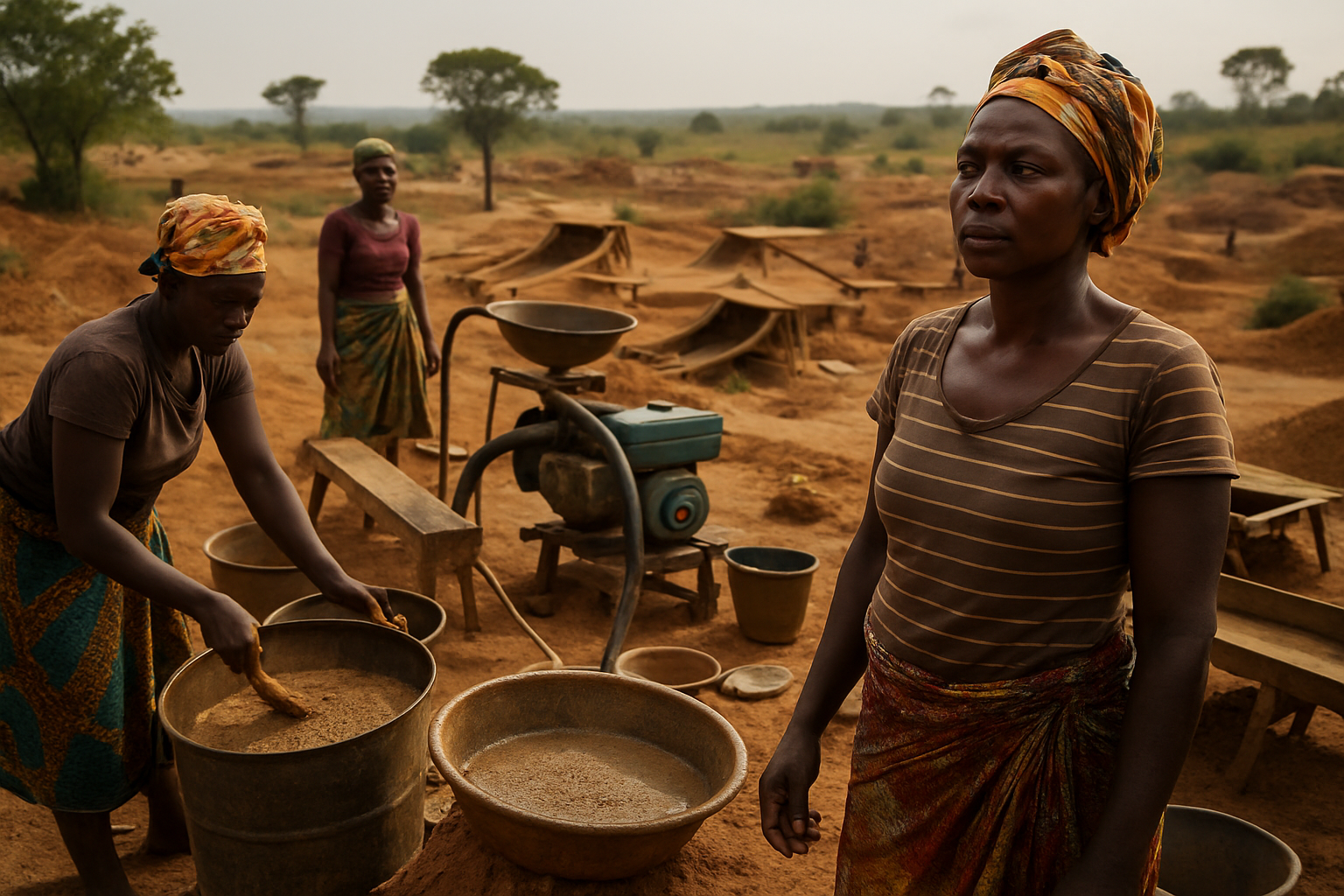
Ten women lost their lives in a tragic artisanal gold mining collapse in Guinea's Kondianakoro village on February 11, 2026, highlighting the stark contrast between Africa's mining investment boom and persistent safety challenges that plague the continent's extractive industries.
The incident occurred in Mandiana Prefecture, Upper Guinea, when women engaged in gold washing and residue treatment at an artisanal mining site were buried under collapsing pit walls. The tragedy underscores the precarious conditions faced by small-scale miners even as Africa experiences an unprecedented surge in mining investments and international partnerships.
Guinea's Mining Context Within Continental Boom
The Kondianakoro disaster comes as Guinea actively participates in major international mining initiatives, including the US-EU-Japan Critical Minerals Partnership involving 55 countries. Guinea is among seven African nations (alongside Angola, DRC, Kenya, Morocco, Sierra Leone, and Zambia) working to challenge China's 60% production and 90% refining dominance in critical minerals.
Just days before the tragedy, Guinea was preparing to showcase its Simandou iron ore strategy at the 32nd African Mining Indaba in Cape Town (February 9-12, 2026), highlighting the country's potential as a major global supplier of critical materials needed for renewable energy transitions.
However, the stark reality facing artisanal miners reveals the gap between high-level international partnerships and ground-level safety conditions. Women in Guinea's mining communities often engage in gold washing and processing activities that provide crucial income but lack adequate safety infrastructure or regulatory oversight.
Brazil's Strategic Minerals Dilemma
Meanwhile, Brazil faces its own mining industry challenges despite holding the world's second-largest rare earth reserves. President Lula da Silva is set to sign a critical minerals memorandum with India next week, yet Brazilian officials acknowledge it will yield limited near-term results due to internal divisions over foreign partnerships.
A government study revealed Brazil's graphite output has declined 8.4% annually in recent years, highlighting the country's struggle to capitalize on its mineral wealth. Internal disagreements over transparency with foreign partners have stalled the development of a coherent national minerals strategy, leaving vast resources underdeveloped.
This strategic paralysis occurs as Brazil's manufacturing trade deficit reached a record $71.1 billion in 2025, despite overall exports rising 3.8%. The country increasingly exports raw materials while importing manufactured goods, exposing the widening gap between Brazil's commodity strength and industrial weakness.
"High-tech sectors drove the deterioration: aerospace imports nearly tripled since 2019, while pharmaceuticals doubled, fueled in part by the post-pandemic recovery."
— Economic Analysis Report
Continental Mining Investment Surge
The Guinea tragedy occurs amid Africa's largest mining investment wave in decades. Recent developments include Ivory Coast's approval of 732.7 billion CFA francs ($1.2 billion) in gold projects and South Africa's R325 million commitment to the Zandkopsdrift rare earth project.
The African Finance Corporation reports that Africa holds $29.5 trillion in mineral reserves—20% of the global total—yet $8.6 trillion remains untapped despite growing demand for critical materials. This represents both enormous potential and significant challenges in developing resources responsibly.
Infrastructure developments are enabling this growth, including Algeria's Gara Djebilet railway accessing the world's third-largest iron ore reserves, Angola's Lobito Corridor revival connecting to the DRC copper belt, and Tanzania's completed feasibility studies for the 1,000-kilometer Mtwara-Mbamba Bay railway.
Safety and Regulatory Challenges
The Kondianakoro incident highlights persistent safety challenges in artisanal mining across Africa. Recent regulatory enforcement demonstrates governments are increasingly asserting oversight, such as Congo's suspension of Congo Dongfang Mining operations following environmental violations.
However, artisanal mining—which employs millions across Africa—often operates in regulatory grey areas with limited safety infrastructure. Women particularly face hazardous conditions while engaging in crucial processing activities that support rural livelihoods but lack adequate protection measures.
Modern large-scale projects increasingly incorporate environmental compliance, renewable energy systems, and community engagement requirements. The gap between these standards and artisanal operations represents a critical challenge for inclusive development.
Geopolitical Implications
Africa's mining sector has become central to global supply chain security, with the February 4-5 Critical Minerals Ministerial in Washington D.C. positioning African suppliers as alternatives to Chinese dominance. This geopolitical significance creates opportunities but also pressures for rapid development.
The challenge lies in balancing speed of development with safety and environmental standards. While international partnerships offer technological advancement and financing, they must address the needs of existing mining communities, including artisanal operators who provide essential livelihoods.
Technology and Safety Integration
Successful mining development increasingly requires sophisticated technology integration combining advanced waste management, smart monitoring systems, and renewable energy solutions. These approaches can address infrastructure limitations while improving safety standards across all scales of operation.
The AfCFTA framework enables cross-border mining ventures and regional value chains, creating opportunities for sharing safety technologies and best practices across the continent. Success depends on ensuring these benefits reach artisanal communities vulnerable to tragedies like Kondianakoro.
Future Implications
The contrast between Guinea's international mining partnerships and the Kondianakoro tragedy illustrates the dual nature of Africa's mining transformation. While the continent positions itself as a major global supplier of critical minerals, fundamental safety challenges persist at the grassroots level.
Addressing these disparities requires comprehensive approaches that combine international investment with local capacity building, regulatory enforcement with community support, and technological advancement with traditional mining knowledge.
As Africa's mining sector continues its unprecedented growth, the lessons from Guinea underscore the urgent need for inclusive development that protects all workers—from major mining operations to artisanal sites where women like those lost in Kondianakoro seek to support their families through mineral extraction.
The coming months will test whether Africa's mining renaissance can successfully balance global strategic importance with local community safety and sustainable development. The memory of the ten women lost in Kondianakoro should serve as a reminder that true success in Africa's mining transformation must include protection for its most vulnerable participants.