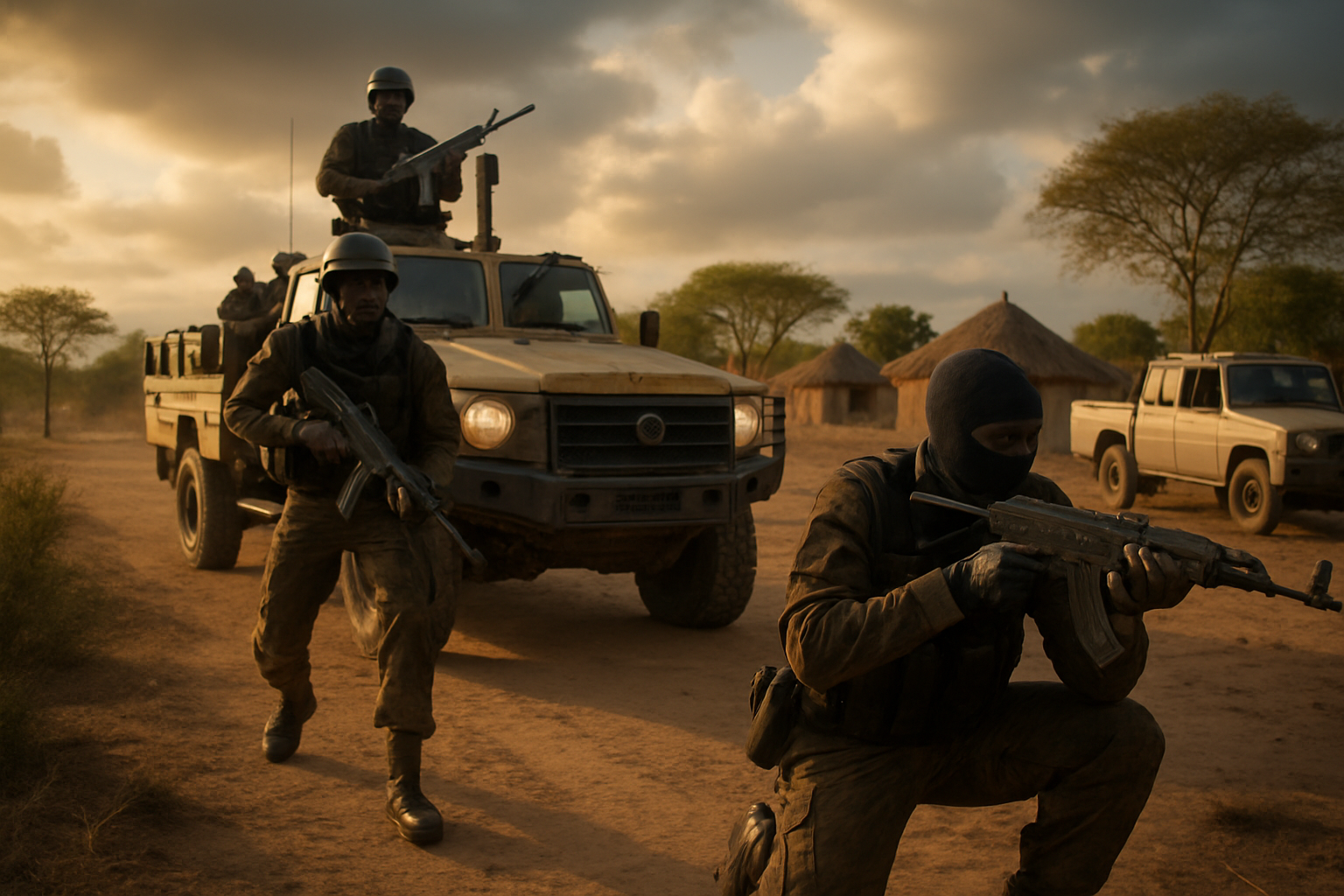
A devastating wave of terrorist attacks has swept across West Africa in February 2026, with at least 32 people confirmed killed in northern Nigeria's latest massacre while regional security leaders raise urgent alarms about an unprecedented escalation of violence threatening previously stable border areas.
The bloodiest incident occurred when motorcycle-riding gunmen launched coordinated assaults on three communities in Niger State's Borgu Local Government Area, killing no fewer than 26 people and setting ablaze houses and a police station, according to multiple security sources. Witnesses reported that fully armed terrorists invaded the communities in what appears to be a systematic campaign of terror expanding beyond Nigeria's traditional northeastern strongholds.
Unprecedented Regional Security Crisis
The attacks represent a dangerous geographic expansion of terrorist operations, with the Pan-Yoruba organization Afenifere expressing "grave concern over persistent terrorist attacks in states bordering the South-West," warning that the development is "heightening fears of a full-scale incursion into Yorubaland."
Al Jazeera correspondents reported that witnesses described the attackers as operating with military precision, using motorcycles for rapid deployment across multiple locations simultaneously. The assault on the police station in particular demonstrates an escalation in targeting state infrastructure, indicating organized capabilities beyond opportunistic violence.
According to Vanguard News sources, the first incident occurred in Feyi community before the violence spread to adjacent areas. The terrorists' ability to coordinate multiple strikes while maintaining operational security suggests sophisticated planning and intelligence networks.
Pattern of Escalating Violence
The February 15 attacks follow a devastating pattern of terrorist expansion documented throughout early 2026. Historical records show that just two weeks earlier, suspected terrorists struck a cattle market in Kaiama community, Kwara State, days after a February 3 massacre that killed between 162-170 people in one of Nigeria's deadliest terrorist attacks in recent months.
"We are witnessing a systematic expansion of terrorism from northeastern strongholds to previously stable regions across the middle belt," according to security analysts tracking the crisis.
— Regional Security Assessment, February 2026
The Kwara State massacre, attributed to the Lakurawa group with Islamic State affiliations, revealed critical intelligence failures when survivors reported that government authorities had ignored months of warnings about armed terrorists camping in surrounding bushes. Community members repeatedly alerted officials about suspicious armed men but received no response.
Infrastructure Under Attack
The systematic targeting of police stations and government buildings represents a strategic shift toward undermining state authority rather than merely causing civilian casualties. In the Niger State attack, terrorists specifically destroyed the local police station before abducting scores of residents, creating a security vacuum in the affected communities.
This pattern mirrors tactics employed by terrorist organizations globally, where destroying symbols of state power serves both practical and psychological purposes. The burning of houses alongside official buildings suggests an intent to displace populations permanently, potentially creating ungoverned spaces for further terrorist operations.
Regional Response and International Concerns
The escalating violence has prompted urgent calls for coordinated regional action. President Bola Ahmed Tinubu previously deployed army battalions including specialized forest guards to affected areas, but the continued attacks demonstrate the limitations of reactive security measures.
Opposition political parties have demanded independent investigations into intelligence failures, particularly regarding community warnings that were systematically ignored. The ability of terrorist cells to operate across state boundaries while maintaining coordination suggests the need for enhanced federal coordination and regional cooperation frameworks.
Transportation Safety Crisis
Beyond terrorist attacks, Africa is grappling with infrastructure safety challenges that compound security concerns. In Ghana's Eastern Region, a catastrophic head-on collision near Akrade in the Asuogyaman District left six individuals, including a toddler, fighting for their lives following a gruesome accident on the deteriorating Tema-Akosombo highway.
The collision occurred when drivers attempted to avoid a large pothole, sending vehicles directly into oncoming traffic. This incident highlights how inadequate infrastructure maintenance creates additional security vulnerabilities, as poor road conditions force dangerous maneuvers that can prove fatal.
Humanitarian Crisis Mounting
The expanding violence has created a significant humanitarian emergency, with thousands of residents displaced and seeking shelter in bushland areas. The destruction of commercial establishments during the attacks has disrupted local economies, while the targeting of agricultural communities threatens food security in affected regions.
International observers note concerning parallels with broader West African security deterioration, including recent attacks in Niger and Mali that have killed dozens and disrupted vital supply routes. The coordinated nature of these incidents across national boundaries suggests transnational terrorist networks are strengthening their operational capabilities.
Intelligence and Operational Failures
Perhaps most troubling is the repeated pattern of intelligence warnings being ignored by authorities. In multiple documented cases, local communities provided advance warnings about terrorist presence that went unheeded by regional and federal security agencies.
The February massacres represent what opposition leaders describe as "preventable tragedies" where institutional failures enabled terrorist expansion. This breakdown in intelligence processing and response coordination has become a central political issue, with calls for comprehensive security sector reform.
International Implications
The expansion of terrorist operations beyond traditional northeastern strongholds has significant implications for regional stability and international security cooperation. West Africa's largest economy experiencing widespread security breakdown affects regional trade, investment confidence, and humanitarian access across multiple countries.
The Alliance of Sahel States (Niger, Mali, Burkina Faso) maintaining distance from traditional regional cooperation frameworks complicates coordinated responses to transnational terrorism. Meanwhile, the need for enhanced intelligence sharing and joint operations becomes increasingly urgent as terrorist networks demonstrate cross-border operational capabilities.
As Africa continues to grapple with this expanding security crisis, the international community faces growing pressure to support comprehensive solutions that address both immediate threats and underlying governance failures that enable terrorist expansion into previously stable regions.