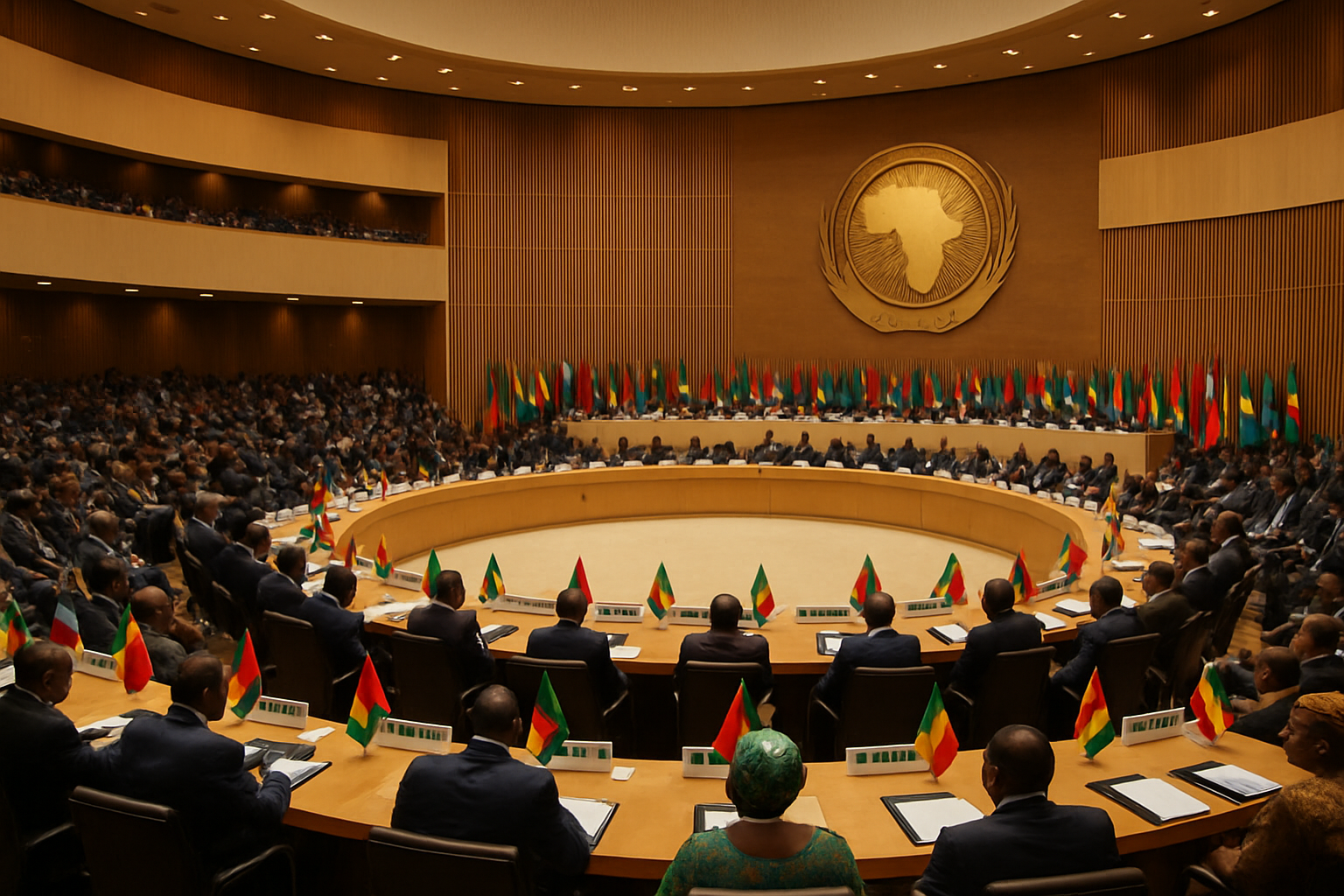
The 39th African Union Summit opened in Addis Ababa under the theme "Ensuring Sustainable Water and Sanitation Access for All by 2030," marking a pivotal moment of continental renewal as African leaders gather to address critical challenges while celebrating diplomatic breakthroughs and advancing women's health initiatives.
Guinea's President Mamadi Doumbouya arrived in Addis Ababa on Friday, marking his first international trip since his democratic election on December 28, 2025. This historic visit signals Guinea's return to the continental stage after years of isolation following the September 5, 2021 military coup that brought Doumbouya to power.
Guinea's Diplomatic Renaissance
The presence of President Doumbouya at the summit represents a significant diplomatic turning point for Guinea, which had faced sanctions from both ECOWAS and the African Union following the 2021 military takeover. The successful conduct of presidential elections in December 2025 paved the way for the lifting of these sanctions and Guinea's reintegration into continental institutions.
This diplomatic rehabilitation comes at a crucial time for the West African nation, which is seeking to normalize its relationships with regional and continental bodies. Guinea's return to the AU Summit demonstrates the effectiveness of the organization's approach to democratic governance, combining principled sanctions with clear pathways for reintegration.
Senegal's Prime Minister Ousmane Sonko is also participating in the summit, representing one of West Africa's most stable democracies and providing a counterpoint to Guinea's recent political transformation. Sonko's presence underscores the diversity of political experiences across the continent while highlighting the AU's capacity to accommodate different democratic trajectories.
Groundbreaking Women's Health Advocacy
Sierra Leone's First Lady Fatima Maada Bio has emerged as a leading voice at the summit, presiding over the 30th General Assembly of the Organization of African First Ladies for Development (OAFLAD) on the sidelines of the main AU session. Her advocacy focuses on integrating uterine and hormonal health into national primary healthcare systems—a groundbreaking initiative that addresses long-overlooked aspects of women's wellness.
In her keynote address, Mrs. Bio argued that African health systems must better recognize the "lived realities" of women and girls. She highlighted that uterine and hormonal health are frequently overlooked in national policies, despite their profound impact on women's education, economic participation, and mental well-being.
"We must move beyond treating women's health as a peripheral concern and place it at the center of our development agenda. When we invest in women's comprehensive health, we invest in the future of our continent."
— Fatima Maada Bio, Sierra Leone's First Lady
This focus on women's health represents a significant evolution in AU priorities, moving beyond traditional security and economic concerns to address fundamental human development issues that affect half the continent's population.
Water Security: A Continental Priority
The summit's central theme of "Ensuring Sustainable Water and Sanitation Access for All by 2030" reflects urgent continental priorities as climate change intensifies water scarcity across Africa. This focus comes against the backdrop of January 2026 being recorded as the hottest month in history, marking the 18th consecutive month of temperatures exceeding 1.5°C above pre-industrial levels.
The water security agenda encompasses multiple dimensions: rural and urban access to clean drinking water, sanitation infrastructure development, agricultural irrigation systems, and sustainable management of transboundary water resources. Several African countries are pioneering innovative approaches, from Morocco's desalination projects to Ethiopia's water harvesting initiatives.
Continental Cooperation in Action
The summit builds on strong institutional foundations established during recent preparatory sessions. The 48th Ordinary Session of the AU Executive Council, which concluded earlier this week, saw Foreign Ministers from all 55 member states participate in comprehensive policy discussions covering continental strategy, regional security, economic development, and climate resilience.
Recent elections to the AU Peace and Security Council demonstrated the organization's growing institutional maturity, with ten countries—including Somalia, Democratic Republic of Congo, Gabon, Uganda, Morocco, Lesotho, South Africa, Benin, Côte d'Ivoire, and Sierra Leone—elected to two-year terms. This geographical balance ensures representation from all African regions in critical security deliberations.
The summit occurs alongside Ethiopia's hosting of the 2nd Italy-Africa Summit, demonstrating the country's strategic positioning as a diplomatic bridge between Africa and Europe. This concurrent hosting showcases Ethiopia's enhanced capacity for complex multilateral coordination and its role as a continental diplomatic hub.
Economic Integration and Development
Leaders are expected to advance implementation of the African Continental Free Trade Agreement (AfCFTA), which has already begun facilitating cross-border trade and investment. Recent infrastructure developments, including Algeria's Gara Djebilet railway project and Angola's Lobito Corridor revival, demonstrate the physical foundations being laid for enhanced continental integration.
The mining sector features prominently in economic discussions, with African nations asserting greater control over their mineral resources while maintaining investment attractiveness. The recent African Mining Indaba in Cape Town highlighted Africa's $29.5 trillion mineral reserves and the continent's determination to move from extraction to value-addition processing.
Climate Adaptation and Security
Climate change looms large over summit deliberations, with leaders addressing both mitigation and adaptation strategies. Recent extreme weather events, including devastating floods in Mozambique affecting over 700,000 people and ongoing drought conditions in parts of East Africa, underscore the urgency of coordinated climate responses.
The summit provides an opportunity to strengthen regional cooperation mechanisms, building on successful recent examples such as SADC's emergency response to Mozambique floods and Rwanda's cross-regional humanitarian assistance. These initiatives demonstrate Africa's growing capacity for self-reliant crisis response.
Security challenges also feature prominently, with the new Peace and Security Council expected to address ongoing conflicts in eastern DRC, instability in the Sahel region, and emerging maritime security threats. The AU's evolution from a symbolic body to an active policy development organization is evident in its sophisticated approach to these complex challenges.
Technology and Digital Innovation
Digital transformation initiatives receive significant attention, with discussions on continental digital infrastructure, cybersecurity frameworks, and technology transfer mechanisms. African countries are increasingly asserting technological sovereignty while embracing beneficial international partnerships.
The summit coincides with several African nations implementing innovative digital solutions, from Nigeria's fintech revolution in digital payments to various countries' smart city initiatives. These developments position Africa as a leader in practical technology implementation focused on real-world utility rather than speculation.
Looking Forward
The 39th AU Summit represents more than a routine diplomatic gathering—it showcases a continent actively shaping its own destiny through enhanced cooperation, innovative policy development, and principled leadership. From Guinea's democratic reintegration to groundbreaking women's health advocacy and comprehensive water security planning, African leaders are demonstrating sophisticated approaches to 21st-century challenges.
The summit's outcomes will likely influence continental policy for years to come, establishing frameworks for sustainable development, democratic governance, and regional integration that reflect uniquely African solutions to global challenges. As delegates prepare for final sessions, the emphasis remains on building practical cooperation mechanisms that translate continental solidarity into tangible benefits for Africa's 1.4 billion people.
The success of this summit, measured not just in declarations but in subsequent implementation, will serve as a crucial test of the African Union's institutional maturity and its capacity to coordinate effective responses to the complex challenges facing the world's second-largest continent.