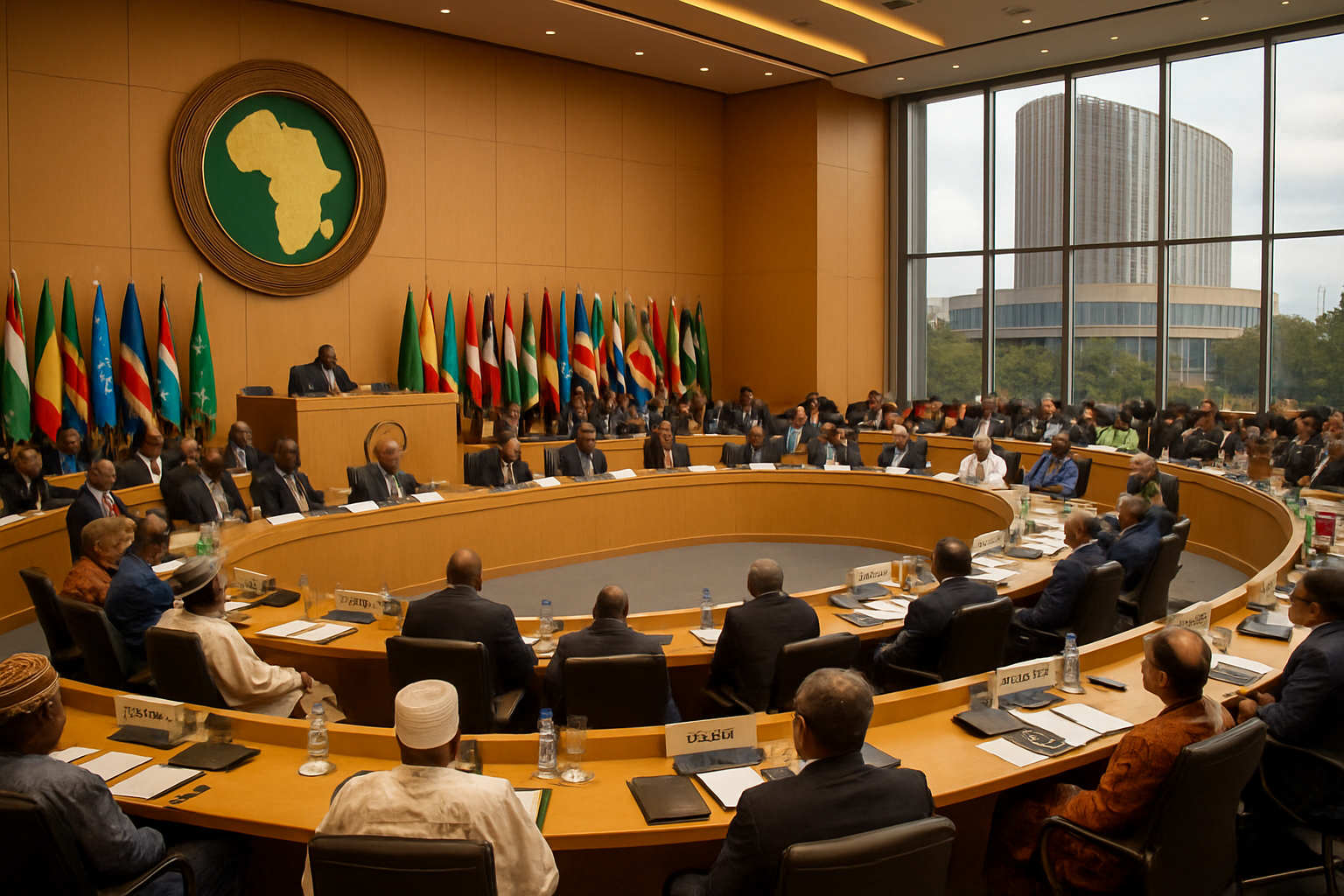
The 39th African Union Summit concluded in Addis Ababa on Sunday with leaders from across the continent addressing the critical water access crisis affecting over 400 million Africans, while simultaneously grappling with ongoing security challenges and governance issues that continue to test the organization's effectiveness.
The summit, held under the theme "Ensuring Sustainable Water and Sanitation Access for All by 2030," brought together heads of state and government from the AU's 55 member states, though the central water security agenda competed for attention with pressing matters including coups, insurgencies, and what critics describe as the organization's limited capacity to address real continental challenges.
Water Security: A Continental Emergency
President Emmerson Mnangagwa of Zimbabwe, who attended the summit before departing for Harare on Sunday morning, was among the leaders who emphasized the urgent need for coordinated action on water access. The summit's focus on water infrastructure reflects a broader continental recognition that climate adaptation has become essential for Africa's 1.4 billion people.
The water crisis has gained particular urgency following devastating floods in Mozambique that affected over 724,000 people across five provinces in January 2026, occurring during what was recorded as the 18th consecutive month of global temperatures exceeding 1.5°C above pre-industrial levels. These climate realities have transformed water security from a development goal into an immediate survival imperative.
"Despite our challenges, Africa stands on the threshold of true integration. Our success hinges on our collective will to align national reforms with continental goals."
— Emmanuel Armah-Kofi Buah, Ghana Mining Minister, reflecting broader continental sentiment
Critics Question AU Effectiveness
However, the summit faced significant criticism from observers who questioned whether the African Union is adequately addressing the continent's most pressing challenges. According to reports from Africanews, leaders convened "at a time of genocide, myriad insurgencies and coups stretching from one end of the continent to the other, for which it has few answers."
This criticism reflects broader concerns about the AU's institutional capacity to move beyond symbolic gestures toward binding commitments and coordinated implementation that can effectively serve Africa's population. The organization has faced particular scrutiny over its response to conflicts in the Sahel, ongoing instability in the Democratic Republic of Congo, and various security challenges across member states.
Leadership Transitions and Diplomatic Developments
The summit marked several significant diplomatic developments, including the transition of the AU's rotating chairmanship from Angola to Burundi. AU Commission Chairperson Moussa Faki Mahamat opened proceedings with a strong statement of Palestinian solidarity, calling for an end to what he termed the "genocide of Palestinian people," reflecting the continental body's consistent support for Palestinian rights amid global conflicts.
Notable participants included Algeria's Prime Minister Naib Ghrib representing President Tebboune, Sierra Leone's President Julius Maada Bio, and Senegal's Prime Minister Ousmane Sonko representing President Faye. Ghana's President John Dramani Mahama, serving as AU Champion on Reparations, delivered a forceful address demanding a transition from "ceremonial language" to "binding frameworks" with clear timelines for historical justice.
Peace and Security Challenges
The summit occurred against a backdrop of significant regional security challenges that continue to strain the AU's peacekeeping capacity. The recently reconstituted Peace and Security Council, which includes ten new members such as Somalia, the Democratic Republic of Congo, and Morocco, faces immediate challenges from West African instability, the Alliance of Sahel States dynamics involving Niger, Mali, and Burkina Faso, and ongoing violence in the DRC's eastern provinces.
These security challenges highlight the gap between the AU's aspirations for continental governance and its practical capacity to enforce peace and stability across member states. The organization's peace and security mechanisms continue to face resource constraints and coordination difficulties that limit their effectiveness.
Economic Integration and Infrastructure Development
Despite security and governance challenges, the summit also highlighted significant progress in economic integration through the African Continental Free Trade Area (AfCFTA) implementation. Major infrastructure developments supporting continental trade include Algeria's Gara Djebilet mining railway accessing the world's third-largest iron ore reserves, Angola's Lobito Corridor railway revival connecting the Atlantic coast to the DRC's mineral-rich regions, and Tanzania's completed feasibility studies for the 1,000-kilometer Mtwara-Mbamba Bay Standard Gauge Railway.
These infrastructure projects represent a broader African infrastructure renaissance that supports the continent's economic diversification goals while reducing dependence on raw material exports. The developments demonstrate how regional integration can create opportunities for cross-border ventures, shared infrastructure, and regional value chains.
International Partnerships and Strategic Autonomy
The summit coincided with China's announcement of a zero-tariff policy for 53 African countries beginning May 1, 2026, representing the most comprehensive expansion of China-Africa trade relations in modern history. President Xi Jinping's policy extends zero-tariff access to all African nations maintaining diplomatic relations with Beijing, dramatically expanding from the previous 33 least-developed countries.
This development occurs as seven African countries—Angola, DRC, Guinea, Kenya, Morocco, Sierra Leone, and Zambia—participate in the US-EU-Japan Critical Minerals Partnership, challenging China's dominance in controlling 60% of production and 90% of refining capacity for critical materials. The diversification reflects Africa's strategic approach to balancing international partnerships while maintaining sovereignty over resource development priorities.
Climate Adaptation and Resilience
The summit's water security theme reflects urgent climate adaptation needs that have become central to African development planning. Ethiopia's shift from emergency relief to long-term climate resilience through water infrastructure investment, Rwanda's identification of 417,000 hectares of undeveloped irrigation potential, and continental recognition of climate change as an existential threat demonstrate the AU's evolution toward comprehensive climate response strategies.
The January 2026 global temperature records and Mozambique flooding crisis provided immediate context for the summit's focus on climate adaptation and water security infrastructure development.
Looking Forward: Tests of Continental Governance
The 39th AU Summit represents a critical test of the organization's capacity for effective continental governance amid climate intensification, persistent regional conflicts, and global economic pressures. Success will depend on member states' willingness to move beyond symbolic commitments toward binding frameworks and coordinated implementation serving the continent's 1.4 billion people.
The summit's outcomes on water security, peace and stability, and economic integration will be measured not by declarations alone, but by tangible progress in addressing the complex challenges that define contemporary Africa. As the AU approaches its third decade, the organization faces the fundamental question of whether it can evolve from a symbolic forum to an active policy development body capable of delivering concrete results for African populations.
The water crisis affecting 400 million Africans provides a clear metric for measuring the AU's effectiveness: whether continental cooperation can translate into improved access to this most basic human need will serve as a crucial indicator of the organization's relevance and capacity in the years ahead.