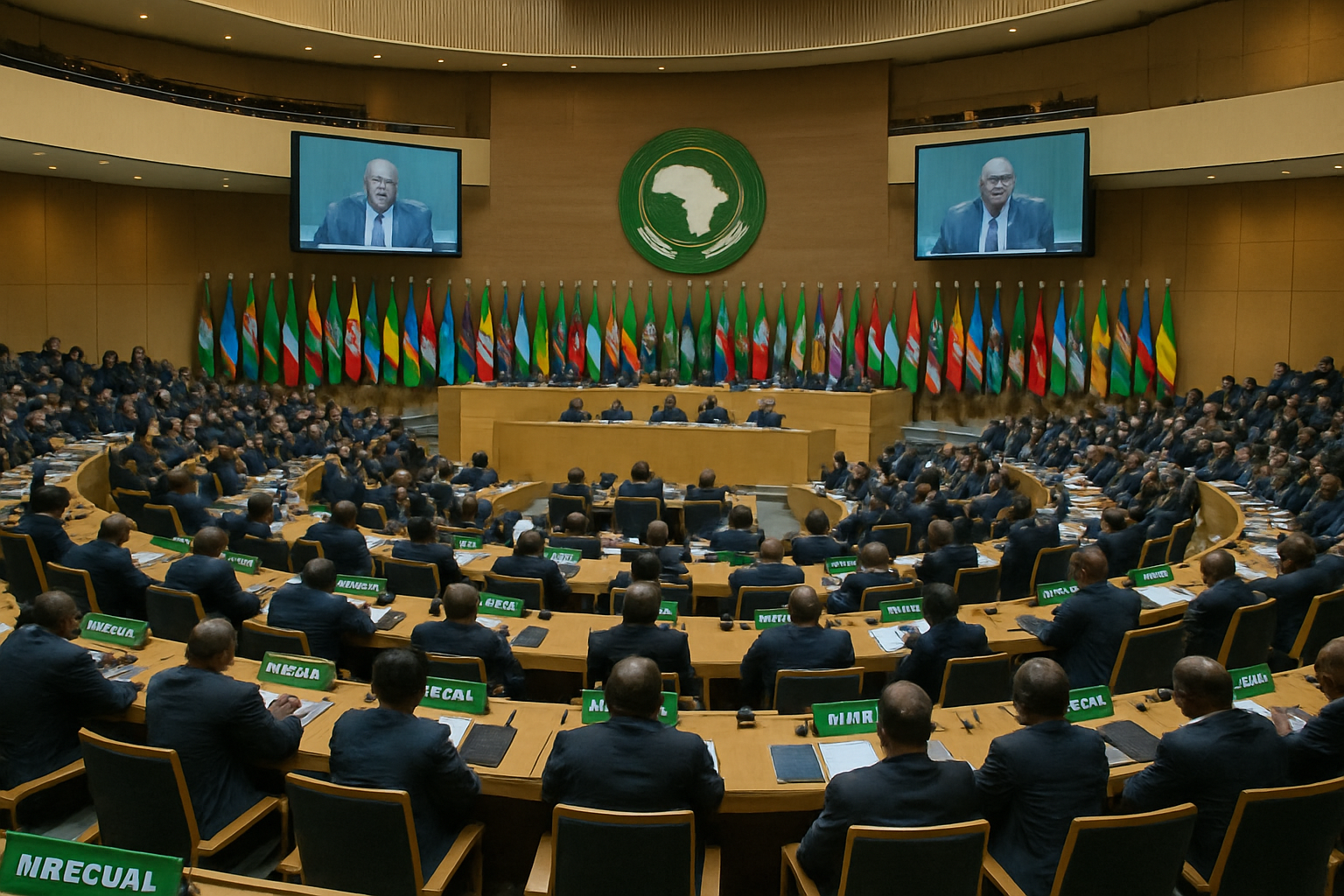
African leaders converged in Addis Ababa for the 39th Ordinary Session of the African Union Assembly of Heads of State and Government, marking a pivotal moment for continental cooperation as they addressed water security, peace initiatives, and regional governance under the theme "Ensuring Sustainable Water and Sanitation Access for All by 2030."
The February 14, 2026 summit brought together representatives from all 55 AU member states, showcasing both established diplomatic partnerships and emerging leadership voices on the continental stage.
Guinea's Presidential Debut on Continental Stage
President Mamadi Doumbouya of Guinea made his inaugural appearance at an African Union summit, delivering his first international address since his election on December 28, 2025. The participation marked Guinea's return to active continental diplomacy following the end of sanctions imposed after the September 5, 2021 military coup.
Speaking from the AU headquarters podium, President Doumbouya emphasized the summit's central theme of water security, acknowledging the critical role of sustainable water management in achieving the continent's development goals outlined in Agenda 2063. His presence signals Guinea's reintegration into continental governance structures and commitment to democratic processes.
"Water security is fundamental to our collective prosperity and the structural transformation of African economies."
— President Mamadi Doumbouya, Guinea
The Guinean delegation's active participation reflects the country's strategic positioning within West African politics and its significant mineral resources, including substantial reserves that could contribute to continental development initiatives.
Nigeria's Federal Representation and Regional Leadership
Vice President Kashim Shettima represented Nigeria at the summit opening ceremonies, demonstrating the country's continued leadership role within continental frameworks. As Africa's most populous nation and largest economy, Nigeria's participation carries significant weight in AU deliberations.
The Nigerian delegation's presence comes during a critical period for West African regional security, with ongoing challenges in the Sahel region and evolving relationships between ECOWAS member states and newer regional alliances like the Alliance of Sahel States.
Nigeria's involvement in the summit's water security discussions is particularly relevant given the country's extensive river systems, ongoing infrastructure development projects, and role as a regional economic hub affecting water resource management across West Africa.
Zimbabwe's Call for Continental Security Enhancement
President Emmerson Mnangagwa of Zimbabwe delivered a forceful address calling for the urgent reclamation of Africa's peace and security agenda through full operationalization of the African Standby Force. His intervention highlighted growing continental concerns about regional conflicts and the need for enhanced African-led security solutions.
"The full operationalization of the African Standby Force is essential for reclaiming Africa's peace and security agenda."
— President Emmerson Mnangagwa, Zimbabwe
The Zimbabwean president's emphasis on continental security mechanisms reflects broader discussions within the AU about strengthening indigenous conflict resolution capacities. The African Standby Force, established as a rapid deployment capability for peace support operations, has faced implementation challenges that Mnangagwa's address sought to address directly.
His call resonates with ongoing regional security challenges across the continent, from conflicts in the Democratic Republic of Congo's eastern provinces to instability in the Sahel region, highlighting the need for coordinated African responses to security threats.
Water Security as Continental Priority
The summit's central theme of sustainable water access reflects urgent continental priorities amid climate change impacts and growing urbanization pressures. African leaders recognized water security as fundamental to achieving broader development objectives, including food security, economic growth, and social stability.
Recent climate events, including devastating floods in Mozambique affecting over 724,000 people and the January 2026 record as the hottest month globally, underscore the urgency of comprehensive water management strategies. The summit's focus on sustainable water systems demonstrates African leadership in climate adaptation planning.

Continental water initiatives include Ethiopia's shift toward long-term climate resilience through watershed management, Rwanda's identification of 417,000 hectares of irrigation potential, and Angola's infrastructure renaissance including the Lobito Corridor railway project connecting the Atlantic coast to mineral-rich interior regions.
Leadership Transitions and Continental Governance
The summit occurred during a period of significant leadership transitions within the African Union structure. Burundi assumed the rotating AU chairmanship, taking over from Angola, reflecting the continental body's commitment to shared leadership and regional representation.
These transitions demonstrate the AU's institutional maturity and capacity for coordinated governance across diverse political systems and development levels. The peaceful transfer of continental leadership responsibilities reinforces the organization's role as a platform for diplomatic engagement and policy coordination.
The presence of newly elected leaders like Guinea's President Doumbouya alongside established continental figures illustrates the AU's function as both a forum for diplomatic integration and a mechanism for legitimizing democratic transitions across member states.
Regional Integration and Economic Cooperation
Summit discussions extended beyond water security to encompass broader continental integration objectives, particularly implementation of the African Continental Free Trade Area (AfCFTA). Leaders emphasized the connection between infrastructure development, water security, and economic integration as mutually reinforcing elements of continental development strategy.
The summit's outcomes support ongoing infrastructure renaissance across Africa, including major projects in Algeria, Tanzania, and Burkina Faso that demonstrate continental capacity for large-scale development initiatives. These projects incorporate modern environmental standards and climate adaptation requirements as integral components rather than optional considerations.
International Partnerships and Strategic Autonomy
African leaders balanced engagement with international partners while asserting continental autonomy over development priorities. Recent developments include seven African countries participating in the US-EU-Japan Critical Minerals Partnership, demonstrating strategic diversification of global relationships while maintaining African agency in resource management.
The summit's emphasis on African-led solutions reflects broader continental trends toward asserting resource sovereignty while engaging productively with global markets and international cooperation frameworks.
Challenges and Future Directions
Despite the summit's constructive atmosphere, African leaders acknowledged persistent challenges including regional conflicts, climate change impacts, and development financing constraints. The recently reconstituted Peace and Security Council, with new members including Somalia, DRC, and Morocco, faces immediate pressure to address ongoing security challenges across multiple regions.
The summit's success in bringing together diverse leadership voices, from established regional powers to newly elected presidents, demonstrates the AU's continued relevance as a platform for continental dialogue and policy coordination. However, the effectiveness of summit decisions depends on member states' willingness to move beyond symbolic commitments toward binding frameworks and coordinated implementation.
"Africa must move from ceremonial language to binding frameworks with clear timelines for addressing our shared challenges."
— Continental governance expert
The 39th AU Summit represents a critical test of the organization's capacity for effective continental governance amid climate intensification, persistent conflicts, and global economic pressures. Success depends on member states' commitment to translating summit declarations into concrete actions serving the continent's 1.4 billion citizens.
Looking Forward: From Addis Ababa to Implementation
As African leaders returned to their respective capitals, the summit's legacy will be measured not by the diplomatic protocols observed in Addis Ababa, but by the concrete progress achieved in water security, regional integration, and peace consolidation across the continent.
The convergence of water security imperatives, leadership transitions, and evolving international partnerships positions the 39th AU Summit as a potentially pivotal moment in contemporary African governance. The months ahead will reveal whether the continental consensus achieved in Ethiopia can translate into sustained cooperation and measurable progress toward the ambitious goals outlined in Agenda 2063.
With climate change accelerating and regional challenges persisting, the summit's outcomes will influence not only African development trajectories but also global approaches to sustainable development, conflict resolution, and international cooperation in an increasingly complex world.