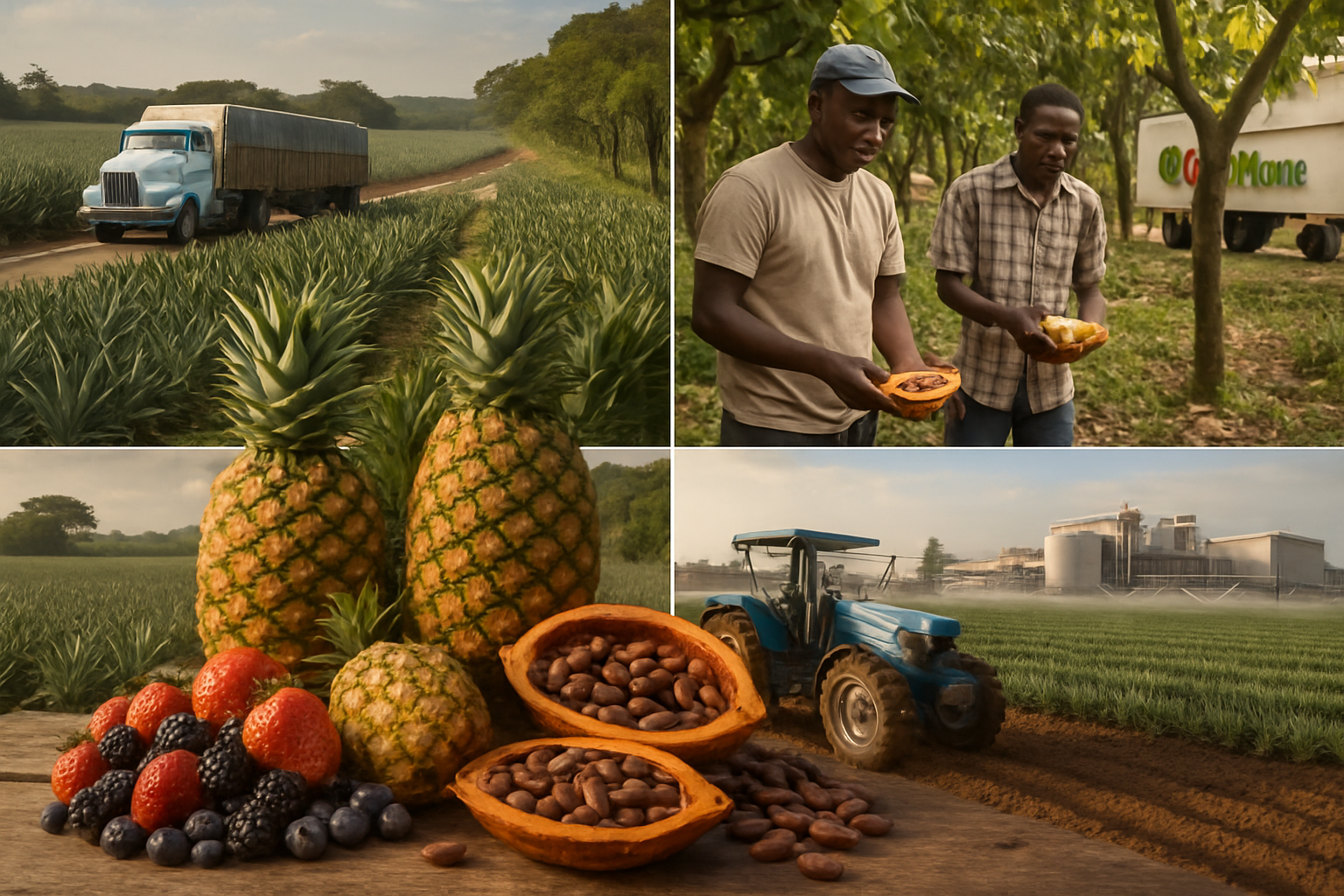
Agricultural development initiatives across Ecuador, El Salvador, Indonesia, and Sierra Leone are demonstrating unprecedented coordination in addressing global food security challenges, as nations implement innovative approaches combining traditional farming wisdom with cutting-edge technology and international cooperation.
The latest developments represent part of a broader agricultural renaissance occurring during a critical juncture in global food systems, as January 2026 marked the 18th consecutive month of global temperatures exceeding 1.5°C above pre-industrial levels, forcing rapid adaptation in agricultural practices worldwide.
Ecuador's Agricultural Recovery Program
In Ecuador, producers are receiving long-awaited compensation following devastating crop losses during last winter's severe weather. The Ministry of Agriculture's agricultural kit distribution program has provided farmers with essential resources to rebuild their operations, with indemnification payments finally reaching affected communities almost a year after the initial losses.
The recovery effort reflects Ecuador's broader commitment to agricultural resilience, building on the success of institutions like ESPAM agricultural university, which moves $11 million annually through Cantón Bolívar while serving over 4,000 students. This integration of agricultural education with practical support demonstrates a comprehensive approach to sector strengthening.
El Salvador's Genetic Enhancement Initiative
El Salvador has launched an ambitious partnership with The Beef Initiative, a U.S. organization specializing in bovine genetics and food sovereignty. The collaboration, announced by Vice Minister Óscar Domínguez and Texas Slim during the Bitcoin Histórico event, aims to modernize the nation's livestock sector through strategic cooperation.
"This represents a vision for rebuilding Salvador's bovine industry from the ground up through genetic improvement and sustainable practices."
— Vice Minister Óscar Domínguez, Ministry of Agriculture and Livestock
The initiative focuses on connecting Salvadoran ranchers with Texas producers through high-performance bovine genetics transfer, technical training in regenerative pasture management, meat traceability systems, and decentralized processing approaches. The program emphasizes sustainable production methods and local producer empowerment, aligning with broader regional efforts to enhance food sovereignty.
Indonesia's Food Price Stabilization Campaign
Indonesia's Bangka Tengah regency has implemented a comprehensive "cheap food movement" (Gerakan Pangan Murah - GPM) to stabilize food prices and ensure accessibility for local communities. The initiative, conducted at Milenial Adhyaksa Field, represents a coordinated government response to food inflation pressures affecting consumers nationwide.
The program builds on Indonesia's broader agricultural development strategy, which includes UMKM (small and medium enterprise) empowerment schemes in regions like Aceh Tamiang, where officials promote egg-laying chicken farming as alternative livelihoods that reduce pressure on natural resources while providing sustainable income opportunities.
Sierra Leone's Modern Poultry Revolution
Sierra Leone has achieved a significant milestone in agricultural modernization with the commissioning of Mulu Poultry Farm Ltd, the first modern battery cage production system in Kono District. Agriculture and Food Security Minister Henry Musa Kpaka presided over the ceremony, highlighting the facility's role in government-private sector partnerships aimed at transforming the national agricultural landscape.
The facility, owned by Sitta Kaikai, operates with an initial stock of 3,000 layer birds producing approximately 3,000 fresh eggs daily. This represents a substantial contribution to local food security while demonstrating the potential for scaling modern agricultural techniques throughout the region.
"My passion to feed fellow Sierra Leoneans continues to grow each day through this modern production system."
— Sitta Kaikai, Owner of Mulu Poultry Farm
Global Context and Historical Precedents
These developments occur within a broader pattern of agricultural renaissance documented across multiple continents throughout early 2026. Similar initiatives have emerged in the Democratic Republic of Congo, where conservation agriculture programs supported over 11,000 farmers, and in Kenya, where irrigation rehabilitation projects benefit more than 10,000 farmers in the Nguruman scheme.
The coordination reflects sophisticated understanding of climate adaptation requirements, with programs emphasizing technology-tradition integration, community ownership principles, and international cooperation enhancement. Success factors identified across these initiatives include sustained political commitment, transparent governance frameworks, and adaptive management capabilities that respond to rapidly changing environmental conditions.
Technology and Traditional Knowledge Integration
A common thread across all four nation initiatives involves the sophisticated synthesis of modern technology with traditional agricultural knowledge. Ecuador's recovery programs respect existing community structures while introducing business development concepts. El Salvador's genetic enhancement program maintains traditional husbandry practices while incorporating contemporary biotechnology. Indonesia's price stabilization efforts leverage both modern distribution systems and traditional market relationships. Sierra Leone's poultry modernization builds on established farming traditions while embracing advanced production methods.
This approach reflects lessons learned from earlier agricultural development efforts, where top-down technology transfer often failed without adequate consideration of local knowledge systems and cultural contexts.
Economic Development Dimensions
The agricultural initiatives demonstrate significant economic development potential beyond immediate food production. Ecuador's compensation program restores farmer purchasing power and stimulates rural economies. El Salvador's genetic cooperation creates new trade relationships and technology transfer opportunities. Indonesia's price stabilization protects consumer spending power while supporting producer incomes. Sierra Leone's poultry facility establishes employment opportunities while reducing import dependencies.
These economic multiplier effects align with broader trends toward viewing agricultural development as essential infrastructure for national resilience rather than simply rural development projects.
Implementation Challenges and Opportunities
Despite the promising developments, significant challenges remain. Funding sustainability represents a critical concern, particularly for developing nations where immediate economic pressures often override long-term environmental and agricultural considerations. Technical capacity building requires sustained investment in education, training, and institutional development. Climate change continues to disrupt project timelines, requiring adaptive management approaches that can respond to rapidly changing conditions.
However, the diversity of approaches provides resilience against single-solution dependencies. The combination of genetic enhancement, technological modernization, market stabilization, and compensation programs offers multiple pathways for addressing food security challenges across different contexts and constraints.
Regional Integration and South-South Cooperation
The agricultural developments reflect a broader trend toward South-South cooperation and regional integration. El Salvador's partnership with Texas represents technological cooperation between developing regions rather than traditional North-South aid relationships. The timing of initiatives across multiple countries suggests coordination through regional forums and international agricultural organizations.
This pattern aligns with the African Continental Free Trade Agreement (AfCFTA) objectives and similar regional integration efforts in Latin America and Asia, where agricultural development increasingly serves continental rather than purely national objectives.
Future Implications and Scaling Potential
The coordinated agricultural developments across Ecuador, El Salvador, Indonesia, and Sierra Leone provide templates for scaling food security interventions globally. The emphasis on community ownership, cultural sensitivity, and international cooperation maintaining local autonomy offers sustainable development models that could influence international agricultural policy.
Success in these initiatives may determine whether agricultural innovation can keep pace with accelerating climate change while maintaining the effectiveness principles that ensure community benefit. The window for building resilient, equitable food systems appears to be narrowing rapidly, making these experiments particularly crucial for global food security planning.
The combination of immediate crisis response (Ecuador's compensation), strategic partnerships (El Salvador's genetic cooperation), market interventions (Indonesia's price stabilization), and infrastructure development (Sierra Leone's modernization) demonstrates comprehensive approaches that address multiple dimensions of food security simultaneously. If successful, these models could be adapted and scaled across similar contexts worldwide, contributing to more resilient global food systems capable of serving growing populations amid accelerating environmental change.